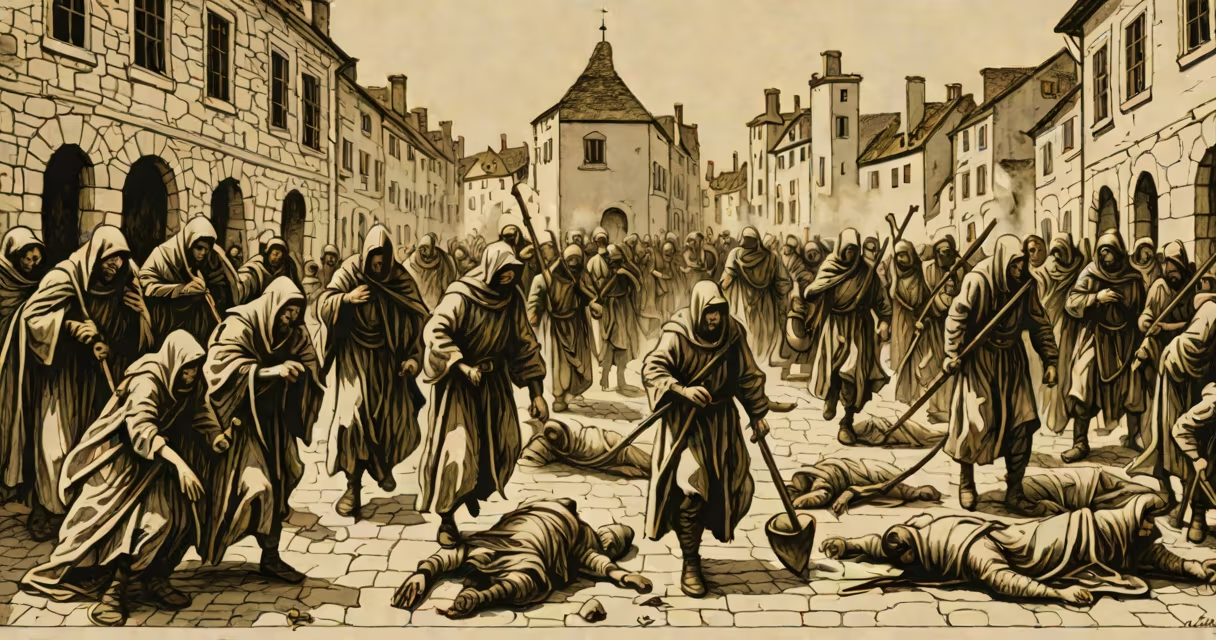
The black plague was a pandemic that swept through Europe between 1347 and 1351, killing an estimated 30-50% of the continent's population. It spread rapidly via fleas carried by rats, turning cities into death zones within weeks.
Outbreaks began in Sicily in October 1347, when Genoese ships arrived from the Black Sea carrying infected cargo. The disease moved north along trade routes, reaching Paris by January 1348 and London by June 1349. By 1350, it had reached Scandinavia and Russia. Mortality rates varied by region, but in urban centers like Florence and Venice, up to 60% of residents died within months.
Transmission occurred primarily through flea bites, though airborne droplets could spread pneumonic plague-a more lethal form. Symptoms included fever, swollen lymph nodes (buboes), and blackened skin from internal bleeding. Victims often died within three days of symptom onset. There were no effective treatments. Religious leaders blamed sin, while physicians prescribed bloodletting, herbal remedies, and prayer.
Rats infested merchant ships and city warehouses. Fleas fed on infected rodents and then bit humans. A single rat could carry hundreds of fleas. Trade hubs became infection hotspots: Genoa, Venice, and Bruges reported mass deaths in early 1348.
Urban density accelerated transmission. In London, 13,000 people died in just four months. Streets filled with unburied bodies. Some towns banned entry to travelers from infected areas, but enforcement failed. The plague moved faster than quarantine could contain it.
Historians estimate that Europe lost 75 million people between 1347 and 1351. The population dropped from 75 million to 35 million. In some villages, entire families vanished. The decline was so severe that fields lay fallow, grain prices spiked, and feudal lords struggled to collect rents.
Three forms of plague emerged during the outbreak:
| Type | Transmission | Survival Rate | Case Example |
|---|---|---|---|
| Bubonic | Flea bite from infected rodent | ~60% | 60% mortality in Paris; 10,000 dead in 1348 |
| Pneumonic | Inhalation of respiratory droplets | ~90% | Spread among soldiers in besieged cities |
| Sepsis | Bloodstream infection from open wounds | ~100% | Common among caregivers and gravediggers |
Only bubonic plague was widespread. Pneumonic cases occurred in crowded shelters and hospitals. Sepsis was fatal for those handling corpses. The combination of high lethality and rapid spread created a crisis beyond medical understanding.
With half the workforce dead, surviving peasants demanded higher wages. Landowners resisted, leading to revolts. In England, the Peasants' Revolt of 1381 erupted partly due to labor shortages and rising demands for fair pay.
Religious institutions lost credibility. When prayers failed to stop the plague, many turned away from the Church. Some communities burned Jews, accusing them of poisoning wells-a false claim that led to massacres in Strasbourg and Cologne.
Art reflected the trauma. Paintings showed skeletons dancing with the living. The Danse Macabre motif appeared in churches across France and Germany. Literature shifted toward themes of impermanence. Geoffrey Chaucer's *Canterbury Tales* includes a narrator who dies mid-story-possibly symbolic of the plague's reach.
The black plague was not a single event. It recurred in waves until the 18th century. Outbreaks hit London in 1665 and Marseille in 1720. Modern DNA analysis confirms the pathogen was Yersinia pestis, not a virus or bacterial strain previously unknown.
Contrary to popular belief, the plague did not always cause blackened skin. The term "black" came from the Latin *nigra morbus*, referring to the dark swellings (buboes) and the grim mood of the time. Skin discoloration was a secondary effect, not a defining feature.
A common misconception is that the plague ended because of quarantine. In reality, it declined due to herd immunity and the extinction of local rat populations. Once hosts were gone, the fleas starved. The cycle broke naturally.
I visited the village of Eyam in Derbyshire, England, where villagers sealed off their community in 1665 to prevent the plague from spreading to nearby towns. They buried the dead in a communal pit. Survivors later erected a stone marker: "God bless this place."
Records show 260 people died out of 350. The remaining 90 survived by isolating themselves and burning contaminated clothing. This act of collective sacrifice preserved neighboring villages. Eyam remains a site of historical pilgrimage.
Today, the black plague is studied through ancient DNA extracted from teeth of victims buried in mass graves. A 2011 study published in *Nature* confirmed Yersinia pestis as the causative agent. The genome matched modern strains found in Central Asia, supporting the theory that the disease originated in the steppes and spread westward.
Modern medicine treats bubonic plague with antibiotics. Death rates drop below 1% with early treatment. The World Health Organization reports 1,000-2,000 cases annually, mostly in Madagascar and the Democratic Republic of Congo. No major outbreaks have occurred since the 19th century.
Understanding what happened during the black plague reveals how fragile societies are when faced with biological threats. The scale of loss reshaped Europe's economy, religion, and culture. It also shows how misinformation spreads as fast as disease itself.