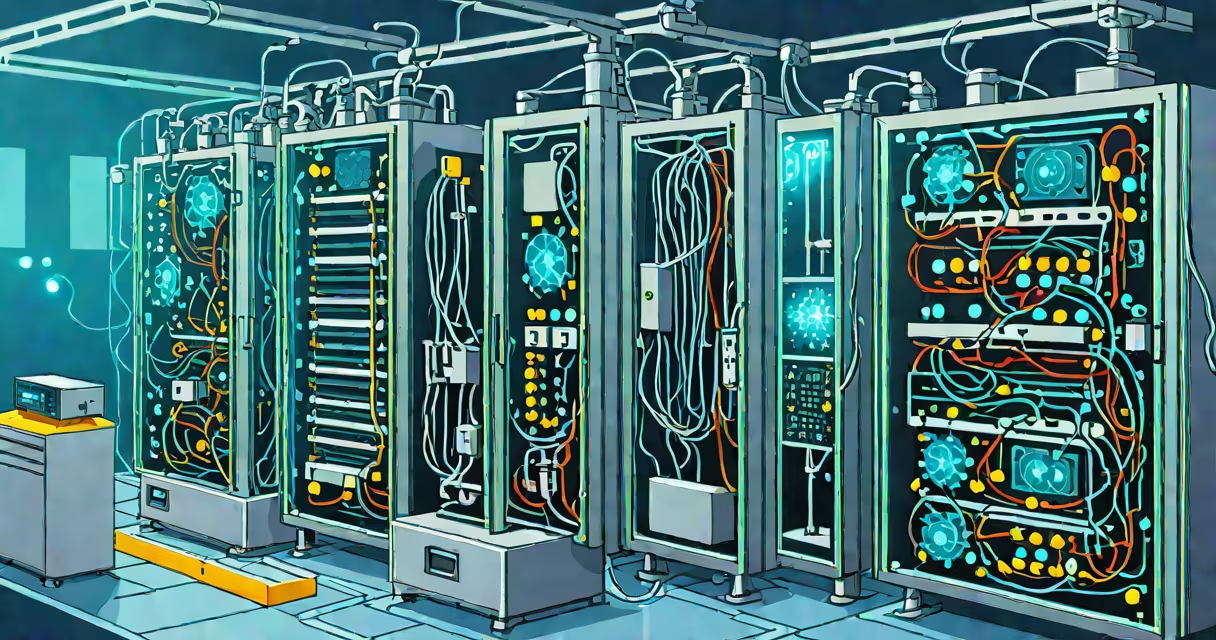
Quantum computers are not sleek desktop units or server racks. They are large, cryogenically cooled systems housed in specialized enclosures, featuring superconducting chips suspended in vacuum chambers, connected by complex wiring and microwave control lines.
These systems operate near absolute zero-typically below 15 millikelvin-to maintain quantum coherence. The physical form is dominated by a dilution refrigerator, a multi-layered cryostat that cools components to temperatures colder than outer space. Inside, a central chip holds qubits-tiny superconducting circuits made from aluminum and niobium-mounted on a cold plate.
External components include microwave generators, signal amplifiers, and digital control systems. These manage qubit states via precise electromagnetic pulses. The entire setup resembles a high-precision laboratory instrument more than a computer. A single system can occupy a room-sized lab space, with multiple layers of shielding and thermal insulation.
Unlike classical bits that store 0 or 1, quantum computers use qubits that exist in superposition-simultaneously representing both states. This allows them to process vast combinations of data in parallel. When measured, a qubit collapses to either 0 or 1, yielding probabilistic outcomes.
Operations are performed using quantum logic gates-controlled microwave pulses applied to qubits. These pulses manipulate the quantum state through interference and entanglement. Entangled qubits share correlated states even when separated, enabling non-local computation.
Measurement occurs after computation, collapsing the quantum state into classical output. The result is not deterministic but statistically valid after repeated runs. Error correction is critical because decoherence-loss of quantum state-can occur within microseconds.
Core components include:
Materials are chosen for low electrical resistance and minimal thermal noise. Aluminum forms the primary superconducting layer, while niobium is used in higher-performance applications. Silicon wafers serve as substrates due to their purity and thermal stability.
Manufacturing uses cleanroom processes similar to semiconductor fabrication. Chips are fabricated using electron-beam lithography and reactive ion etching. Each chip contains between 16 and over 100 qubits, depending on the platform.
Many assume quantum computers resemble futuristic devices with glowing lights or holograms. In reality, they are industrial-scale instruments designed for extreme precision. Visuals from media often exaggerate size and aesthetics.
A common confusion is equating quantum computers with quantum simulators. While both use quantum principles, simulators model quantum behavior on classical hardware. True quantum computers perform actual quantum operations.
Examples include:
Each system shares core elements: cryogenic environment, superconducting qubits, microwave control, and error mitigation. Differences lie in qubit type, connectivity, and software stack.
There are several distinct approaches to building quantum processors. Each has different physical forms and scaling challenges.
| Platform | Qubit Type | Operating Temperature | Key Physical Features |
|---|---|---|---|
| Superconducting circuits | Transmon, Xmon | 10-20 mK | Chip-based, microwave-controlled, housed in dilution fridge |
| Trapped ions | Electrons in ionized atoms | 100 mK - 1 K | Ion traps with lasers, vacuum chambers, optical alignment systems |
| Photonic systems | Single photons | Room temperature (some) | Optical fibers, beam splitters, phase modulators, detectors |
| Topological qubits | Majorana fermions (theoretical) | ~1 K | Still experimental; requires exotic materials and extreme conditions |
Superconducting platforms dominate current commercial systems. IBM, Google, and Rigetti all use this approach. Trapped ions offer longer coherence times but slower gate speeds. Photonic systems are scalable and operate at room temperature but struggle with photon loss and efficient entanglement.
One non-obvious fact: superconducting qubits are not isolated. They interact via capacitive coupling, which enables entanglement. This requires precise tuning of coupling strengths-often adjusted via external magnetic fields or capacitor arrays.
I once visited IBM's quantum research facility in Yorktown Heights. The system was enclosed in a stainless steel vacuum chamber, with a clear window allowing visual access to the chip. The cryostat stood about 2 meters tall, with multiple cooling stages stacked vertically. Control wires snaked from the base to a rack of electronics in a separate room.
The ambient sound was a faint hum from cryogenic pumps. Engineers monitored qubit fidelity in real time. A single measurement took 100 nanoseconds. Repeating a calculation 10,000 times yielded statistical confidence in the result.
This experience clarified that quantum computers aren't "running" programs like classical machines. They execute quantum algorithms, then return probabilistic outputs. The hardware is not a processor-it's a controlled quantum environment.
Quantum computers are deployed in research labs, tech companies, and government facilities. Applications include:
They are not replacements for classical computers. Instead, they solve specific problems where quantum advantage exists-such as combinatorial optimization or quantum chemistry simulations.
For example, in 2019, Google demonstrated quantum supremacy using a 53-qubit Sycamore processor. It completed a random circuit sampling task in 200 seconds-estimated to take a classical supercomputer 10,000 years.
Despite this, practical applications remain limited. Current systems face high error rates and short coherence times. Researchers are developing error-corrected logical qubits, but these require thousands of physical qubits per logical unit.
Quantum computers are not faster versions of classical computers. They don't improve everyday tasks like web browsing or video rendering. Their speedup is problem-specific and theoretical in many cases.
They are not standalone devices. They require extensive infrastructure: power, cooling, shielding, and software integration. A single system may cost $10 million to $20 million to build and maintain.
They are not yet capable of running general-purpose software. Programming involves quantum circuits written in languages like Qiskit or Cirq. Developers must understand quantum mechanics to design effective algorithms.
Finally, they are not magic. They cannot solve NP-hard problems instantly. Their advantage lies in exponential speedups for specific classes of problems-not universal computation.
Understanding what quantum computers look like clarifies their role: they are tools for scientific exploration, not consumer gadgets. Their form reflects function-extreme precision, isolation, and control.