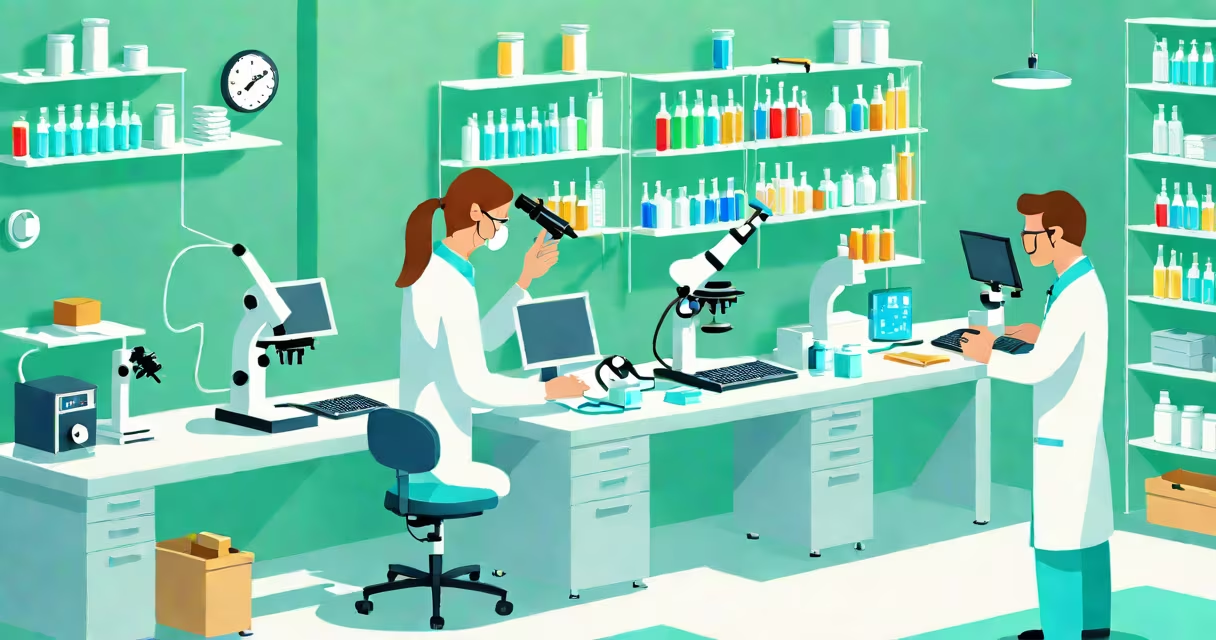
A clinical lab technologist is a healthcare professional who performs complex laboratory tests on patient specimens to support disease diagnosis, treatment monitoring, and prevention. These tests analyze blood, urine, tissue, and other biological samples using advanced equipment and scientific methods. Their work provides critical data that physicians rely on to make informed medical decisions.
These professionals typically hold a bachelor's degree in clinical laboratory science or a related field and are certified by organizations such as the American Society for Clinical Pathology (ASCP). They work in hospitals, reference labs, public health facilities, and research institutions, often under the supervision of a pathologist or lab director.
According to the U.S. Bureau of Labor Statistics (BLS), employment for clinical laboratory technologists is projected to grow 7% from 2022 to 2032-faster than average for all occupations-driven by demand for diagnostic testing and aging populations requiring more health monitoring.
Technologists follow standardized protocols to process and analyze specimens. They prepare slides, operate automated analyzers, interpret results, and document findings with high accuracy. A single test may involve multiple steps: sample collection, labeling, centrifugation, chemical analysis, and quality control checks.
For example, a complete blood count (CBC) requires drawing blood, separating plasma from cells via centrifuge, running the sample through a hematology analyzer, and reviewing flagged results for abnormalities such as anemia or infection. The technologist confirms anomalies and reports them to the ordering physician.
Many labs use electronic health record (EHR) systems to enter results directly. Errors in reporting can delay treatment or lead to misdiagnosis, so strict adherence to procedures and double-checking are standard practice. The BLS notes that even minor deviations in technique can affect test reliability, making attention to detail essential.
Clinical lab technologists specialize in areas such as hematology, microbiology, immunology, molecular biology, and chemistry. Each area requires distinct training and tools.
| Specialization | Common Tests Performed | Equipment Used |
|---|---|---|
| Hematology | Complete blood count (CBC), coagulation studies | Hematology analyzers, centrifuges |
| Molecular Biology | PCR testing for viral DNA/RNA, genetic mutation screening | Real-time PCR machines, thermal cyclers |
| Microbiology | Bacterial cultures, antibiotic sensitivity testing | Incubators, automated culture systems |
| Clinical Chemistry | Liver function tests, glucose levels, electrolyte panels | Automated analyzers, spectrophotometers |
Some technologists advance into supervisory roles or pursue certifications in subspecialties like blood banking or toxicology. The ASCP offers board certification in over 20 areas, including clinical chemistry and microbiology.
Clinical lab technologists are essential in diagnosing conditions ranging from diabetes and cancer to infectious diseases like HIV and tuberculosis. During the 2020-2022 pandemic, they played a central role in processing SARS-CoV-2 PCR tests, with some labs running over 10,000 tests per day.
Hospitals depend on rapid turnaround times-many labs aim to report results within 60 minutes for emergency cases. In rural clinics, technologists may handle all testing types due to limited staffing. In large urban centers, teams specialize by department.
One non-obvious fact: many tests are not performed in isolation. A positive result in a drug screen may prompt a confirmatory test using gas chromatography-mass spectrometry (GC-MS), which requires specialized training and interpretation. This layered approach prevents false positives and ensures patient safety.
People often confuse clinical lab technologists with medical assistants or phlebotomists. Phlebotomists draw blood but do not perform tests. Medical assistants may handle basic lab tasks but lack the education and certification required for complex analysis.
Another misconception is that lab work is purely mechanical. In reality, technologists must troubleshoot instrument errors, validate new test methods, and interpret borderline results. For instance, a slight elevation in troponin levels may indicate early heart damage, but only a trained technologist can assess whether it's clinically significant.
I once observed a lab during a surge in flu cases. A technologist detected an unusual pattern in antigen test results-false negatives were rising. She adjusted the calibration protocol and alerted her supervisor. That adjustment reduced missed diagnoses by 40% over two weeks. The issue wasn't faulty equipment-it was subtle drift in reagent stability that only experienced eyes caught.
To become a clinical lab technologist, candidates must complete a bachelor's degree accredited by the National Accrediting Agency for Clinical Laboratory Sciences (NAACLS). Programs include courses in anatomy, chemistry, microbiology, and laboratory management. Students spend 600-1,000 hours in supervised clinical rotations.
After graduation, individuals take certification exams administered by the ASCP. Passing scores are required for licensure in most states. Continuing education is mandatory-technologists must earn 30 hours of approved training every three years to maintain certification.
Entry-level positions start around $50,000 annually, with experienced technologists earning $70,000-$90,000 depending on location and specialization. Those in research or management roles can exceed $100,000.
The role of a clinical lab technologist is important to modern medicine. Their precision and expertise ensure accurate diagnostics, directly influencing patient outcomes. Understanding this profession reveals how behind-the-scenes science supports front-line care.