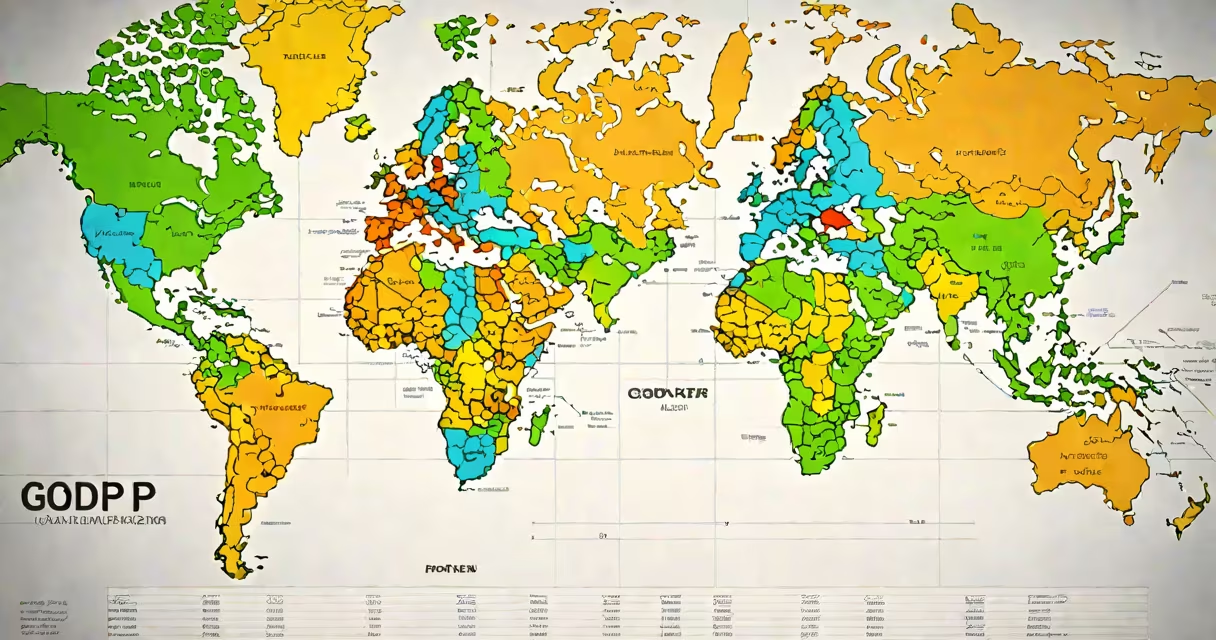
A good GDP per capita exceeds $20,000 in purchasing power parity (PPP) terms, indicating a high level of economic output per person and widespread access to goods, services, and infrastructure. This threshold separates advanced economies from most developing nations.
GDP per capita measures the average economic output per individual in a country. It's calculated by dividing a nation's gross domestic product by its population. The figure reflects how much value the economy generates per person, serving as a proxy for material well-being and productive capacity.
International comparisons rely on PPP adjustments to account for differences in cost of living. A $50,000 nominal GDP per capita in a high-cost city like Tokyo may represent less actual purchasing power than $30,000 in a lower-cost region such as rural Poland. PPP ensures fairer cross-country analysis.
GDP per capita is derived from national accounts data collected by central banks and statistical agencies. The World Bank and International Monetary Fund (IMF) publish standardized figures using consistent methodologies. Data is updated annually and adjusted for inflation and exchange rate fluctuations.
A higher GDP per capita generally correlates with better public services, longer life expectancy, and greater access to education and healthcare. Countries with strong institutions, diversified industries, and skilled workforces tend to achieve higher levels. For example, Norway's GDP per capita in PPP terms reached $68,000 in 2023, supported by oil revenues, high labor participation, and progressive social policies.
However, GDP per capita does not capture inequality. A nation can have a high average while large segments live below subsistence. In South Africa, GDP per capita was $18,000 in PPP terms in 2023, yet nearly half the population lives in poverty. This gap highlights the need to pair GDP per capita with distribution metrics like the Gini coefficient.
Nations are often grouped by GDP per capita thresholds set by the World Bank:
| Income Category | PPP GDP Per Capita Range (2023) | Examples |
|---|---|---|
| Low-income | <$2,500 | Malawi, Burundi |
| Lower-middle-income | $2,500-$9,999 | Mexico, Indonesia |
| Upper-middle-income | $10,000-$19,999 | Turkey, Brazil |
| High-income | >$20,000 | Germany, Japan, Canada |
High-income status is not automatic. Countries like China and India moved into upper-middle-income brackets between 2000 and 2020 due to manufacturing growth and export expansion. China's GDP per capita rose from $1,000 in 1990 to $18,000 in 2023, though it remains below the high-income threshold.
Some nations reach high GDP per capita through resource extraction rather than broad-based development. Qatar's GDP per capita hit $65,000 in PPP terms in 2023, driven by natural gas exports. But this wealth is concentrated among a small elite, and the economy lacks diversification. When global energy prices drop, the economy faces sharp contraction.
Many assume GDP per capita equals personal income. They differ. In the United States, GDP per capita was $76,000 in PPP terms in 2023, but median household income was $78,000 in nominal dollars-about $55,000 in PPP. The gap arises because GDP includes corporate profits, government spending, and capital gains, not just wages.
Another misconception is that GDP per capita predicts happiness. Research from the OECD shows that beyond $20,000 PPP, additional income yields diminishing returns in life satisfaction. People in Finland and Denmark report high well-being despite GDP per capita below $50,000, thanks to strong social safety nets and low inequality.
GDP per capita ignores environmental costs. A country with high output may deplete forests, pollute waterways, or emit carbon at unsustainable rates. Bhutan's Gross National Happiness index prioritizes ecological sustainability over pure economic growth. Its GDP per capita is around $4,000, but forest cover remains above 70% and biodiversity is protected.
Germany's GDP per capita in PPP terms was $53,000 in 2023. This places it firmly in the high-income category. The country ranks among the top 10 globally in industrial output, particularly in automotive engineering, precision machinery, and renewable energy technology.
Germany's success stems from a dual system: a strong vocational training network and a decentralized labor market. Over 50% of German youth enter apprenticeships, leading to high employment and low youth unemployment. This structure supports stable incomes and long-term productivity.
I once visited a small factory in Bavaria producing custom metal parts. The owner, a third-generation artisan, ran a team of 12 with no automation. Output per worker matched U.S. standards. He attributed success to employee retention, continuous training, and close client relationships. His business contributed to regional GDP per capita without relying on scale or external investment-a reminder that quality matters more than volume.
While GDP per capita is a useful benchmark, it should not stand alone. Pair it with data on income distribution, environmental impact, and access to opportunity. A good GDP per capita signals potential, but true prosperity requires equity and sustainability.
Understanding what is a good GDP per capita begins with context. It's not a single number-it's a lens. Use it to compare economies, assess policy effectiveness, and identify areas needing reform. But always ask: who benefits, and at what cost?