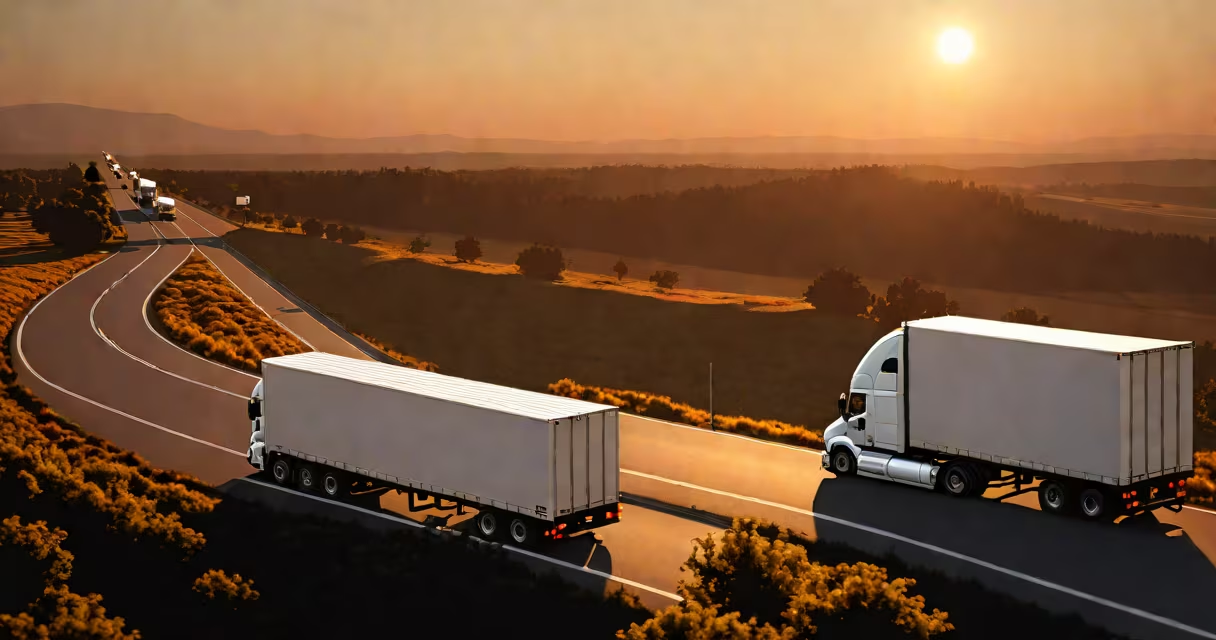
Line haul shipping is the movement of freight over long distances-typically 500 miles or more-between major distribution centers, ports, or rail terminals using dedicated trucks or trailers. It forms the core of national freight networks, connecting regional hubs and enabling goods to travel across states.
This phase of freight transportation occurs after goods are collected from local pickup points and before they reach final delivery destinations. It is distinct from last-mile delivery, which covers the final leg within cities or neighborhoods. Line haul operations are typically scheduled, route-optimized, and operated by specialized carriers focused on efficiency and speed over extended routes.
According to the U.S. Bureau of Transportation Statistics, line haul accounts for approximately 60% of all intercity freight movement in the United States. The process relies heavily on standardized trailer sizes (53-foot dry vans), GPS tracking, and electronic logging devices (ELDs) to ensure compliance and performance monitoring.
Freight begins its line haul process after being consolidated at a regional warehouse or terminal. Shippers or freight forwarders book space on a carrier's scheduled route based on destination and transit time requirements. Once loaded, the trailer is secured and dispatched via a predetermined route optimized for fuel efficiency and regulatory compliance.
Trucks operate under strict hours-of-service regulations set by the Federal Motor Carrier Safety Administration (FMCSA). Drivers are limited to 11 hours of driving per day and must take 10 consecutive hours off duty before returning to the road. These rules reduce fatigue-related accidents and ensure consistent delivery timelines.
During transit, shippers track shipments through real-time telematics systems. Carriers use GPS-enabled dashboards to monitor location, speed, idle time, and engine diagnostics. This data supports dispatch decisions, maintenance scheduling, and customer service updates.
Line haul services vary by equipment type, load configuration, and operational model. The most common categories are:
| Type | Description | Typical Use Case |
|---|---|---|
| Dry Van | Enclosed trailer for non-perishable goods | Electronics, apparel, machinery |
| Reefer | Refrigerated trailer for temperature-sensitive cargo | Frozen food, pharmaceuticals |
| Flatbed | Open deck for oversized or heavy loads | Construction materials, industrial equipment |
| Step Deck | Multi-level trailer with lower deck for tall freight | Heavy machinery, furniture |
Line haul shipping is often confused with local delivery or cross-docking. Cross-docking involves transferring goods from one truck to another at a terminal without storing them. While this may happen during line haul operations, it is not part of the line haul itself.
A frequent misunderstanding is that line haul is always faster than other modes. In reality, rail line haul can move bulk freight more efficiently over 1,000+ miles, especially for commodities like coal or grain. However, trucks remain dominant for high-value, time-sensitive goods due to their flexibility and door-to-door access.
Another misconception is that line haul drivers work exclusively long-distance. Many drivers operate in a "split run" model-driving part of a route, then handing off to a co-driver who completes the remainder. This allows continuous movement without violating FMCSA rest rules.
Consider a clothing manufacturer in Los Angeles shipping 100 standard-sized boxes (each 20 lbs) to a distribution center in Chicago. The freight is first picked up by a regional carrier and transported to a central hub in Dallas. From there, it enters line haul mode.
A dry van trailer is loaded with 20,000 lbs of inventory and departs Dallas at 6 a.m. on a Monday. The driver follows a pre-planned route via I-35 and I-70, covering 1,200 miles in 3 days. The trailer arrives in Chicago on Wednesday morning. During the trip, the carrier's system logs 14 stops for rest, fuel, and inspections-all compliant with FMCSA regulations.
The shipment is unloaded at the Chicago facility and transferred to a local delivery fleet for final distribution to retail stores. The entire process-from LA to Chicago-was completed in 5 days, with line haul accounting for 70% of the transit time.
According to the American Trucking Associations, the average line haul cost in 2023 was $2.10 per mile for dry van freight. For a 1,200-mile trip, that amounts to $2,520 in transportation fees-excluding fuel surcharges or handling charges.
Line haul shipping enables just-in-time manufacturing and globalized retail. Without it, products from overseas suppliers couldn't reach domestic warehouses quickly enough to meet consumer demand. It also supports seasonal spikes-like holiday shopping-by allowing rapid redistribution of inventory across regions.
One non-obvious fact: many line haul routes are designed to avoid toll roads and congestion zones even if they increase distance. A 2022 study by the University of Michigan's Transportation Research Institute found that avoiding urban bottlenecks reduced average delivery delays by 18% compared to shortest-path routing.
I once observed a line haul operation during a field visit to a logistics center in Memphis. A team of dispatchers monitored 37 trucks in real time using a centralized dashboard. When one truck experienced a mechanical issue in Arkansas, the system rerouted the load to a backup vehicle within 45 minutes-demonstrating how automation reduces downtime in line haul networks.
Understanding what is line haul shipping reveals its role not as a standalone service, but as a critical link in a larger supply chain. It helps goods move reliably across vast distances, forming the foundation of modern commerce.
When you see a semi-truck on the interstate carrying containers across state lines, it's likely engaged in line haul shipping-the invisible engine powering nationwide delivery.