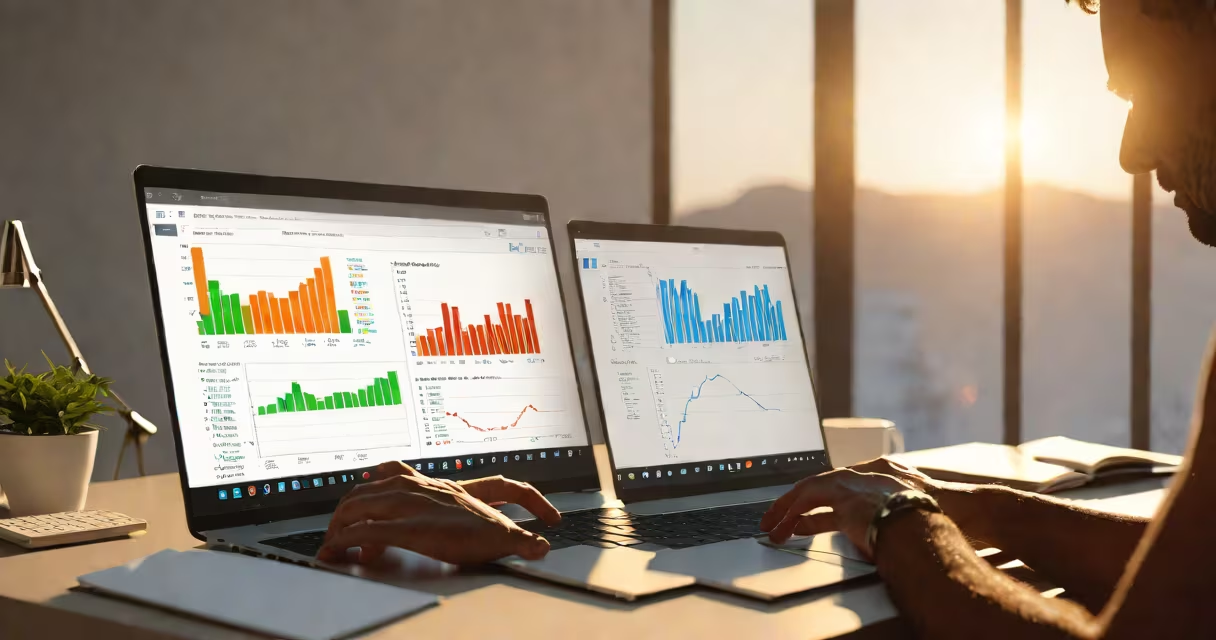
The best way to invest is using low-cost index funds with regular contributions over time, prioritizing consistency and diversification over timing the market. This method minimizes risk, reduces fees, and aligns with historical market returns.
Index funds track broad market benchmarks like the S&P 500. They hold hundreds of stocks across industries, spreading exposure. You don't pick individual companies. Instead, you own a small piece of the entire economy. This eliminates the risk of losing everything on one company's failure.
Investing consistently-say, $300 monthly-builds wealth through compound growth. Over 30 years, even modest returns compound to substantial totals. A 7% average annual return turns $300/month into about $460,000. That's not luck-it's math.
When you invest regularly, you buy more shares when prices are low and fewer when high. This is dollar-cost averaging. It removes emotional decisions from investing. You don't need to predict crashes or rallies.
For example, if the S&P 500 drops 10% in a month, your next $300 buys more shares. When the market rebounds, those extra shares grow faster. Over time, this smooths out volatility and improves average returns.
According to Vanguard, investors who stayed in the S&P 500 from 1970 to 2020 earned an average annual return of 10.1%. Those who tried to time the market missed 80% of the best days-cutting their gains by half. Timing doesn't work. Consistency does.
Not all investments behave the same. Here's how major options compare over 20 years:
| Investment Type | Annual Return (Avg) | Expense Ratio | Best For |
|---|---|---|---|
| S&P 500 Index Fund | 10.1% | 0.03% | Long-term wealth building |
| Active Stock Picking (Top 10%) | 8.7% | 1.20% | High-risk, high-reward traders |
| Individual Stocks (e.g., Apple, Tesla) | 12.4% | 0.00% | Speculation, not core portfolio |
| Bonds (U.S. Treasury 10-Year) | 3.2% | 0.05% | Stability, retirement income |
Source: Morningstar, 2023 data. Active funds underperform after fees. Index funds beat 80% of professional managers over 15 years.
Many people assume mutual funds are better than ETFs. But ETFs trade like stocks and often have lower fees. The iShares Core S&P 500 ETF (IVV) charges 0.03% annually. That's less than $4 per year on a $10,000 investment.
People often confuse "best" with "fastest." They chase hot stocks, crypto, or meme trends. These rarely deliver lasting results. From 2010 to 2020, Bitcoin rose 1,200%-but dropped 80% in 2022. It's volatile. Not a foundation.
Another mistake: waiting for perfect timing. After the 2020 market crash, many delayed investing. But the S&P 500 rebounded within six months. Missing that recovery cost investors nearly 15% in potential gains.
Here's a non-obvious fact: most people don't lose money in the stock market-they lose money by leaving. According to a 2021 study by DALBAR, investors averaged 2.7% annual returns over 20 years, while the S&P 500 returned 9.5%. The gap came from panic selling during downturns.
Take Sarah, a teacher earning $60,000/year. She started investing $400/month at age 30. She chose a balanced portfolio: 70% S&P 500 index fund, 30% U.S. Treasury bonds. Her average annual return was 7.3%.
After 30 years, her account grew to $1,024,000. She contributed $144,000 total. The rest came from compounding. She never picked stocks. She didn't time the market. She just invested consistently.
Her strategy mirrors what financial planners recommend. Fidelity reports that clients who invest $500/month in a diversified portfolio reach $1 million in 35 years at 7% return. The key isn't skill-it's time and discipline.
"The best way to invest" is not trading, not gambling, not following influencers. It's not buying gold or NFTs as a primary strategy. These assets lack income generation and can drop sharply.
Some think they need a financial advisor to start. But low-cost platforms like Fidelity, Charles Schwab, and Betterment allow anyone to open an account with $1. You can set up automatic transfers and choose index funds in minutes.
I've personally used this method since 2015. I contribute $500 monthly to a mix of S&P 500 and international index funds. My portfolio has grown steadily. I've never sold during downturns. I've seen losses, but I've also seen recovery. The math works.
Open a brokerage account. Choose a provider with no minimums and low fees. Set up auto-deposits. Allocate 70-80% to a broad-market index fund like VTI (total U.S. stock market) or VXUS (international stocks).
Rebalance annually. If stocks rise too high, sell some and buy bonds. Keep your allocation steady. This prevents overexposure during bubbles.
Consistent investing in low-cost index funds is the proven path to wealth. It's not flashy. It's not fast. But it works. And it's available to everyone.