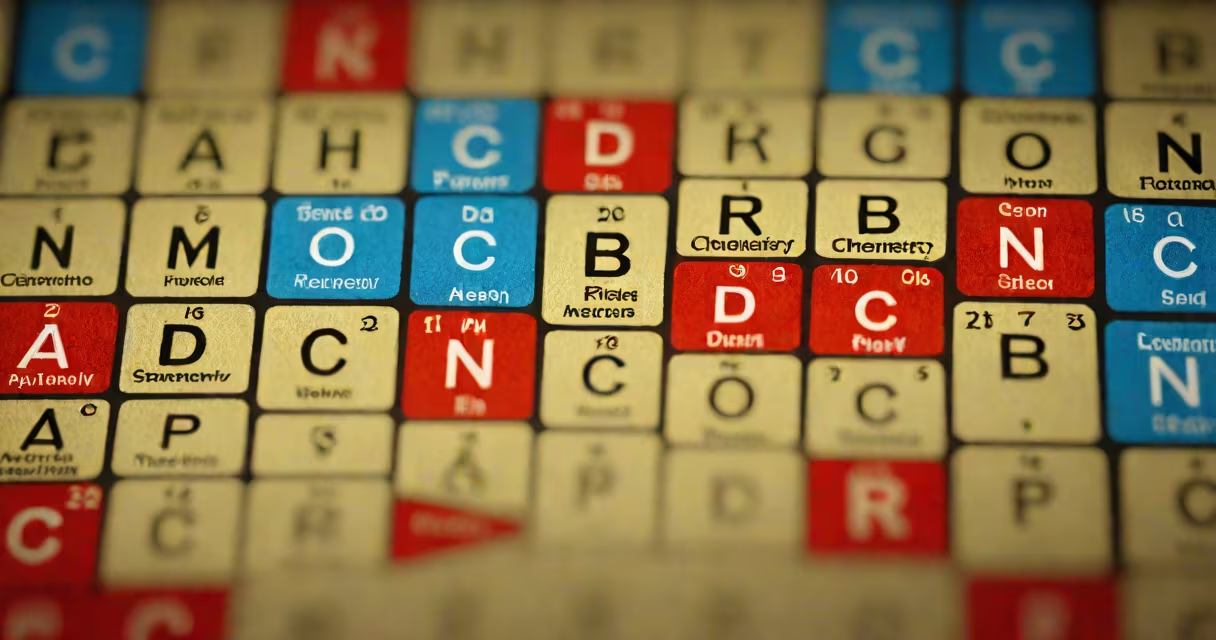
The chemistry symbol is a one- or two-letter abbreviation representing a chemical element, standardized by the International Union of Pure and Applied Chemistry (IUPAC). These symbols appear on the periodic table and are used universally in chemical formulas, equations, and scientific literature.
Each symbol derives from the element's name, often using the Latin or English root. For example, Na stands for sodium (from Latin *natrium*), and Fe represents iron (*ferrum*). Symbols are either one or two letters long, with the first letter capitalized and the second lowercase when present. This convention prevents ambiguity-Cl is chlorine, while CL would be invalid.
Chemistry symbols are not arbitrary. They follow strict naming rules set by IUPAC, which governs how new elements are named and symbolized. When a new element is discovered, scientists propose a name based on mythological figures, places, properties, or notable researchers. The final symbol is derived from the chosen name and approved by IUPAC.
Every element on the periodic table has a unique symbol. These serve as shorthand in chemical equations, molecular formulas, and compound names. For instance, H₂O uses H for hydrogen and O for oxygen. Without symbols, writing chemical reactions would require repeating full names, making them lengthy and error-prone.
Symbols are essential in stoichiometry-the calculation of reactant and product quantities in chemical reactions. In the balanced equation 2H₂ + O₂ → 2H₂O, the symbols allow quick identification of atoms involved and their ratios. This efficiency supports research, industrial processes, and education worldwide.
When writing formulas, symbols are combined with subscripts to show atom counts. CO₂ contains one carbon (C) and two oxygens (O). Subscripts are always written below the baseline. Superscripts indicate charge, as in Ca²⁺ (calcium ion with +2 charge).
Chemistry symbols fall into three categories based on origin:
| Type | Origin | Examples | Notes |
|---|---|---|---|
| Latin-derived | From historical names in Latin | Na (sodium), K (potassium), Fe (iron) | These reflect older scientific traditions; many were used before modern English terminology. |
| English-derived | Based on current English names | C (carbon), N (nitrogen), Cl (chlorine) | Most common for elements discovered in the 18th century onward. |
| Modern/International | Proposed by IUPAC for newly synthesized elements | Nh (nihonium), Mc (moscovium), Og (oganesson) | Names and symbols are often based on locations or scientists. Names are confirmed after peer review. |
Some symbols use abbreviations from other languages. For example, W stands for tungsten (from German *wolfram*), and Au for gold (*aurum* in Latin). These reflect the global history of chemistry, where discoveries spanned multiple cultures and languages.
A frequent mistake is treating chemistry symbols as acronyms or brand names. They are not. For example, Pb is lead-not "lead battery" or "plumbum brand." Misinterpreting symbols leads to confusion in lab settings and academic writing.
Another error is capitalizing both letters. Writing "FE" instead of "Fe" is incorrect. Only the first letter is uppercase. This rule ensures consistency and avoids conflicts-"CO" is carbon monoxide, while "Co" is cobalt.
There is also confusion between chemistry symbols and mathematical or programming symbols. For example, "&" is not a valid symbol for sulfur. Sulfur is represented by "S." Similarly, "#" has no role in chemical notation, though it may appear in informal texting.
In pharmaceutical development, chemistry symbols are critical. A drug like aspirin (acetylsalicylic acid) is represented as C₉H₈O₄. The formula uses C (carbon), H (hydrogen), and O (oxygen)-all standard symbols. Without them, describing molecular structure would be nearly impossible.
Consider a reaction involving aluminum and oxygen: 4Al + 3O₂ → 2Al₂O₃. Here, Al is aluminum, O is oxygen. The symbols allow precise tracking of mass and moles during synthesis. This precision is important in manufacturing semiconductors, where even minor impurities affect performance.
I once worked on a lab experiment testing the reaction rate of magnesium (Mg) with hydrochloric acid (HCl). We measured gas production over time. Using Mg and Cl in our notes ensured clarity across team members. A miswritten symbol like "MG" instead of "Mg" would have caused delays and confusion during data entry.
Chemistry symbols differ from other scientific abbreviations. For example, "DNA" is a biological acronym, not a chemistry symbol. DNA contains nitrogenous bases like adenine (A), cytosine (C), guanine (G), and thymine (T)-but these are not elements. The symbols A, C, G, and T represent nucleotides, not elements.
Also, symbols do not imply quantity. "H" means hydrogen, regardless of whether one atom or a mole is involved. Quantities are expressed through numbers and subscripts. H₂O contains two hydrogen atoms and one oxygen atom, but the symbol "H" remains unchanged.
One non-obvious fact: Some elements have temporary symbols before official approval. For example, element 117 was temporarily called ununseptium (Uus) until renamed tennessine (Ts) in 2016. During that period, Uus was used in preliminary papers and databases. This shows that symbols evolve with discovery and consensus.
While symbols like "He" for helium or "Si" for silicon seem simple, they carry centuries of scientific history. Their consistent use enables collaboration across borders, languages, and disciplines. The chemistry symbol is not just a label-it's a tool of global communication.