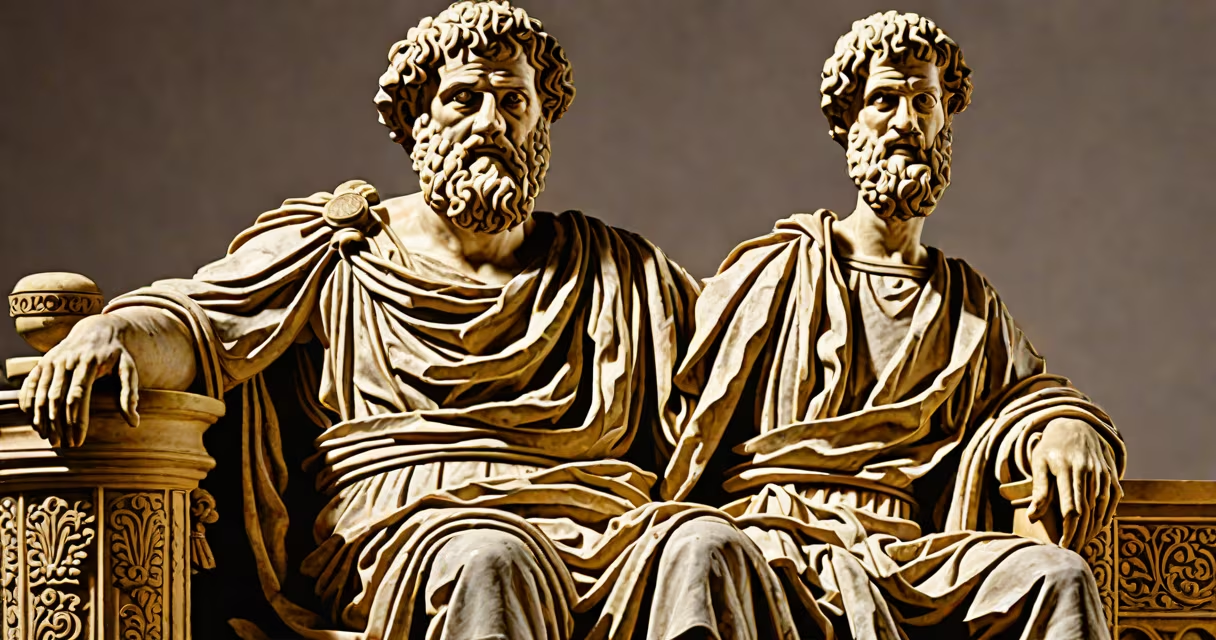
Aristotle lived from 384 BCE to 322 BCE, a period spanning the late Classical and early Hellenistic eras in ancient Greece. He was born in Stagira, a coastal town in northern Greece, and spent much of his life in Athens, where he studied under Plato and later taught at the Lyceum.
Aristotle's lifespan coincided with major political shifts in the Greek world. He was 12 years old when Philip II of Macedon rose to power, and he served as tutor to Alexander the Great from 343 to 336 BCE. His death occurred in Chalcis, on the island of Euboea, after fleeing Athens due to fears of prosecution following the death of his former pupil, who had conquered much of the known world.
His surviving writings cover logic, metaphysics, ethics, politics, biology, and poetics. These texts were preserved through the Byzantine and Islamic worlds and became central to medieval European scholasticism. The Library of Alexandria and later Arabic scholars like Avicenna and Averroes translated and expanded upon his ideas, ensuring their survival into the Renaissance.
Aristotle's method emphasized observation and classification. He believed knowledge came from examining the natural world rather than relying solely on abstract reasoning. This approach led him to study over 500 animal species, documenting their anatomy and behavior-a practice rare among philosophers of his time.
He founded the Peripatetic School, named for the walking (peripatos) he did while teaching. Students gathered around him as he moved through the Lyceum's colonnaded garden, discussing topics ranging from causality to human virtue. This setting shaped his pedagogical style: dialogic, empirical, and rooted in everyday experience.
His concept of "entelechy"-the idea that all things have an inherent purpose or end-was central to his understanding of nature. For example, a seed's telos (goal) is to become a tree. This teleological view influenced Christian theology, particularly Thomas Aquinas, who integrated Aristotelian metaphysics into Catholic doctrine.
Aristotle's logical structure, especially syllogistic reasoning, became the foundation of formal logic. A syllogism like "All men are mortal. Socrates is a man. Therefore, Socrates is mortal" demonstrates deductive validity. This system dominated Western logic until the 19th century, when symbolic logic emerged.
In ethics, Aristotle introduced the concept of the "Golden Mean," which holds that virtue lies between excess and deficiency. Courage, for instance, is the balance between recklessness and cowardice. He argued that moral character develops through habituation-not innate talent-and that happiness (eudaimonia) results from living well according to reason.
His biological research included detailed descriptions of animal reproduction and embryology. He noted that some species reproduce sexually, others asexually, and he correctly identified the placenta in mammals. Modern scholars credit him with laying groundwork for comparative anatomy, though his conclusions were limited by the tools of his era.
Aristotle was not a scientist in the modern sense-he did not conduct controlled experiments or use statistical analysis. His observations were often based on anecdotal evidence and cultural assumptions. For example, he claimed that women have fewer teeth than men, a belief he derived from observing only a few individuals, not systematic sampling.
He also believed the Earth was the center of the universe, a geocentric model later refined by Ptolemy. This view persisted for nearly 1,500 years. However, Aristotle's cosmology was not purely speculative; he based it on observable phenomena like the apparent motion of stars and the lack of perceived movement on Earth.
Another myth is that Aristotle invented the term "philosophy." He didn't. The word originated earlier, but he popularized it as a discipline focused on wisdom, inquiry, and rational explanation. He distinguished philosophy from poetry and rhetoric, arguing that philosophy seeks truth through argument, not metaphor.
While Plato focused on ideal forms and transcendent truths, Aristotle grounded reality in material existence. Where Plato saw justice as a perfect form, Aristotle defined it as fairness in distribution and proportionality in exchange. His practical focus shaped legal theory and economics.
Unlike Socrates, who left no written works and whose teachings were recorded by others (mainly Plato), Aristotle wrote extensively. Over 300 treatises are attributed to him, though only about 30 survive in complete or near-complete form. The rest were lost or fragmented, recovered through medieval manuscripts.
| Philosopher | Lifespan | Primary Focus | Difference from Aristotle |
|---|---|---|---|
| Socrates | 469-399 BCE | Ethics, dialogue, virtue | Left no writings; taught orally. Focused on self-examination, not classification. |
| Plato | 428-348 BCE | Ideal forms, metaphysics, political theory | Believed reality exists beyond the physical world. Aristotle rejected this dualism. |
| Aristotle | 384-322 BCE | Natural science, logic, ethics, politics | Emphasized empirical observation and causal explanation. |
One non-obvious fact: Aristotle never used the word "universe" as we do today. He referred to the cosmos as "the whole" (to pan), a finite, spherical structure bounded by the outermost sphere of fixed stars. The term "universe" entered Latin via the word "universus," meaning "all together," and only later took on its modern scientific meaning.
During my visit to the National Archaeological Museum in Athens, I saw a fragment of an ancient manuscript containing Aristotle's *Physics*. The papyrus, carbon-dated to the 2nd century CE, bore marginalia in Greek and Latin. The handwriting showed signs of frequent revision-proof that his works were actively studied, debated, and copied centuries after his death.
Modern scholars estimate that Aristotle's influence extends to over 10,000 academic papers published annually on topics related to his philosophy. His ethical structure continues to inform medical ethics, business leadership, and educational policy. The concept of "virtue ethics" remains a core component of contemporary moral philosophy.
Understanding when Aristotle was alive clarifies why his ideas resonated across cultures and centuries. His work wasn't isolated-it grew from Athenian intellectual life, was shaped by Macedonian political power, and survived through translation networks spanning the Mediterranean and Near East.
His legacy lives on not because he was infallible, but because he modeled rigorous inquiry. When was Aristotle alive? From 384 to 322 BCE. That span marks the rise of systematic thought in the West, a foundation still visible in science, law, and education today.