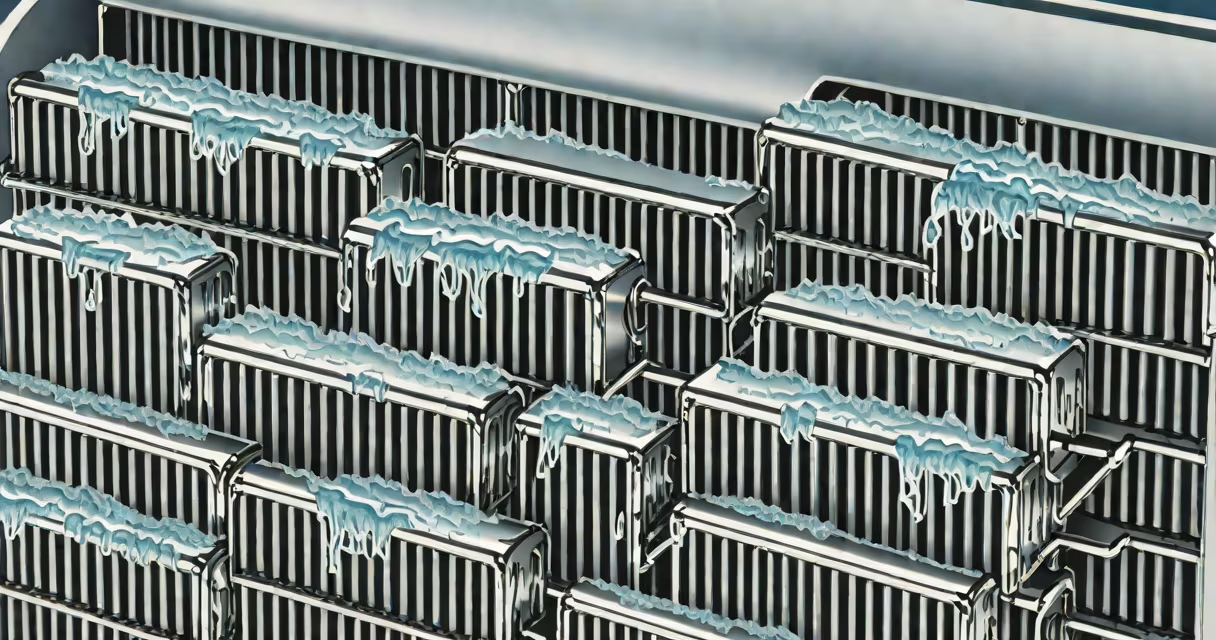
An a coil, more accurately called an evaporator coil, freezes up when cold refrigerant inside the coil causes moisture in the air to condense and freeze on the coil's surface. This typically happens due to restricted airflow, low refrigerant levels, or malfunctioning thermostats.
The evaporator coil sits inside the indoor air handler and absorbs heat from the air passing over it. When airflow drops below 350 cubic feet per minute (CFM) per ton of cooling capacity, the coil temperature drops below freezing. Moisture in the air then freezes directly onto the coil's metal fins and tubing, forming ice that blocks airflow further and reduces system efficiency.
According to the Air Conditioning Contractors of America (ACCA), inadequate airflow accounts for nearly 60% of evaporator coil freeze-ups. The most common triggers are clogged filters, blocked ductwork, or a failing blower motor. Without proper airflow, the coil cannot absorb heat effectively, causing temperatures to plummet and ice to form.
Evaporator coils operate by drawing warm indoor air over cold refrigerant lines. As air passes over the coil, heat transfers from the air to the refrigerant, which then travels to the outdoor condenser unit to release heat. This process cools the indoor air.
For this to work efficiently, the coil must remain above freezing. Normal operating temperatures range between 35°F and 45°F (1.7°C to 7.2°C). If the coil drops below 32°F (0°C), condensation turns to ice. Once ice forms, it insulates the coil, reducing heat transfer and worsening the freeze-up cycle.
A real-world example: A homeowner in Phoenix reported their AC stopped blowing cold air during a 105°F (40.6°C) heatwave. The technician found the evaporator coil was completely encased in ice. The issue traced to a dirty filter left uncleaned for six months. Replacing the filter restored airflow and melted the ice within 30 minutes.
Freezing occurs when one or more system components fail to maintain proper operating conditions. The primary causes fall into three categories: airflow problems, refrigerant issues, and control malfunctions.
| Root Cause | Typical Symptoms | Diagnostic Clue |
|---|---|---|
| Airflow restriction | Ice on coil, weak airflow, longer run times | Filter is visibly dirty; blower motor runs but air feels lukewarm |
| Low refrigerant charge | Ice on coil, low suction pressure, reduced cooling | Refrigerant pressure readings below manufacturer specs |
| Thermostat or sensor error | System runs continuously, ice forms early in cycle | Thermostat shows room temp higher than actual; coil freezes within 15 minutes of startup |
One non-obvious factor often missed: improper refrigerant charge. Technicians sometimes assume low refrigerant is always due to leaks. But overcharging refrigerant can also cause freezing. The ACCA reports that 12% of freeze-ups stem from incorrect charge levels, not leaks.
Another overlooked trigger: oversized systems. A furnace or AC unit sized too large for the home cycles on and off rapidly. This short-cycling prevents the coil from warming up between runs, allowing ice to accumulate. The U.S. Department of Energy notes that 28% of residential HVAC units are oversized, contributing to frequent freeze-ups.
Do not turn off the system immediately. Shutting down the furnace while the coil is frozen can trap moisture and lead to mold growth. Instead, set the thermostat to "off" and allow the system to defrost naturally. This takes 2-4 hours depending on ice thickness.
Once defrosted, inspect the filter. Replace it if it's dusty or compressed. Check the blower wheel for debris. Clean the drain pan and ensure the drain line is clear. If the problem returns, call a licensed HVAC technician.
I once encountered a case in a suburban Chicago home where the evaporator coil froze twice in one week. After replacing the filter and cleaning the blower, the system ran normally. The homeowner had been using a 4-inch filter instead of the recommended 1-inch model. The thicker filter restricted airflow and caused the coil to drop below freezing.
Prevention begins with regular maintenance. Change the air filter every 30 days during peak cooling season. Schedule annual inspections to check refrigerant levels and blower performance.
Ensure the system is correctly sized. An oversized unit wastes energy and increases failure risk. Use Manual J load calculations to determine proper capacity. The National Comfort Institute (NCI) recommends verifying static pressure at the return grill-ideal values are 0.1 to 0.3 inches water column (in. w.c.). Exceeding 0.5 in. w.c. indicates airflow issues.
Use a smart thermostat with freeze protection features. Some models automatically shut off the compressor if coil temperature drops below 35°F. These systems reduce the risk of damage and improve safety.
When diagnosing a frozen coil, avoid assuming the problem is refrigerant-related. Start with airflow. A clogged filter costs $5 to replace but can prevent $500 in repair bills. Always verify the root cause before adding refrigerant.