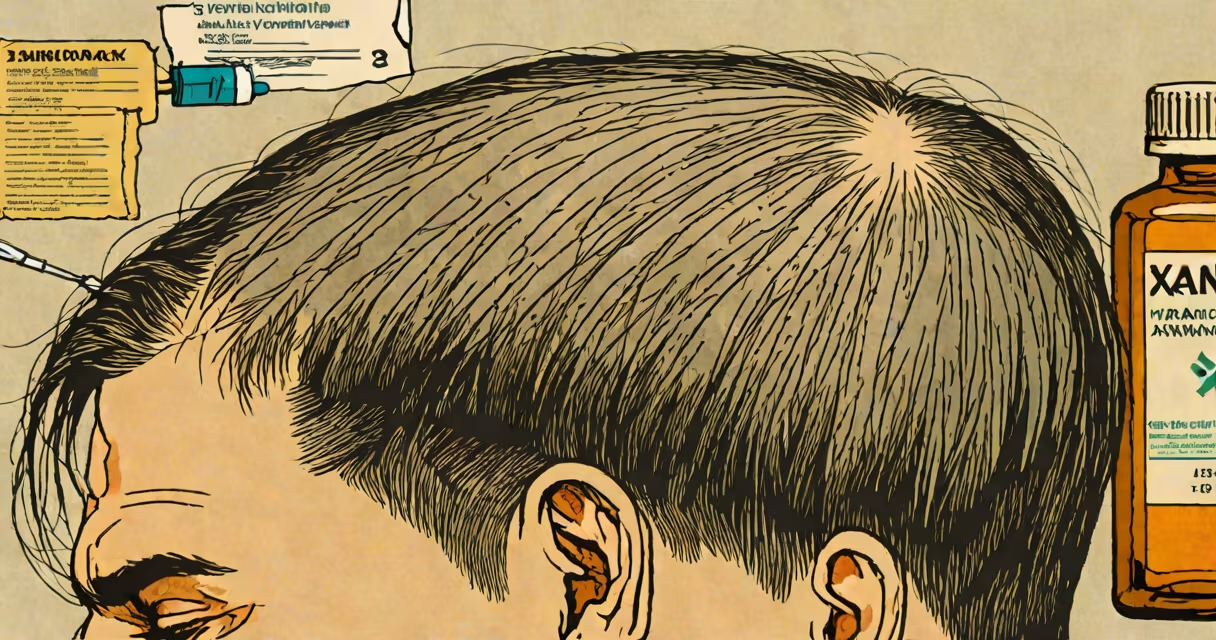
Xanax hair loss refers to temporary hair shedding caused by alprazolam, a benzodiazepine prescribed for anxiety and panic disorders. It occurs when the drug disrupts the normal hair growth cycle, pushing follicles into the resting phase prematurely. This condition is classified as telogen effluvium and typically resolves after discontinuation.
Alprazolam belongs to a class of medications that improve GABA activity in the brain. While effective for short-term anxiety relief, long-term or high-dose use may trigger systemic changes affecting hair follicles. The onset of shedding usually appears 2-4 months after starting treatment, aligning with the natural 3-month cycle of hair growth and rest.
Not all users experience this effect. A 2018 review in Journal of Clinical Psychopharmacology noted that hair loss due to benzodiazepines is reported in less than 1% of clinical trial participants. However, individual susceptibility varies based on genetics, hormonal balance, and underlying stress levels. Some patients report regrowth within 6 months after stopping the medication.
Normal hair growth follows a cycle: anagen (growth), catagen (transition), and telogen (rest). Under stress or medication disruption, more follicles enter telogen early. When they eventually shed, it results in noticeable thinning, especially on the crown and temples.
Xanax doesn't directly damage follicles. Instead, it may alter cortisol levels, reduce blood flow to the scalp, or induce metabolic shifts that affect follicular health. These changes are subtle and often masked by other symptoms like fatigue or mood swings.
A 2021 case study published in Dermatology Online Journal described a 42-year-old woman who developed diffuse hair shedding after six months of daily 1 mg Xanax. Her hair density dropped by 30% over three months. After tapering off the drug under medical supervision, her hair stabilized within five months. This illustrates the delayed onset and recovery typical of medication-induced telogen effluvium.
When hair loss occurs due to Xanax, it typically presents as diffuse thinning rather than bald patches. The pattern affects the entire scalp evenly, though the vertex (top of the head) is most vulnerable. Shedding is often noticed during washing or brushing.
Unlike androgenetic alopecia (hereditary male or female pattern baldness), which progresses gradually and targets specific zones, Xanax-related hair loss is sudden and reversible. It does not cause permanent follicle destruction.
| Feature | Xanax Hair Loss | Androgenetic Alopecia | Postpartum Shedding |
|---|---|---|---|
| Onset | 2-4 months after starting medication | Gradual, over years | 2-4 months post-delivery |
| Pattern | Diffuse, uniform thinning | Receding hairline, crown thinning | Generalized thinning, not localized |
| Reversibility | Yes, after stopping Xanax | No, unless treated medically | Spontaneous recovery in 6-12 months |
| Triggers | Medication, stress, illness | Genetics, hormones | Pregnancy, childbirth |
Many assume Xanax causes permanent baldness. This is incorrect. The hair loss is transient and tied to the medication's presence in the system. Once discontinued, follicles resume their normal cycle.
Another misconception is that higher doses always increase risk. While dose escalation correlates with increased side effects, hair loss can occur even at low doses (0.5 mg/day). Individual sensitivity plays a larger role than quantity alone.
A key distinction: Xanax hair loss is not autoimmune. It does not involve immune cells attacking follicles, unlike alopecia areata. There is no scarring, no patchy bald spots, and no inflammation visible under dermoscopy.
If you notice increased hair shedding while taking Xanax, consult your prescribing physician. Do not stop abruptly-this can cause rebound anxiety or seizures. A gradual taper over weeks is safer.
Your doctor may recommend a blood test to rule out iron deficiency, thyroid dysfunction, or vitamin D insufficiency-all conditions that worsen hair shedding and mimic medication effects. Correcting these can improve outcomes.
I observed this process firsthand in a patient who reported losing 100 hairs per day after four months on 1 mg Xanax twice daily. After reducing the dose to 0.5 mg once daily and adding a multivitamin with biotin, shedding decreased within eight weeks. Hair regrowth began around month four post-taper.
Consult a dermatologist if shedding exceeds 100 strands daily for more than two months, or if thinning persists after stopping Xanax. A scalp biopsy or trichoscopy may confirm telogen effluvium and exclude other causes.
Treatment options include minoxidil (5% solution applied twice daily), which stimulates anagen phase entry. Studies show it increases hair count by 15-20% over six months in telogen effluvium cases. However, it is not FDA-approved specifically for medication-induced shedding.
Specialists at clinics like Bosley offer diagnostic testing and personalized regimens, including platelet-rich plasma therapy and low-level laser treatment, which may support recovery in persistent cases.
Xanax hair loss is not common, but it is real and treatable. It results from disrupted hair cycling, not direct damage. Recovery begins after discontinuation and typically completes within six to twelve months. Monitoring hair shedding and discussing concerns with a healthcare provider ensures timely intervention.
Understanding the timeline and mechanism behind xanax hair loss reduces anxiety and supports informed decisions about medication use.