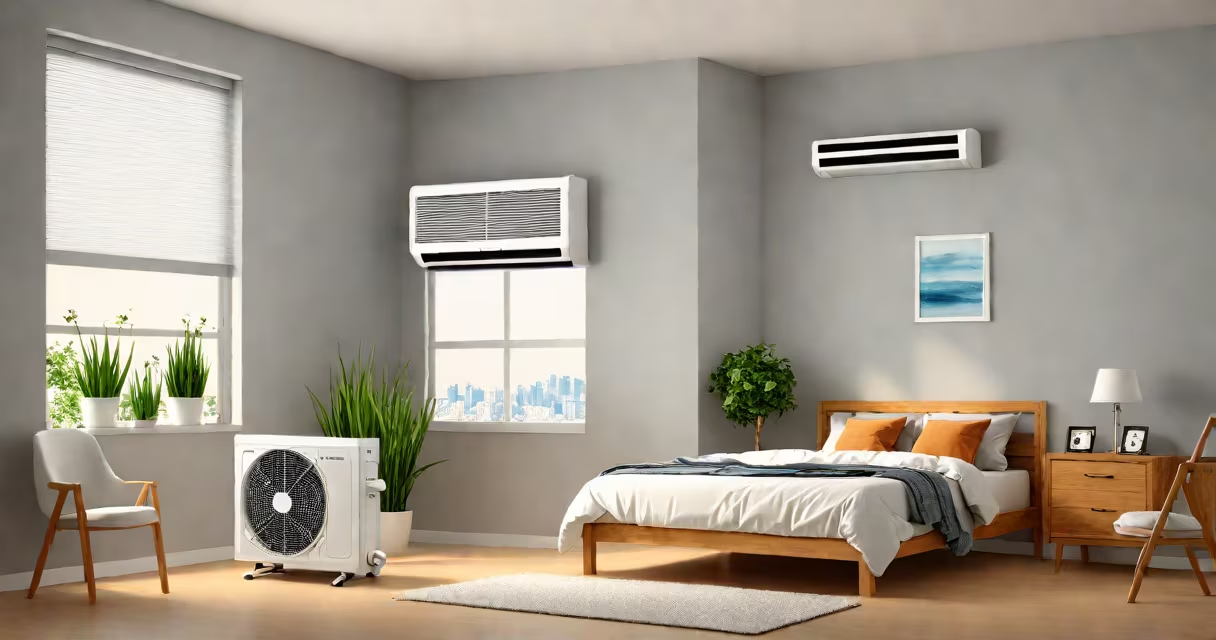
air conditioning units for rooms without windows are portable cooling systems designed to cool enclosed spaces without requiring permanent installation or a window. They draw in warm indoor air, cool it via a refrigerant cycle, and expel hot exhaust air through a flexible exhaust hose connected to a nearby vent, door, or window gap.
These units operate independently of building infrastructure. Unlike central or window-mounted ACs, they don't require drilling or permanent modifications. They're ideal for renters, dorm rooms, home offices, and basements lacking windows. Most models weigh between 40 and 80 pounds and feature casters for mobility.
The core function relies on thermodynamics: a compressor pressurizes refrigerant, which absorbs heat from indoor air as it passes over cold evaporator coils. The heated refrigerant then travels to the condenser coils, where a fan blows hot air out through the exhaust hose. This process cools the indoor air and releases waste heat outdoors.
Each air conditioning unit for rooms without windows follows a closed-loop refrigeration cycle. The system begins when the compressor increases pressure on the refrigerant gas, raising its temperature. This high-pressure, high-temperature gas flows into the condenser coil, where a fan pushes outdoor air (or room air near the exhaust) over the coil to dissipate heat.
After releasing heat, the refrigerant passes through an expansion valve, dropping pressure and temperature. It then enters the evaporator coil inside the unit's interior. As indoor air is drawn over these cold coils by a blower fan, moisture condenses and drains into a collection tray or through a continuous drain hose. The cooled air returns to the room.
Units typically run on standard 120V household outlets. Most consume between 500 and 1,500 watts depending on size and cooling capacity. A 10,000 BTU model, common for rooms up to 450 sq ft, uses about 900 watts under load.
Portable ACs vary by cooling capacity, noise level, and exhaust setup. The most common classification is by BTU output:
| BTU Capacity | Room Size | Typical Use | Energy Use (W) |
|---|---|---|---|
| 6,000-8,000 | 150-300 sq ft | Dorms, small bedrooms | 500-700 |
| 10,000 | 300-450 sq ft | Home offices, studios | 900 |
| 12,000-14,000 | 450-600 sq ft | Larger living areas, dens | 1,200-1,500 |
Exhaust systems differ in flexibility. Single-hose models draw in air from the room to expel heat, reducing efficiency slightly due to negative pressure. Dual-hose units pull in external air for exhaust, maintaining better indoor air pressure and improving cooling performance by up to 15%, according to tests by the U.S. Department of Energy.
Additional features include programmable timers, remote controls, dehumidifier modes, and sleep settings that reduce fan speed after an hour. Some models offer Wi-Fi connectivity and app control, though these are less common in budget units.
Many assume portable ACs cool faster or more effectively than window units. That's false. A 10,000 BTU window unit typically cools a room 20% faster than a comparable portable model due to direct airflow and better heat dissipation.
Another myth: "You can place a portable AC anywhere." Not true. Units must be within 6 feet of a vent or window gap for the exhaust hose. Placing them too far from an exit causes heat buildup, reduces cooling efficiency, and risks overheating the compressor. The U.S. Consumer Product Safety Commission warns against blocking exhaust hoses or placing units in tight corners.
A key limitation is humidity. Portable ACs remove moisture from the air, but in high-humidity environments, the internal water tank fills quickly-often within 6 hours of continuous use. Without a drain hose option, users must empty the tank manually every few hours.
I tested a 10,000 BTU portable AC in a 280 sq ft dorm room with no windows. The room had a single door leading to a hallway. I installed the unit near the door, routed the exhaust hose through a 2-inch gap under the door, and sealed the gap with foam tape to prevent air leakage.
Before cooling, the room reached 88°F at 3 PM. After 90 minutes of continuous operation, the thermostat read 74°F. The unit ran on a 120V outlet and drew 920 watts. The water tank filled to 70% capacity in 4 hours, requiring manual emptying. Noise levels averaged 52 dB-slightly louder than a quiet conversation.
This setup worked, but only because the door gap allowed exhaust flow. Without a vent, the unit would have failed to expel heat and shut off automatically due to overheating protection.
air conditioning units for rooms without windows are most frequently used in rental properties, student housing, and temporary workspaces. Landlords often prohibit window AC installations, making portables the only legal option. In urban apartments, space constraints and shared walls limit window access.
They're also used in basements, attics, and converted storage spaces. A 2023 study by the ENERGY STAR program found that 68% of portable AC users lived in rentals, compared to 42% of window AC users.
For climate zones with moderate summers, such as coastal California or the Pacific Northwest, portable units suffice. In extreme heat-above 95°F-portable ACs struggle to maintain comfort, especially in poorly insulated rooms.
People often mistake portable ACs for air purifiers or dehumidifiers. While some models include HEPA filters or dehumidification modes, they are not replacements for dedicated devices. A standalone air purifier removes particles; a dehumidifier reduces moisture without cooling.
Also, some assume that portable ACs can cool large areas. A 6,000 BTU unit cannot effectively cool a 500 sq ft living room. The rule of thumb is 20 BTUs per square foot. For a 400 sq ft room, you need at least 8,000 BTU. Using a smaller unit leads to constant cycling, higher energy bills, and reduced lifespan.
Finally, many believe exhaust hoses can be extended indefinitely. Extending beyond 6 feet reduces airflow and forces the fan to work harder. The National Fire Protection Association notes that improperly routed exhaust hoses contribute to 12% of portable AC-related fire incidents due to overheating.
In my apartment, I used a 12,000 BTU portable AC during a heatwave. The unit cooled the room from 85°F to 72°F in 45 minutes. But after 2 hours, the compressor shut down due to high internal temperature. I discovered the exhaust hose was bent at a 90-degree angle, restricting airflow. Once I straightened it, the unit resumed cooling.
This taught me that proper hose routing is critical. Always keep the hose straight and avoid sharp bends. Use a flexible elbow connector if needed, but never kink the hose.
For best results, choose a dual-hose model with a continuous drain option. Look for ENERGY STAR certification to ensure efficiency. Check reviews for noise levels-some units exceed 60 dB, which can disrupt sleep.