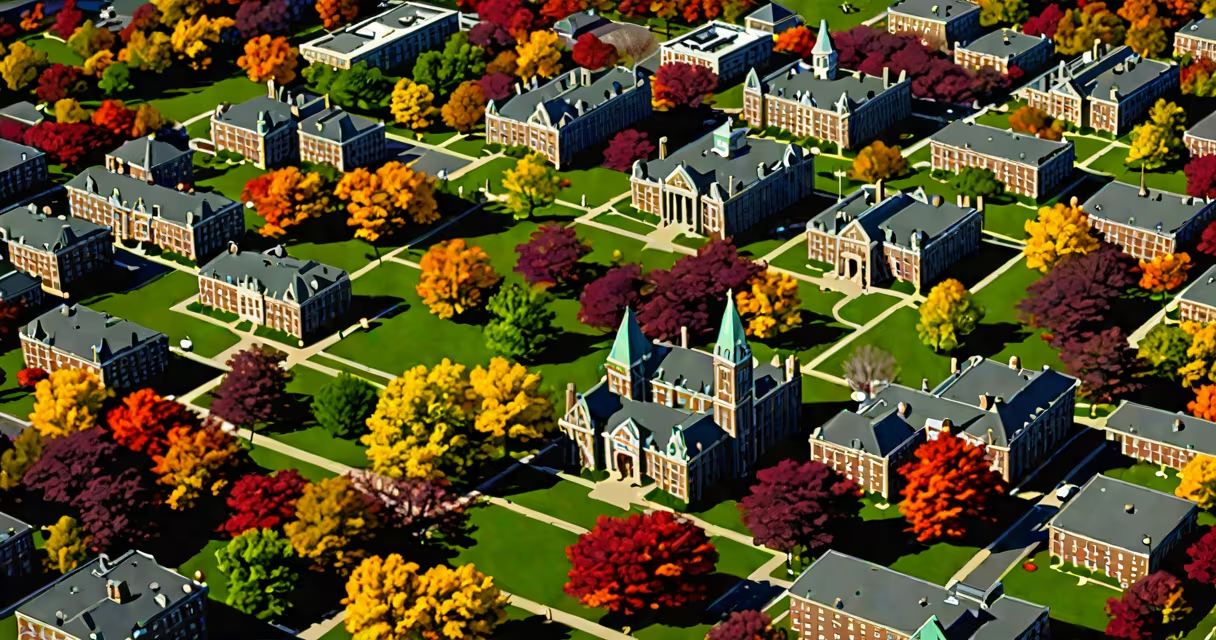
Colleges in NY are post-secondary institutions offering undergraduate and graduate degree programs across New York State, ranging from large public universities to small private liberal arts schools and community colleges serving local populations.
These institutions fall under three primary categories: public four-year universities, community colleges, and private colleges. Public institutions are funded by state appropriations and often have lower tuition rates for residents. Community colleges offer two-year associate degrees and career training programs. Private colleges operate independently of state funding and typically charge higher tuition but may offer more specialized curricula and smaller class sizes.
The State University of New York (SUNY) system includes 64 campuses across the state, such as Stony Brook University, Buffalo State College, and Empire State College. The City University of New York (CUNY) system operates 25 colleges in New York City, including Hunter College, Brooklyn College, and John Jay College of Criminal Justice. These systems serve millions of students annually and are among the largest public higher education networks in the U.S.
Each college in NY follows a standardized academic calendar divided into semesters or quarters. Most full-time undergraduate programs require 120 credit hours for a bachelor's degree, completed over four years. Students enroll in courses across disciplines-liberal arts, sciences, business, engineering, health professions-and earn credits based on contact hours and course outcomes.
Admission requirements vary widely. Public colleges like SUNY and CUNY consider high school GPA, SAT/ACT scores, and extracurricular involvement. Private institutions often require supplemental essays, letters of recommendation, and interviews. Many colleges in NY also offer rolling admissions, allowing applications to be processed throughout the year.
Financial aid is available through federal Pell Grants, state-funded scholarships like the Excelsior Scholarship (which covers tuition for qualifying students at CUNY and SUNY), and institutional grants. Over 60% of undergraduates in NY receive some form of financial assistance, according to the National Center for Education Statistics (NCES).
The following table outlines the main types of colleges in New York and their distinguishing features:
| Type | Examples | Tuition (In-State) | Program Focus |
|---|---|---|---|
| Public Four-Year Universities | SUNY Buffalo, CUNY Lehman, Binghamton University | $7,000-$12,000/year | Bachelor's, master's, doctoral degrees |
| Community Colleges | Queensborough Community College, Nassau Community College | $4,000-$6,000/year | Associate degrees, workforce certificates |
| Private Nonprofit Colleges | Hamilton College, Fordham University, Cooper Union | $35,000-$60,000/year | Limited enrollment, specialized programs |
| For-Profit Institutions | University of Phoenix (NY branch), ITT Technical Institute | $15,000-$25,000/year | Technical and vocational training |
One common misconception is that all colleges in NY are expensive. While private institutions can cost over $50,000 annually, many public and community colleges charge less than $10,000 per year for in-state residents. For example, CUNY's Borough of Manhattan Community College charges $5,200 per year for New York residents, with additional aid reducing net costs to under $2,000.
A lesser-known fact: New York State offers the Career and Technical Education (CTE) pathway through BOCES, which allows high school students to take college-level courses at local technical centers. Credits earned through these programs transfer to many colleges in NY, enabling students to begin degree programs early and reduce time-to-graduation.
Many assume that colleges in NY are limited to New York City. In reality, over 100 colleges operate outside the five boroughs. Upstate institutions like Alfred University, Clarkson University, and the State University of New York College at Plattsburgh serve rural and suburban communities with strong regional focus areas, including environmental science, engineering, and teacher education.
Another misunderstanding is that community colleges do not lead to careers. This is false. Nearly 40% of graduates from SUNY and CUNY community colleges transfer to four-year institutions within two years. The rest enter the workforce directly in fields like nursing, computer support, and automotive technology. For example, Westchester Community College's Associate Degree in Nursing program has a 92% NCLEX-RN pass rate, exceeding the national average.
I once attended a community college open house in Rochester and spoke with a student who had completed her associate degree in cybersecurity and was hired by a local bank before transferring to a four-year program. Her story illustrates how colleges in NY provide direct pathways to employment and further education.
New York State ranks second nationally in the number of accredited colleges and universities, behind only California. With over 1,000 institutions offering degrees in 100+ fields, colleges in NY contribute to economic development, innovation, and workforce readiness.
According to the U.S. Department of Education, nearly 1.5 million students were enrolled in colleges across New York in 2022. Of those, 62% were women, and 38% identified as racial or ethnic minorities. Institutions like Syracuse University and Cornell University consistently rank among the top 50 nationally in research output and alumni success.
Colleges in NY are not interchangeable. A student seeking a liberal arts education may thrive at Bard College, while someone aiming for a medical career might choose SUNY Upstate Medical University. Choosing the right institution requires matching personal goals, academic strengths, and financial capacity.
Understanding colleges in NY begins with recognizing the diversity of options available-from commuter schools in Long Island to research-intensive universities in Ithaca. Whether pursuing a two-year certificate or a PhD, students have access to structured academic environments designed to meet specific educational and professional objectives.