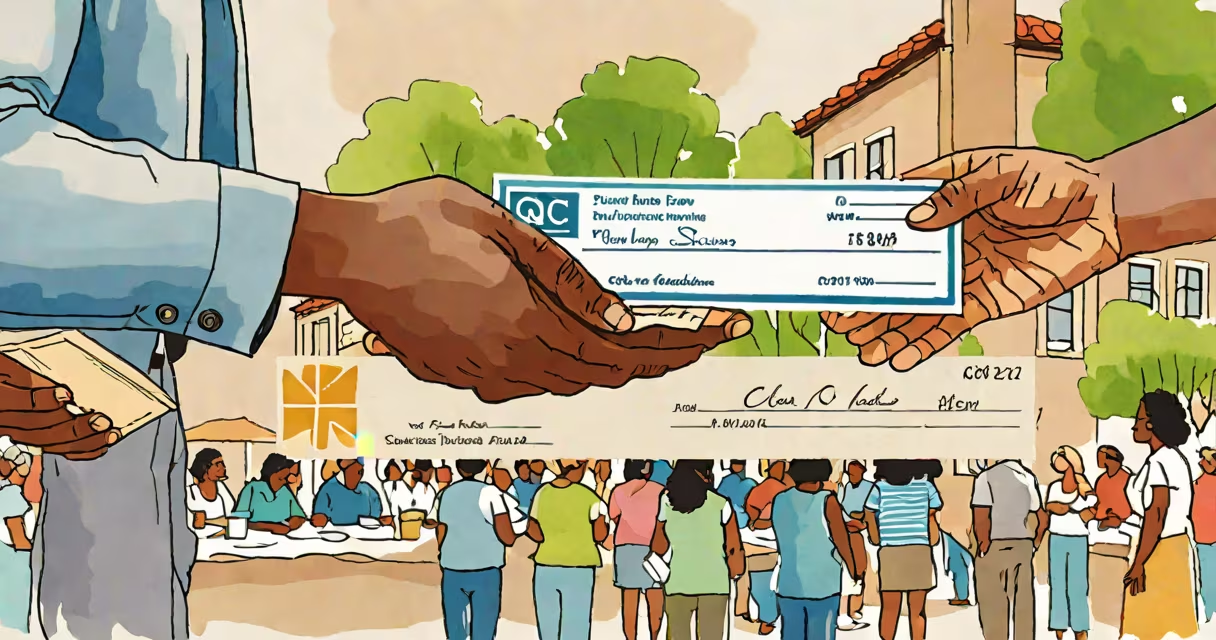
A QCD donation, or qualified charitable distribution, is a direct transfer of funds from an individual's traditional or Roth IRA to a qualified nonprofit organization, which counts toward their required minimum distribution (RMD) and is excluded from taxable income.
QCDs are available only to individuals aged 70½ or older who have a traditional or Roth IRA. The IRS allows up to $100,000 annually per person to be transferred directly from an IRA custodian to a charity without being taxed as income. This makes QCDs a strategic tool for retirees seeking to fulfill RMD obligations while reducing taxable income.
For example, a 75-year-old taxpayer with a $50,000 RMD can make a $50,000 QCD to a local food bank. That amount satisfies the RMD requirement and is not included in adjusted gross income (AGI), potentially lowering Medicare premiums and reducing exposure to the 3.8% net investment income tax.
The donor instructs their IRA custodian to send funds directly to a qualified charity. The transfer occurs outside the donor's hands, meaning the money never touches their bank account or gets reported as income on their tax return. This direct-to-charity mechanism is key to the tax advantage.
Transfers must be made by check, wire, or electronic transfer directly from the IRA custodian to the charity. Cash withdrawals or checks payable to the donor-even if immediately given to charity-are not eligible. The IRS defines "direct" as no intermediary handling of funds by the donor.
For instance, if a retiree withdraws $20,000 from their IRA and gives it to a school fundraiser, that's a taxable distribution. But if the IRA provider sends $20,000 directly to the school's designated account, it qualifies as a QCD and avoids taxation.
To qualify, donors must be at least 70½ years old when the distribution is made. Age is measured at the time of the transaction-not at year-end. A 70-year-old cannot make a QCD until they turn 70½, even if they're close to the milestone.
Only traditional IRAs and Roth IRAs qualify. QCDs cannot come from 401(k)s, 403(b)s, or other employer-sponsored plans unless the funds are rolled into an IRA first. The $100,000 annual limit applies per individual, not per account. So a married couple both aged 72 can each make a $100,000 QCD, totaling $200,000 in tax-free giving.
| Requirement | Details |
|---|---|
| Minimum Age | 70½ at time of distribution |
| Maximum Annual Amount | $100,000 per person |
| Eligible Accounts | Traditional and Roth IRAs only |
| Funds Path | Direct transfer from IRA custodian to charity |
| Tax Treatment | Excluded from AGI; counts toward RMD |
Many people assume QCDs are only useful for those with large RMDs. But even modest distributions can reduce AGI. For example, a $25,000 QCD lowers AGI by that amount, which may push a taxpayer below thresholds for phase-outs of deductions or credits.
Another common error is thinking QCDs can be combined with other charitable contributions. They cannot. A QCD cannot be claimed as a deduction on Form 1040, Schedule A. Because the amount is not counted as income, it's not deductible. However, the IRS treats it as a gift for purposes of satisfying RMDs.
Some believe QCDs apply to donations made via platforms like GoFundMe or PayPal. They do not. Only transfers from an IRA custodian to a qualified 501(c)(3) organization qualify. The charity must have valid tax-exempt status. Donors should verify a charity's status using the IRS's Tax Exempt Organization Search.
Regular charitable gifts from cash or investments are deductible, but only if the donor itemizes. For many retirees, standard deductions exceed itemized amounts. In 2023, the standard deduction was $13,850 for singles and $27,700 for married couples filing jointly. If a donor doesn't itemize, the charitable deduction offers no benefit.
QCDs eliminate this issue. They reduce AGI regardless of whether the donor itemizes. Lower AGI can also reduce the cost of Medicare Part B and D premiums, which are based on modified adjusted gross income (MAGI).
I once advised a client who had a $60,000 RMD and wanted to give $30,000 to a university. She was in the 24% marginal tax bracket. Without a QCD, her $30,000 donation would have been taxed at 24%, costing her $7,200 in taxes. With a QCD, she gave $30,000 tax-free, effectively increasing her net contribution by $7,200.
QCDs are most beneficial for retirees whose RMDs exceed their planned charitable giving. By directing part of the RMD to charity, they avoid paying income tax on that portion. This strategy is especially effective for those with high RMDs and limited itemized deductions.
They're also useful for individuals who want to support causes but don't want to increase their taxable income. For example, someone who lives off Social Security and IRA withdrawals may face higher Medicare premiums due to elevated MAGI. A QCD reduces MAGI and can lower those costs.
QCDs do not affect the donor's ability to claim the charitable deduction for other gifts. A donor can make a QCD and still deduct cash donations on Schedule A-just not the QCD itself.
Planning a QCD requires coordination with your IRA custodian. Most financial institutions offer forms or online portals to initiate direct transfers. Always confirm the charity's designation and ensure the transfer is labeled as a QCD to avoid processing errors.
For guidance on eligible charities, consult the charitable donation list to verify organizations that meet IRS criteria. Not all nonprofits qualify-only those with 501(c)(3) status and approved by the IRS.
Understanding what is a QCD donation clarifies a useful tax-efficient giving method. It's not just about giving more-it's about giving smarter, especially for retirees managing RMDs and tax liabilities.