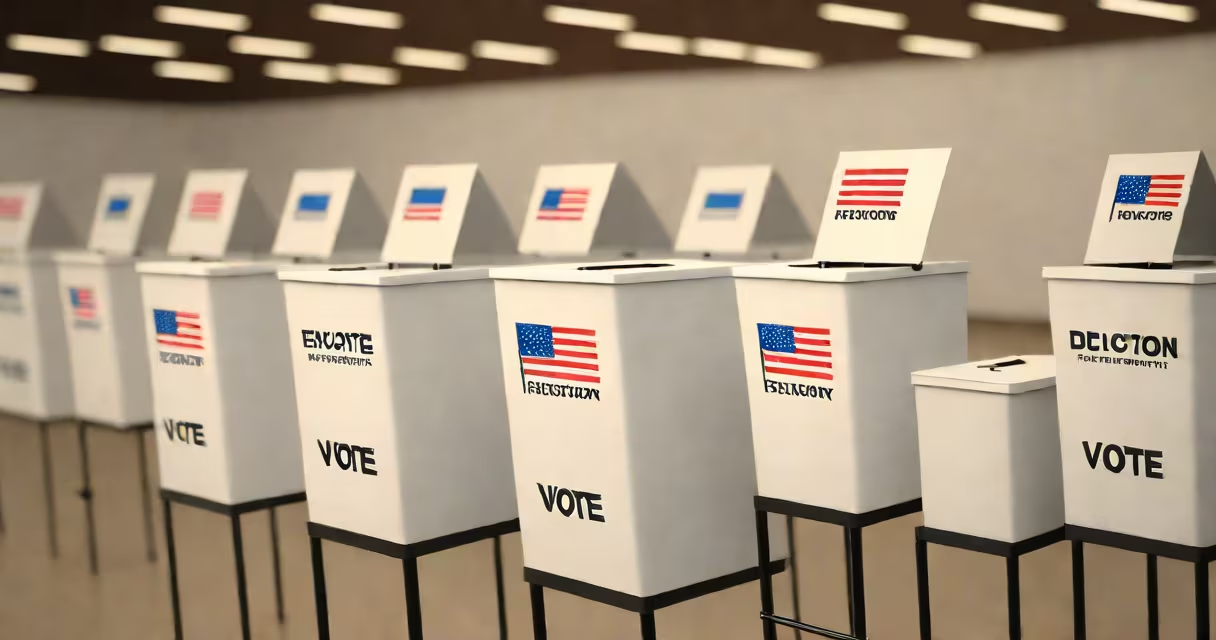
Democracy is a system of government where citizens elect their leaders through free and fair elections and have a direct or indirect role in making laws. Power rests with the people, not a single ruler or elite group.
At its core, democracy means rule by the people. Citizens participate in choosing who governs them, either directly or through elected representatives. This system relies on regular elections, protection of civil liberties, and equal access to political power. The United States, India, Germany, and South Africa all operate under democratic frameworks, though they differ in structure and implementation.
The term originates from ancient Greece, where "demos" meant "people" and "kratos" meant "power." Athenian democracy in the 5th century BCE allowed male citizens to attend assemblies and vote on laws, though women, slaves, and foreigners were excluded. Modern democracies extend suffrage to all adult citizens regardless of gender, race, or class.
Democracies function through institutions that ensure accountability and transparency. The most common model is representative democracy, where voters select individuals to make decisions on their behalf. These representatives serve in legislative bodies such as parliaments or congresses.
In a representative system, elections occur at set intervals-every four years in the U.S. presidential cycle, every five in the UK general election. Voters choose candidates based on platforms, policies, and track records. Once elected, lawmakers debate legislation, approve budgets, and oversee executive actions.
Direct democracy exists in smaller communities or specific policy areas. Switzerland uses referendums to let citizens vote on national laws. In California, voters decide on propositions related to taxes, education, and criminal justice. These mechanisms allow people to bypass intermediaries and vote directly on issues.
Democracies vary in structure. The two primary models are parliamentary and presidential systems, each with distinct power distributions.
| System | Leadership | Executive Authority | Examples |
|---|---|---|---|
| Parliamentary | Prime minister chosen by legislature | Head of government drawn from elected lawmakers | United Kingdom, Canada, Japan |
| Presidential | President elected separately from legislature | Executive independent of legislature | United States, Brazil, Nigeria |
Both systems require regular elections and checks on power. In parliamentary systems, the prime minister must maintain support from the majority in parliament. If they lose confidence, the government collapses and new elections may follow. In presidential systems, the president serves a fixed term and cannot be removed by parliament except through impeachment.
Democracy is often misunderstood as simply "majority rule." But in functioning democracies, minority rights are protected. A majority cannot pass laws that strip fundamental freedoms like speech, religion, or due process. Constitutional courts in countries like Germany and Canada review laws for compliance with human rights standards.
Another misconception is that democracy requires consensus. In reality, democratic societies accept disagreement as normal. Political debate, protests, and opposition parties are features of healthy democracies, not signs of failure. The U.S. Supreme Court's decision in *Tinker v. Des Moines* (1969) affirmed students' right to wear black armbands in protest-a foundational moment for free expression in schools.
Some confuse democracy with populism. Populism appeals to "the people" against elites but often undermines institutional safeguards. True democracy balances popular will with legal limits and minority protections. As political scientist Larry Diamond notes in *The Spirit of Democracy* (2008), "Democracy is not just about elections-it's about the rule of law, pluralism, and civic engagement."
The 2020 U.S. presidential election illustrates how democratic processes work in practice. Over 158 million Americans voted-about 66% of eligible voters-through mail-in ballots, early voting, and in-person polling. Voter turnout reached its highest level since 1900.
After the polls closed, state officials certified results using auditable paper ballots. Legal challenges were filed in multiple states, but courts-including the Supreme Court-ruled that evidence did not show widespread fraud. On January 6, 2021, Congress met to count electoral votes. After certification, Joe Biden was officially declared the winner.
This process demonstrates key democratic principles: verified voting, judicial oversight, and peaceful transfer of power. Despite misinformation campaigns, the system held. As the Brennan Center for Justice reported, "There is no credible evidence of systemic voter fraud in the 2020 election."
Democracy helps governments remain accountable. When leaders face re-election, they must respond to public concerns. Policies on healthcare, education, and climate change reflect voter priorities. In contrast, authoritarian regimes often suppress dissent and lack transparent decision-making.
A 2023 study by the Varieties of Democracy (V-Dem) Institute found that countries with higher levels of democratic governance report better economic performance, lower corruption, and greater life expectancy. For example, Sweden and New Zealand rank among the top 10 globally in both democracy scores and quality of life indicators.
One non-obvious fact: democracy is not inherently stable. Countries can slide into authoritarianism even after holding elections. The V-Dem project tracks "democratic backsliding"-a decline in civil liberties, media freedom, and electoral fairness. Hungary and Turkey have experienced measurable erosion of democratic norms since the 2010s, despite maintaining formal elections.
I once observed a local town meeting in Portland, Oregon, where residents debated zoning changes. A homeowner argued against building a new apartment complex, citing traffic and noise. A young renter countered that affordable housing was needed. The city council later voted to approve the project with design modifications. That moment showed democracy not as theory, but as daily negotiation among citizens.
Understanding the definition of democracy simple means recognizing it as a living system-not a static ideal. It functions through participation, institutions, and shared rules. It's not perfect, but it provides a structure for resolving conflict peacefully and adapting to change.