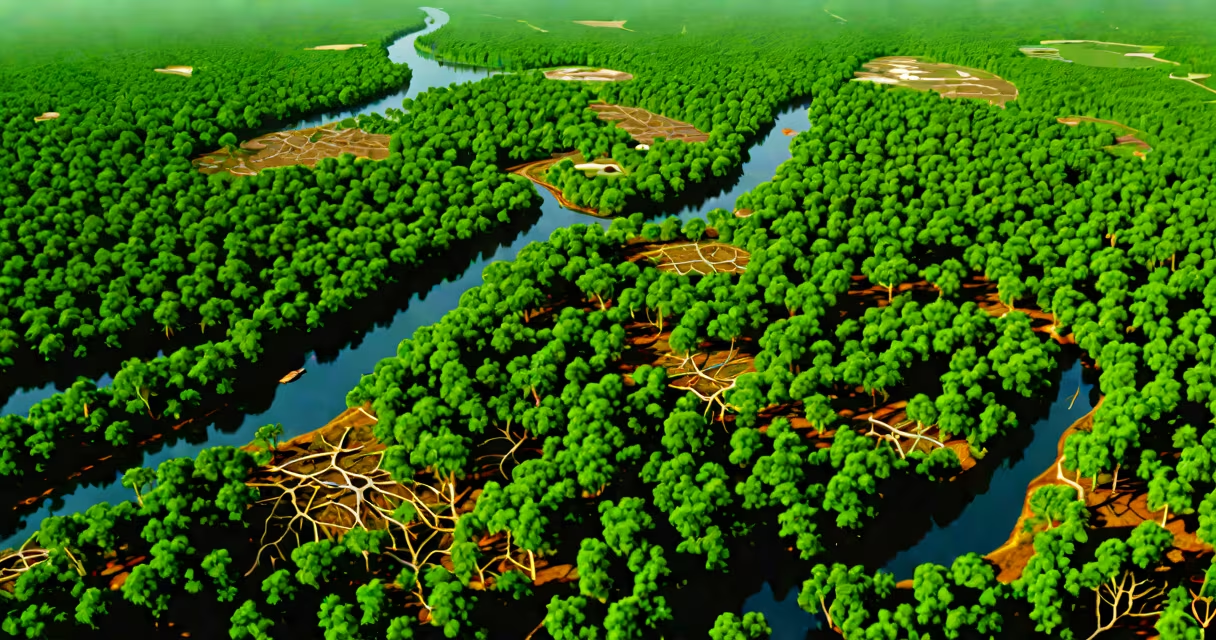
Environmental change refers to measurable shifts in Earth's natural systems over time, including climate patterns, species distribution, land cover, and ocean chemistry. These changes result from both natural processes and human activities, with increasing frequency and intensity linked to industrialization and population growth.
Environmental change operates across multiple scales. On a local level, it may appear as wetland drainage due to infrastructure development. On a global scale, it manifests as rising average temperatures, melting glaciers, and shifting precipitation zones. The Intergovernmental Panel on Climate Change (IPCC) identifies anthropogenic greenhouse gas emissions as the dominant driver of recent large-scale environmental change since the late 19th century.
Changes are tracked through consistent monitoring programs. NASA's Earth Observing System, for example, collects satellite data on vegetation health, sea surface temperature, and atmospheric composition. These datasets reveal that global average surface temperature rose 1.1°C between 1880 and 2020, a trend directly correlated with increased carbon dioxide concentrations.
Environmental change occurs when energy flows, material cycles, or biological interactions within ecosystems exceed their historical ranges. A forest fire alters soil chemistry, reduces biodiversity, and increases erosion risk-each a form of environmental change. Similarly, ocean acidification from absorbed CO₂ disrupts shell formation in marine organisms, affecting entire food webs.
These shifts follow feedback loops. Melting Arctic ice reduces Earth's albedo (reflectivity), causing more solar radiation to be absorbed rather than reflected. This accelerates warming, which leads to further ice melt-an amplifying cycle. Such dynamics make some changes irreversible on human timescales.
Monitoring relies on long-term datasets. The Mauna Loa Observatory in Hawaii has recorded atmospheric CO₂ levels since 1958. Data show a steady rise from 315 parts per million (ppm) in 1958 to over 420 ppm in 2023, confirming a direct link between fossil fuel combustion and atmospheric composition change.
Environmental change falls into three broad categories: climatic, biotic, and geochemical. Each involves distinct mechanisms and measurable indicators.
| Type | Primary Drivers | Measurable Indicators | Real-World Example |
|---|---|---|---|
| Climatic | Greenhouse gas emissions, solar variability | Global temperature anomalies, sea level rise | Arctic sea ice extent declined 13% per decade from 1979-2020 (NASA) |
| Biotic | Habitat destruction, invasive species | Species extinction rates, range shifts | North American monarch butterfly populations dropped 80% between 1990 and 2020 due to milkweed loss |
| Geochemical | Industrial runoff, mining waste | Soil pH, heavy metal concentration | Lead levels in soil near old smelters in Leadville, Colorado, remain above EPA safety thresholds decades after closure |
Not all environmental change is negative. Some natural shifts support system resilience. For example, periodic wildfires in boreal forests clear underbrush, enabling regeneration of fire-adapted species like lodgepole pine. However, human-induced changes often outpace adaptation capacity.
Environmental change is frequently conflated with climate change. While climate change is a subset involving long-term shifts in temperature and weather patterns, environmental change encompasses broader ecological transformations-including habitat fragmentation, pollution, and species invasions.
A common error is assuming all change is harmful. The 2016 study published in Nature Ecology & Evolution found that some ecosystems recover after disturbance if stressors are removed. After the 1980 eruption of Mount St. Helens, plant recolonization began within two years, demonstrating rapid recovery potential in certain conditions.
Another misconception is that environmental change only affects remote regions. Urban areas experience significant change too. In Los Angeles, air quality improvements since 1970 reduced ozone levels by 40%, but heat island effects have increased nighttime temperatures by 3°C compared to surrounding rural areas-a localized environmental shift driven by infrastructure and land use.
Understanding the definition of environmental change enables accurate assessment of risks to human health, agriculture, and infrastructure. Coastal cities face higher flood risk due to sea level rise-projected to increase by 0.3 to 1 meter by 2100 under moderate emission scenarios (IPCC AR6).
Management strategies differ based on cause and scale. Localized changes, such as nutrient runoff from farms, are addressed through watershed planning and buffer zones. Global changes require international cooperation. The Paris Agreement aims to limit warming to below 2°C by reducing emissions through national commitments.
I once observed a restoration project in the Florida Everglades where hydrological models predicted improved water flow after removing a canal barrier. After implementation, wading bird populations rebounded by 35% within five years-proof that reversing environmental change is possible with science-based intervention.
The definition of environmental change is not static. As new data emerge, our understanding evolves. What was once considered natural variation-like the 1930s Dust Bowl-is now recognized as a consequence of poor land stewardship. Today's environmental change is increasingly shaped by cumulative human impacts, demanding continuous monitoring and adaptive responses.