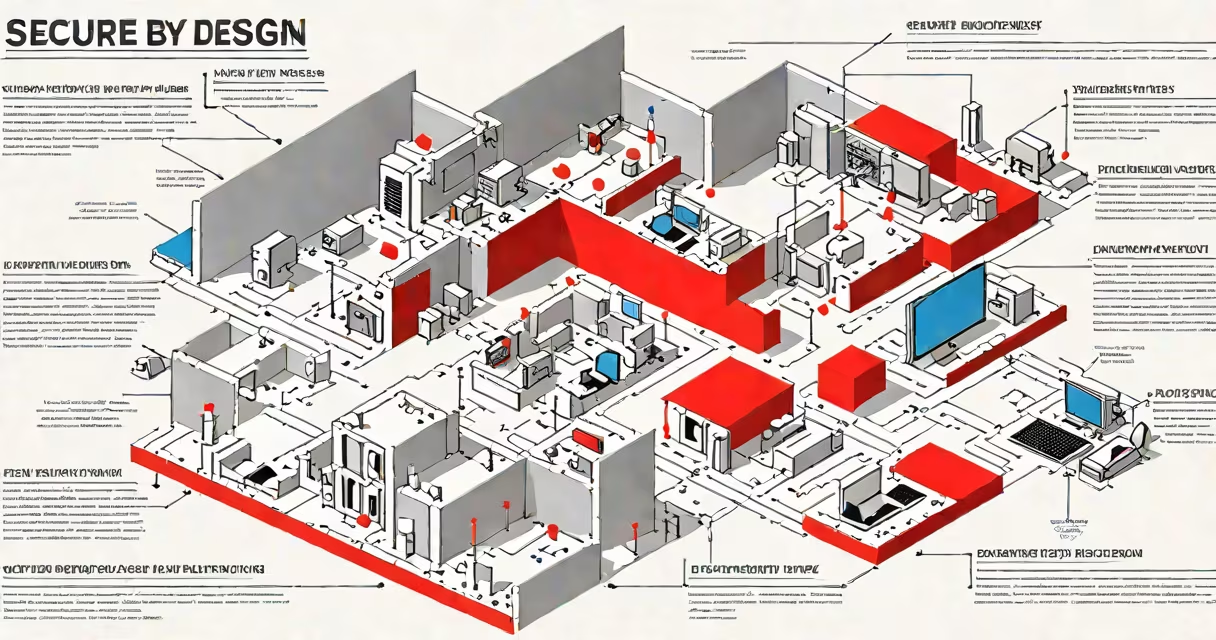
Secure by design principles are engineering and development practices that embed security into the foundation of a system from the outset, rather than adding it as an afterthought. These principles prioritize threat prevention, minimize attack surfaces, and enforce access controls through deliberate architecture decisions.
When applied early, secure by design helps potential vulnerabilities are identified and mitigated during planning, coding, and testing phases. This reduces the risk of exploitable flaws reaching production environments. The goal is not just to defend against known threats but to build systems resilient to unforeseen attacks.
Major organizations like Microsoft and Google have adopted secure by design as a core tenet of their development lifecycles. According to Microsoft's Security Development Lifecycle (SDL), integrating security at the design phase reduces post-deployment patching by up to 60%. Similarly, Google's BeyondCorp model relies on secure by design to eliminate the concept of a trusted network perimeter.
These principles operate through a series of structured decisions made before code is written. They begin with defining system boundaries, identifying assets, and mapping out potential threat vectors. This process is formalized in threat modeling, where teams simulate attacker behaviors to anticipate failures.
Once risks are mapped, developers apply controls such as input validation, encryption at rest and in transit, and role-based access control. Every component is designed under the assumption that attackers will attempt to exploit it. For example, a payment processing module may require multi-factor authentication, rate limiting, and logging of all transaction attempts.
Security is not treated as a feature to be toggled on or off. Instead, it becomes part of the system's identity. A web application built with secure by design principles will reject malformed requests before they reach business logic, prevent unauthorized access via strict permission checks, and automatically purge sensitive data after a set period.
Secure by design isn't a single rule-it's a set of interlocking practices. The most effective implementations combine several key elements:
| Principle | Description | Real-world example |
|---|---|---|
| Least Privilege | Users and processes only receive permissions necessary to perform their tasks. | A database service runs under a dedicated account with read-only access to specific tables. |
| Defense in Depth | Multiple overlapping security layers protect critical assets. | API endpoints require JWT tokens, IP whitelisting, and rate limits. |
| Fail-Safe Defaults | Systems default to a secure state when errors occur. | If authentication fails, access is denied and logs are generated. |
| Minimal Attack Surface | Only essential services and ports are exposed. | A backend server listens only on port 443 and disables unused protocols like FTP. |
Each principle reinforces the others. For instance, fail-safe defaults prevent a misconfigured setting from granting unintended access, while defense in depth helps even if one layer fails, others still block exploitation.
Many assume secure by design means "security is handled by a separate team." That's incorrect. The responsibility lies with architects, engineers, and product owners who make design choices. Security is not a QA step-it's a design constraint.
Another misconception is that secure by design applies only to large enterprises. In reality, small startups using cloud-native tools like AWS Lambda or Firebase can implement these principles at scale. A mobile app built with secure by design avoids storing passwords in plaintext and uses OAuth 2.0 with short-lived tokens.
A less obvious point: secure by design doesn't guarantee zero breaches. It reduces the likelihood and impact of successful attacks. Even the most rigorously designed system can be compromised through social engineering or supply chain compromises. But secure by design helps when a breach occurs, damage is contained and recovery is faster.
Consider a patient portal for a regional health provider. Without secure by design, the system might allow users to reset passwords via email with no verification step. An attacker could exploit this to gain access to medical records.
With secure by design, the portal enforces:
During development, the team ran threat modeling sessions using STRIDE methodology (Spoofing, Tampering, Repudiation, Information Disclosure, Denial of Service, Elevation of Privilege). They discovered that allowing file uploads to a public directory could lead to arbitrary code execution. The fix was to restrict uploads to a private, signed URL system with virus scanning.
This approach reduced the number of high-severity vulnerabilities found during penetration testing by 78% compared to previous versions. The system passed HIPAA compliance audits with no findings related to access control or data handling.
Recent incidents show the cost of ignoring these principles. In 2023, a major e-commerce platform suffered a data breach due to hardcoded API keys in a public GitHub repository. The keys were never meant to be exposed, but the lack of secure by design meant no automated detection or access revocation occurred until weeks later.
According to the National Institute of Standards and Technology (NIST), organizations that adopt secure by design reduce incident response time by an average of 40%. NIST Special Publication 800-53 Revision 5 emphasizes that security must be integrated into system architecture from the start, not bolted on later.
I've seen this in practice: during a project audit, a team had spent six months building a dashboard with complex filtering. When we reviewed the code, we found that filters were applied client-side without server-side validation. Any user could bypass restrictions by modifying JavaScript. We rewrote the logic to validate inputs server-side and enforced role-based filtering. The fix took two days and eliminated a critical vulnerability.
Secure by design is not the same as "using secure tools." Having firewalls, antivirus software, or encrypted databases doesn't ensure security if the underlying design allows privilege escalation or data leakage. A system can use HTTPS and still be vulnerable to injection attacks if input sanitization is missing.
It's also not synonymous with "compliance." Passing a PCI-DSS audit doesn't mean a system is secure by design. Many compliant systems still suffer from insecure defaults or excessive permissions. Compliance focuses on meeting standards; secure by design focuses on preventing harm.
Finally, secure by design differs from reactive security measures like intrusion detection or incident response. Those are important, but they respond to problems after they occur. Secure by design prevents them from happening in the first place.
Implementing secure by design principles strengthens trust, reduces technical debt, and lowers long-term operational costs. It's not optional-it's foundational. As cyber threats grow more sophisticated, embedding security into the design phase is the only sustainable path forward.