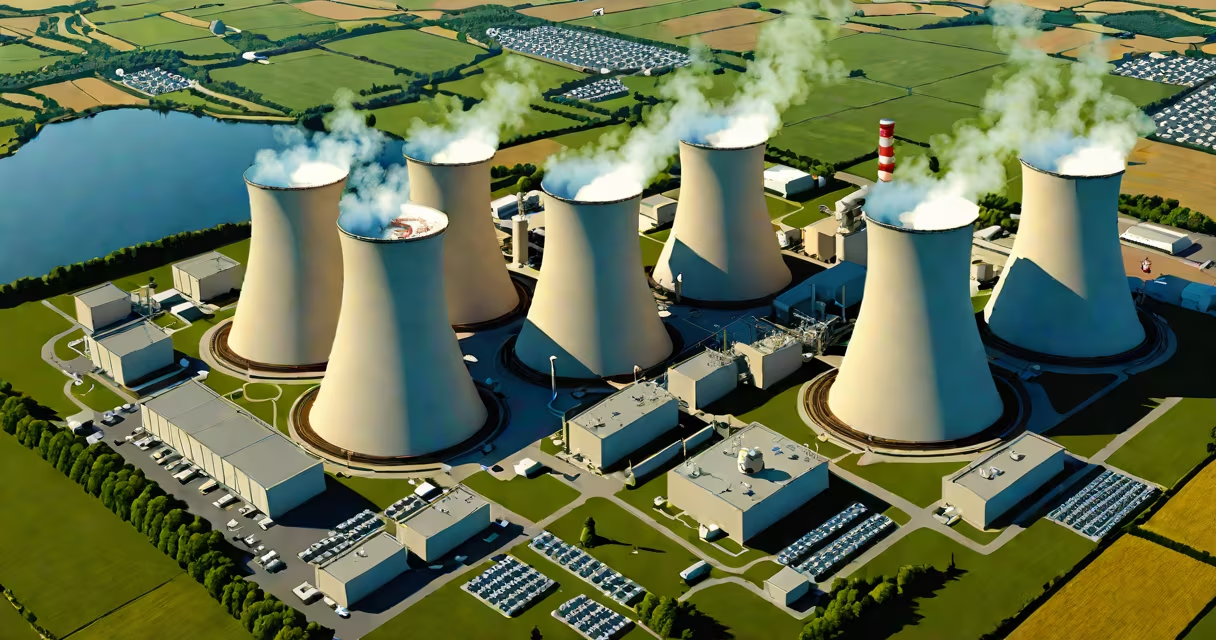
Electricité de France (EDF) is a state-owned French energy company responsible for generating, transmitting, and distributing electricity across France and parts of Europe. It operates 56 nuclear reactors, supplies over 30 million customers, and manages more than 100,000 kilometers of high-voltage transmission lines.
EDF was created in 1946 under the nationalization of France's electricity sector. Its core mission is to provide secure, low-carbon electricity through a mix of nuclear, hydroelectric, wind, solar, and gas-fired generation. The company holds a dominant position in France's energy market, supplying nearly 70% of the country's electricity from nuclear sources.
EDF operates under strict regulatory oversight by the French energy regulator (CRE) and the European Commission. It reports annually to the Ministry of Economy and Finance and is subject to public procurement rules. As of 2023, EDF generated 473 terawatt-hours (TWh) of electricity, with 87% derived from nuclear power-a global benchmark for low-emission energy production.
EDF manages a vertically integrated system: it generates electricity, transmits it via high-voltage grids, and distributes it to homes and businesses. The company owns and maintains over 100,000 km of transmission and distribution lines, including 38,000 km of high-voltage lines rated at 400 kV and 220 kV.
Nuclear power plants form the core of EDF's output. Reactors like those at Flamanville, Gravelines, and Fessenheim produce continuous baseload power. Each unit typically operates at 90% capacity factor-higher than most global nuclear fleets. For example, the Flamanville 3 reactor, though delayed, aims to generate 1,300 megawatts (MW) of electricity, enough to power approximately 1.3 million homes.
When demand exceeds supply, EDF uses hydroelectric plants (such as those in the Massif Central) and gas turbines to balance the grid. During peak winter months, EDF dispatches up to 15 GW of flexible generation to maintain stability. The company also manages smart meters and time-of-use tariffs to encourage off-peak consumption.
EDF's energy mix includes five primary sources. Nuclear remains the largest contributor, followed by hydro, wind, solar, and gas. The company is investing heavily in offshore wind and green hydrogen projects to meet EU climate targets.
| Source | Share of EDF's Output (2023) | Capacity (GW) | Key Locations |
|---|---|---|---|
| Nuclear | 87% | 63.5 | Flamanville, Gravelines, Bugey |
| Hydroelectric | 6% | 10.2 | Alpes-Maritimes, Corsica |
| Wind | 4% | 4.7 | Bretagne, Hauts-de-France |
| Solar | 2% | 1.8 | Provence-Alpes-Côte d'Azur |
| Gas & Other | 1% | 0.5 | Various regional plants |
EDF's wind portfolio includes offshore installations like the Saint-Nazaire project, which began commercial operation in 2021. This site features 80 turbines capable of producing 480 MW-enough to power 500,000 households annually. Solar projects are expanding rapidly in southern France, with over 1.2 GW of installed capacity across 30 sites.
A non-obvious fact: EDF owns and operates the entire French high-voltage transmission network, managed by RTE (Réseau de Transport d'Électricité), a separate entity under EDF Group. RTE handles grid operations, while EDF focuses on generation and customer service. This separation ensures regulatory independence and prevents conflicts of interest.
EDF serves 30 million residential and commercial customers in France. It provides electricity to all 96 departments, including overseas regions like Réunion and Martinique. In metropolitan France, EDF delivers power through 20 regional distribution centers and 25,000 substations.
For industrial clients, EDF offers long-term contracts with fixed pricing. A steel mill in Dunkerque, for example, signed a 15-year agreement at €45/MWh-lower than the average market rate due to volume discounts. EDF also supplies heat and steam to district networks in cities like Lyon and Lille.
EDF extends services beyond France. It operates in Belgium, Germany, and the UK through subsidiaries. In the UK, EDF Energy supplies electricity to 5 million households and manages the Hinkley Point C nuclear project, expected to begin operations in 2027. The company also partners with local utilities in Africa and Southeast Asia to develop renewable infrastructure.
Many assume EDF is solely a nuclear operator. While nuclear accounts for 87% of its output, EDF actively develops renewables. By 2030, the company aims to increase wind and solar capacity by 40%, reducing reliance on aging reactors.
Another misconception is that EDF is entirely state-owned. While the French government holds 84% of shares, EDF is listed on the Euronext Paris exchange. Public trading allows capital raising for infrastructure upgrades, such as the €20 billion investment in nuclear safety and modernization between 2021 and 2025.
EDF is often confused with Engie, another French utility. Engie specializes in natural gas, heating, and renewable energy solutions. EDF focuses exclusively on electricity generation and distribution. The two companies compete in retail markets but operate distinct business models.
During the 2023 energy crisis, EDF faced criticism over price hikes. However, regulated tariffs in France limit annual increases to 3.5%-a cap set by the government. Customers who choose fixed-rate plans avoid volatility. I observed this firsthand during a home energy audit in Marseille: a family on a fixed tariff paid €120/month regardless of usage spikes, while a neighbor on variable pricing saw bills double in winter.