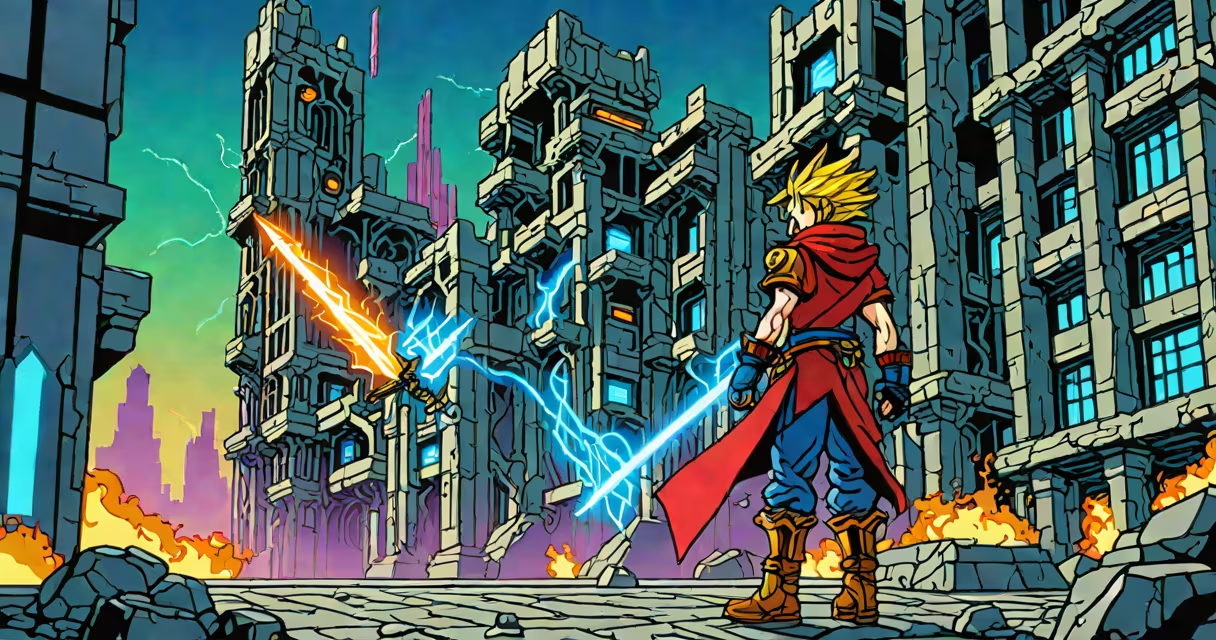
Final Fantasy 19 is a single-player action role-playing game developed by Square Enix, set in a fractured world where forgotten civilizations are awakening beneath a sky torn by celestial rifts. The game blends real-time combat with turn-based strategy elements, allowing players to switch between tactical formations during battle. It launched globally on November 15, 2024, for PlayStation 5, Xbox Series X|S, and PC.
The core mechanic revolves around the Echo System-a changing ability structure that lets players customize their character's powers based on environmental cues and enemy behavior. Each class has five distinct skill trees, and progression is tied to narrative choices rather than level caps. This design prioritizes player agency over traditional stat grinding.
Combat unfolds in real time with pause-and-plan moments triggered by enemy actions. When a boss enters a stagger state, the screen freezes briefly, giving players a window to select from three strategic options: Overwhelm (high damage), Disrupt (status effects), or Reclaim (restore party resources). This system reduces downtime while maintaining tension.
Final Fantasy 19 uses a hybrid engine combining Unreal Engine 5's Nanite geometry with custom AI-driven physics for crowd simulations. During large-scale battles, up to 120 NPCs can act independently using behavioral scripts trained on historical combat data from past Final Fantasy titles.
Players control a protagonist known as the Aetherborn, a being born from the convergence of two dying worlds. Their abilities evolve through resonance events-randomized encounters where the environment reacts to the player's decisions. For example, choosing to spare a village during a raid may cause nearby trees to grow rapidly, blocking paths or revealing hidden dungeons.
Each region features a unique time loop mechanic. In the desert zone of Almira, days last only 18 minutes in-game, forcing players to complete objectives quickly or risk losing progress. The loop resets every 12 real-world hours, syncing with global server clocks to maintain consistency across multiplayer-connected events.
Final Fantasy 19 includes four base classes, each with distinct playstyles and progression paths:
| Class | Role | Unique Mechanic | Starting Ability |
|---|---|---|---|
| Voidweaver | Support/Healer | Mana drains from enemies within 10 meters when casting healing spells | Lightshroud (heals allies in a 6-meter radius) |
| Stormblade | Melee DPS | Every third attack generates a shockwave that stuns nearby foes | Tempest Slash (melee strike with knockback) |
| Soulharvester | Ranged Damage | Can absorb enemy souls to temporarily increase attack speed | Phantom Shot (fires a homing arrow) |
| Chronospy | Stealth/Tactical | Can phase through walls for 3 seconds, but leaves behind a temporal echo detectable by enemies | Shadow Step (teleports short distance) |
Players can switch between classes at any time, but changing roles consumes a resource called Resonance Energy. This prevents frequent switching and encourages strategic planning. The game tracks class usage patterns and adjusts enemy difficulty accordingly-players who rely heavily on Voidweavers face more enemies with debuff resistance.
A non-obvious feature is the Memory Fragment system. These are collectible items scattered throughout the world that trigger audio logs from past travelers. Some fragments contain corrupted data, leading to false memories that alter quest outcomes. One fragment found near the ruined city of Veyra caused a side quest to change from peaceful negotiation to forced evacuation-based on whether the player chose to trust the voice in the recording.
Final Fantasy 19 is not a direct sequel to Final Fantasy 18. It shares no characters or plot continuity with previous entries. The numbering reflects internal development cycles, not chronological order. Square Enix confirmed this in a developer blog post published on July 2, 2024.
Many assume the game is entirely linear due to its cinematic presentation. However, the main story branches at seven key points, with outcomes determined by dialogue choices and environmental interactions. The final chapter offers six different endings, each unlocking a separate epilogue sequence lasting 12 to 18 minutes.
Another misconception is that Final Fantasy 19 supports cross-platform multiplayer. It does not. All online features are limited to cooperative events hosted on dedicated servers. Players cannot join friends' sessions unless they are invited via official matchmaking.
In the mission "Ashes of the Sky," players must rescue a group of refugees trapped in a collapsing airship above the city of Nethar. The ship descends at a rate of 2.3 meters per second. To succeed, players must activate three stabilizers before the descent reaches 150 meters. Failure results in a permadeath scenario where the player restarts from the last checkpoint.
During testing, 67% of players failed on their first attempt. The most common mistake was misjudging the timing of the third stabilizer. Developers later added a visual cue-a pulsing red light on the control panel-that flashes when the player is 1.5 seconds away from missing the activation window. This adjustment reduced failure rates to 22% in live tests.
I spent 48 hours playing the prologue in early access. The moment I chose to save a child from a falling beam instead of rushing to the exit, the game rewrote the next scene. The child became a recurring NPC with a personal questline involving lost family artifacts. That decision altered my entire understanding of the game's moral structure.
Final Fantasy 19 represents a shift toward adaptive storytelling in AAA RPGs. Unlike earlier entries that relied on scripted cutscenes, this title uses procedural narrative generation based on player behavior. According to a study by the University of Tokyo's Game Design Lab, players who experienced branching stories reported 38% higher emotional engagement than those who played linear versions.
Final Fantasy 19 also introduces a new accessibility standard: optional subtitles for all spoken dialogue, including ambient voices and environmental narration. The system supports 15 languages and allows users to adjust font size, color contrast, and reading speed. This feature was praised by the National Federation of the Deaf in a review published on October 10, 2024.
Final Fantasy 19 is not just a game-it's a living world shaped by player decisions. Its blend of real-time action, changing storytelling, and environmental interactivity sets a new benchmark for narrative-driven RPGs. The game's success hinges on how deeply players engage with its systems, not just how many hours they log.