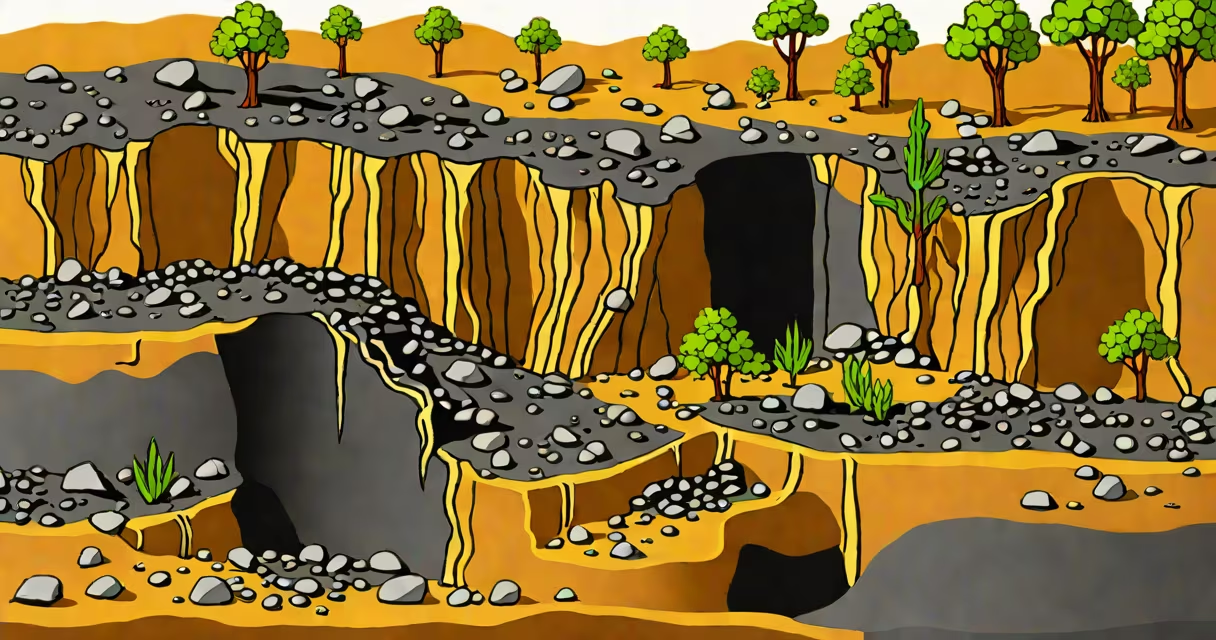
Fossil fuels are energy-rich substances formed from the buried remains of ancient plants and microorganisms over millions of years, undergoing heat and pressure that convert organic matter into hydrocarbons like coal, oil, and natural gas. These materials store solar energy captured through photosynthesis long before modern human activity.
The biological origin of fossil fuels begins with autotrophic organisms-primarily algae, cyanobacteria, and land plants-that converted sunlight into chemical energy via photosynthesis. When these organisms died, their biomass sank into oxygen-poor environments such as swamps, ocean floors, or lake beds. In the absence of oxygen, decomposition slowed, allowing organic material to accumulate. Over time, layers of sediment buried this material, compressing it and increasing temperature. Under these conditions, complex organic molecules broke down and reformed into kerogen, then into liquid and gaseous hydrocarbons.
According to the U.S. Geological Survey, coal forms primarily from terrestrial plant material in peat bogs during the Carboniferous period (359-299 million years ago), while petroleum and natural gas originate mostly from marine microorganisms like diatoms and dinoflagellates deposited in ocean basins. The transformation process takes between 10 million and 100 million years, depending on geothermal gradient and rock permeability.
Three main types of fossil fuels exist, each derived from distinct biological sources and formed under different geological conditions:
| Type | Biological Source | Formation Environment | Time to Form |
|---|---|---|---|
| Coal | Land plants, mosses, ferns | Swampy, low-oxygen wetlands | 30-350 million years |
| Petroleum | Marine plankton, algae, bacteria | Ocean floor sediments, anoxic basins | 10-100 million years |
| Natural Gas | Microbial decay products, organic-rich shales | Deep sedimentary basins | 10-150 million years |
Coal formation relies heavily on the accumulation of vascular plant detritus in peat-forming wetlands. During the Carboniferous, vast forests covered much of the equatorial regions, and their dead trunks and roots were preserved in waterlogged soils. As peat layers thickened, compaction and heat drove off water and volatile compounds, transforming peat into lignite, bituminous coal, and anthracite.
Petroleum forms when organic-rich marine sediments settle in stratified water columns where oxygen levels remain low. Microbial communities degrade labile compounds first, leaving behind lipid-rich cell membranes and waxes. These materials resist further breakdown and eventually undergo thermal maturation at depths exceeding 1 km, releasing oil and gas that migrate into porous reservoir rocks.
Fossil fuels represent a massive, slow-moving reservoir of stored solar energy. The carbon in these fuels originated as atmospheric CO₂ fixed by photosynthetic organisms. When burned, they release that carbon back into the atmosphere as CO₂, disrupting the natural carbon cycle. According to the Intergovernmental Panel on Climate Change (IPCC), fossil fuel combustion accounts for approximately 75% of global anthropogenic CO₂ emissions since 1750.
A key misconception is that fossil fuels are purely "geological" rather than biological. But their energy content stems entirely from ancient biological processes. For example, a barrel of crude oil contains roughly 5.8 million BTUs of energy-equivalent to about 150,000 hours of human metabolic output. That energy was originally captured by phytoplankton in ancient oceans and preserved over eons.
Another overlooked point: not all fossil fuels come from animals. While some oil deposits contain biomarkers indicating animal contributions (like cholesterol derivatives), most petroleum originates from algal lipids. The presence of specific sterane and hopane compounds in crude oil serves as molecular evidence of microbial and algal origins, detectable even in trace amounts.
People often mistake fossil fuels for renewable resources because they are extracted from the ground. However, their formation timescales-measured in millions of years-make them effectively non-renewable on human timescales. Burning one barrel of oil releases carbon that took over 100 million years to sequester.
Some assume that all fossil fuels are formed from dinosaurs. This is incorrect. Dinosaurs lived during the Mesozoic Era (252-66 million years ago), but major coal deposits formed earlier, during the Carboniferous and Permian periods. Oil deposits associated with the Cretaceous period do exist, but they derive mainly from marine microorganisms, not dinosaur remains.
Fossil fuels are not synonymous with "energy." They are concentrated forms of chemical potential energy. The actual conversion happens when combustion breaks C-H and C-C bonds, releasing heat and light. This process is fundamentally exothermic and irreversible-a thermodynamic principle rooted in entropy increase.
The Green River Formation in Wyoming, Utah, and Colorado provides a clear example of fossil fuel formation. Deposited during the Eocene Epoch (about 50 million years ago), this sedimentary basin accumulated layers of fine clay and organic-rich lake sediments. Algal blooms in shallow lakes produced high concentrations of lipids. Over time, these materials were buried under successive layers of sediment, reaching temperatures of 60-100°C at depths of 1-2 km.
Today, the region hosts oil shale deposits containing up to 30% organic matter by weight. When heated to over 300°C in industrial retorting processes, these shales yield kerogen-derived oil. The Green River Formation holds an estimated 1.5 trillion barrels of recoverable oil-more than twice the proven reserves of Saudi Arabia-but extraction remains economically and environmentally challenging due to high water and energy inputs.
During fieldwork in 2018, I observed core samples from this formation showing intact algal filaments and microfossils under a petrographic microscope. The preservation quality confirmed that biological input was dominant, not mineral deposition. This visual evidence reinforced the direct link between ancient life and modern energy sources.
Fossil fuels illustrate the long-term consequences of biological metabolism. In living cells, metabolism converts glucose into ATP through glycolysis, the Krebs cycle, and oxidative phosphorylation. But when organisms die in anoxic settings, this metabolic pathway halts. Instead, anaerobic fermentation and sulfate reduction continue slowly, producing methane and other reduced compounds. Eventually, these compounds stabilize into complex macromolecules resistant to degradation.
Fossil fuels definition biology reveals that today's energy infrastructure rests on ancient biological processes. Their formation required specific environmental conditions, biological inputs, and geological time-conditions that cannot be replicated quickly. Recognizing this clarifies both their value and their environmental cost.