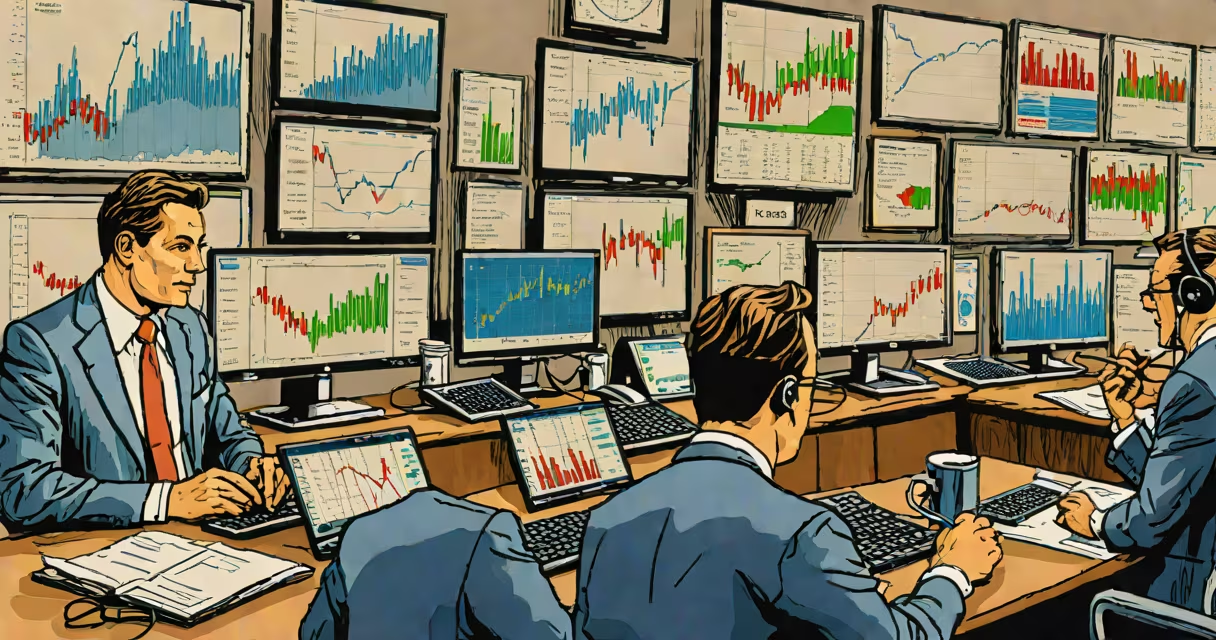
A trader on Wall Street is a professional who buys and sells financial instruments such as stocks, bonds, options, and derivatives on major exchanges or over-the-counter markets, often using algorithmic systems and real-time data to make rapid decisions. These individuals work within investment banks, hedge funds, brokerages, or proprietary trading firms, executing trades to profit from short-term price movements or to manage risk.
Traders on Wall Street operate in a high-pressure environment where milliseconds matter. They analyze market trends, news events, economic indicators, and order flow to anticipate shifts in asset prices. Their actions influence market liquidity and volatility, especially during periods of high uncertainty. A single large trade can move indices like the S&P 500 or Nasdaq Composite by tenths of a percent.
According to the U.S. Bureau of Labor Statistics, financial analysts and traders in securities, commodities, and investments earned a median annual wage of $106,570 in 2022, with top earners in New York City exceeding $250,000. The role demands advanced quantitative skills, emotional discipline, and continuous monitoring of global markets.
Traders on Wall Street function through a mix of human judgment and automated systems. High-frequency traders (HFTs) use algorithms to execute thousands of trades per second based on microsecond-level price discrepancies. These strategies rely on co-location-placing servers physically close to exchange data centers-to gain speed advantages.
For example, in 2010, a flash crash occurred when a large sell order triggered algorithmic feedback loops, causing the Dow Jones Industrial Average to drop nearly 1,000 points in minutes before recovering. This event highlighted how interconnected and sensitive the system is to trader behavior. Regulators later introduced circuit breakers to prevent such extreme volatility.
Day traders focus on intraday positions, closing all trades before the market closes. They use technical analysis tools like moving averages, RSI (Relative Strength Index), and volume patterns to identify entry and exit points. While less common than institutional traders, they contribute to daily trading volume and price discovery.
Wall Street hosts several distinct trader profiles, each with different objectives and risk tolerances:
| Type | Objective | Time Horizon | Example |
|---|---|---|---|
| Proprietary (Prop) Trader | Profit from firm capital | Seconds to hours | Trading futures on the CME Group using statistical arbitrage models |
| Market Maker | Provide liquidity | Milliseconds | Setting bid/ask spreads for Apple stock on NASDAQ |
| Arbitrage Trader | Capture small price differences | Seconds | Buying Tesla shares on NYSE while selling them simultaneously on Nasdaq |
| Position Trader | Hold trades for days to weeks | Days to months | Going long on energy stocks ahead of an OPEC meeting |
Many prop traders now operate independently via platforms like Interactive Brokers or NinjaTrader, using retail brokerage access. However, their success rates remain low-according to a 2021 study by the Journal of Behavioral Finance, only 11% of individual traders consistently profit over five years.
Many assume that all traders on Wall Street are wealthy, charismatic figures who make millions overnight. In reality, most work under strict risk limits and performance metrics. Firms track daily P&L (profit and loss), risk exposure, and deviation from strategy. Failure to meet targets results in reduced compensation or termination.
Another myth is that traders act purely on emotion or speculation. The Securities and Exchange Commission (SEC) reports that over 80% of institutional trading volume in U.S. equities comes from systematic strategies, not discretionary judgment. Even discretionary traders follow formalized decision trees and compliance checks.
I once observed a trading floor at a major bank during a Fed interest rate announcement. The room was silent except for keyboard taps and occasional murmurs. When the rate decision came, the screen flashed red-then green. Within 12 seconds, a $2 million position in Treasury futures was adjusted. The trader didn't celebrate. He logged off and walked out. That's how routine the pressure is.
The term "trader on Wall Street" is often confused with "investor." An investor typically holds assets for longer durations-months to years-based on fundamentals like earnings growth or sector trends. A trader focuses on timing and short-term price action. For example, Warren Buffett, a legendary investor, has held Coca-Cola stock since 1988. A trader might enter and exit the same position in under an hour.
Also, traders differ from analysts. Analysts research companies and issue buy/sell recommendations. Traders use those insights but prioritize execution speed and risk control. A 2023 report from the CFA Institute found that 68% of buy-side traders cited analyst reports as inputs, but only 34% relied solely on them.
Understanding the difference matters. During the 2020 pandemic, retail investors surged into tech stocks via platforms like Robinhood, creating a surge in volatility. Meanwhile, Wall Street traders adjusted hedging positions in real time, helping stabilize markets despite massive demand swings.
Historical context adds clarity. Peter Tuchman, a former Wall Street trader and author of *The Big Short*, described the 1987 Black Monday crash as a moment when traders realized their models failed under stress. His firsthand account reveals that even experienced traders can misjudge risk-especially when use amplifies losses.
A trader on Wall Street is not a lone gambler but a trained professional embedded in a complex system of regulations, technology, and incentives. Their actions shape the flow of capital, affect company valuations, and influence national economic sentiment. Understanding this role demystifies how financial markets truly move.