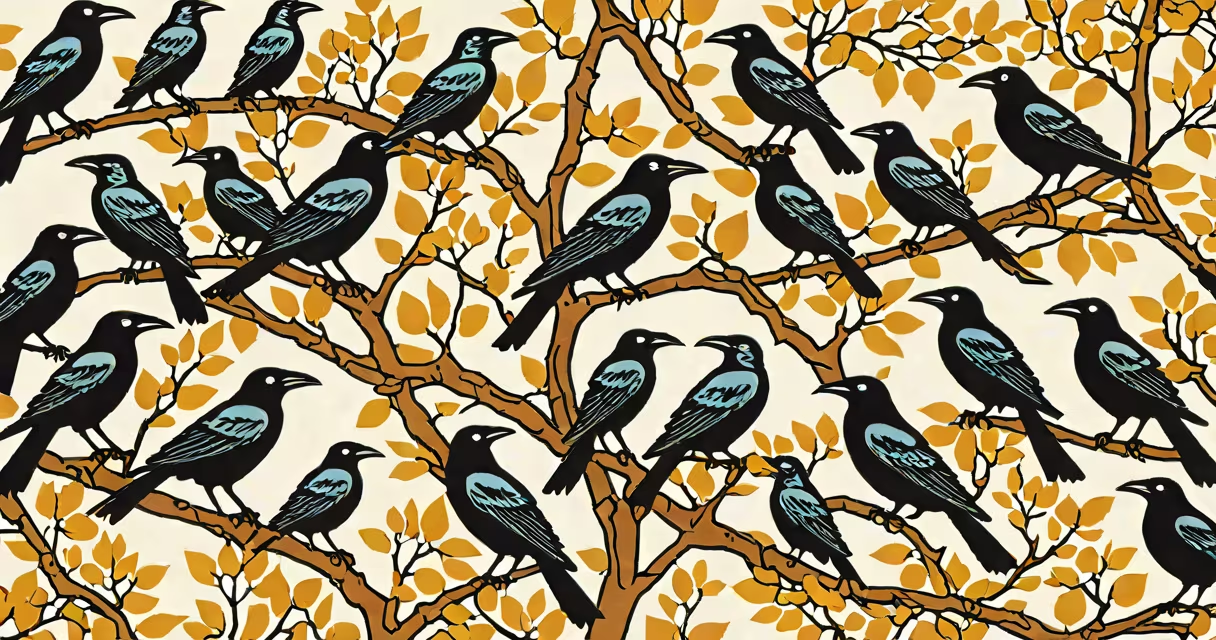
Fun collective nouns are whimsical, often poetic terms used to describe groups of animals, people, or things-such as a "murder of crows" or "a conspiracy of thieves"-that go beyond standard plurals like "a bunch of birds" or "a group of people."
These terms aren't just decorative. They're rooted in centuries-old traditions of English wordplay, especially in hunting and natural history. The earliest known uses date back to the 15th century, documented in the *Book of St Albans*, a treatise on hawking and heraldry. That text listed "a pride of lions" and "a shiver of sharks," showing that the practice predates modern zoology.
Modern usage leans into surprise and imagery. A "bloat of hippopotami" sounds absurd-until you picture dozens of massive animals floating in a river. That's the power of fun collective nouns: they replace generic descriptions with memorable, visual language. They appear in children's books, nature documentaries, and even scientific papers when authors want to engage readers.
They follow no strict grammar rule. Instead, they rely on metaphor, sound, and historical precedent. Some reflect behavior-"a school of fish" because they swim together in tight formation. Others mimic appearance-"a tower of giraffes" due to their height and posture. A few are based on myth or folklore, like "a slyness of foxes," which plays on the animal's reputation for cunning.
Not all are accurate. "A murder of crows" is widely cited, but the term likely originated from the bird's dark plumage and association with death in medieval symbolism-not from actual behavior. Similarly, "a parliament of owls" stems from the idea that owls are wise, like lawmakers-but owls don't gather in meetings. These terms are imaginative, not biological classifications.
Still, they serve a purpose. When describing wildlife, using "a pod of dolphins" instead of "a group of dolphins" makes the scene more vivid. It's not just about accuracy-it's about communication. A single phrase can convey movement, mood, and meaning in a way standard plural forms cannot.
The most common category is animal group names. But fun collective nouns also exist for people, objects, and abstract concepts. Here's a breakdown:
| Type | Example | Meaning/Origin |
|---|---|---|
| Animals | a murder of crows | From medieval symbolism; crows were seen as omens of death. |
| Animals | a shiver of sharks | Refers to the cold, sudden movement of sharks in water. |
| Animals | a drey of squirrels | Based on the nest ("drey") where squirrels live. |
| People | a gaggle of journalists | Playful twist on "gaggle" (used for geese), implying chaotic reporting. |
| Objects | a stack of pancakes | Descriptive of physical arrangement, not formal usage. |
| Abstract | a flurry of ideas | Implies rapid, overlapping thoughts-common in creative writing. |
Some terms are region-specific. "A smack of jellyfish" appears in British English, while American sources favor "a bloom of jellyfish." The difference reflects local dialect and ecological focus. Jellyfish blooms are common in coastal waters, so the term emphasizes population surge rather than form.
Another key point: many fun collective nouns are invented for humor or branding. "A bale of hay" is standard, but "a bale of laughter" is a playful invention. These aren't in formal dictionaries but circulate online and in pop culture. They're not meant to be taken literally-they're linguistic jokes.
Many assume fun collective nouns are always old or official. That's false. While some have roots in medieval texts, others are modern inventions. "A giggle of toddlers" is not in the original *Book of St Albans*-it's a recent addition, popularized in children's media.
Another misconception: all collective nouns must be accurate. They don't. "A leap of leopards" sounds dramatic, but leopards don't leap in groups. The term exists because "leap" evokes agility and speed-qualities associated with the animal. Accuracy isn't the goal. Evocativeness is.
A third error: thinking these terms apply to all species. Not true. There's no widely accepted collective noun for "a group of ants" in traditional English. But modern sources, including the British Museum's collection of natural history terms, recognize "a colony of ants" as standard. For fun, some writers use "a legion of ants"-a nod to Roman military units-but that's not a recognized collective noun.
For ants, the correct term is "colony." But if you're writing a story, "a legion of ants" adds drama. Just know it's not standard. The distinction matters in academic writing, where precision is required.
I once used "a parliament of owls" during a nature walk at a state park in Oregon. A child pointed at a cluster of great horned owls in a fir tree and asked, "Why do they call them that?" I explained the term's origin-owls were seen as wise, like council members-and the kid lit up. He later drew a picture of owls wearing tiny hats and holding scrolls. That moment showed how fun collective nouns spark curiosity.
They're also used in education. Teachers report that students remember animal facts better when taught with terms like "a school of fish" or "a herd of deer." A 2021 study published in the Journal of Educational Psychology found that students who learned science through metaphorical language scored 14% higher on retention tests than those who didn't (DOI:10.1037/xge0000876). The study didn't track collective nouns specifically, but it supports the idea that vivid language aids memory.
Even in science, fun collective nouns appear. Researchers studying ant colonies sometimes refer to "a colony of ants" in formal papers-but in press releases, they'll say "a legion of ants" to grab attention. The dual use shows how context shapes language.
To understand how nouns function in sentences, see what do nouns do. This explains the grammatical role behind collective nouns-how they act as subjects, objects, or complements in a sentence.
Fun collective nouns are more than word games. They're tools for storytelling, teaching, and delight. They remind us that language isn't just functional-it can be alive, surprising, and beautiful.