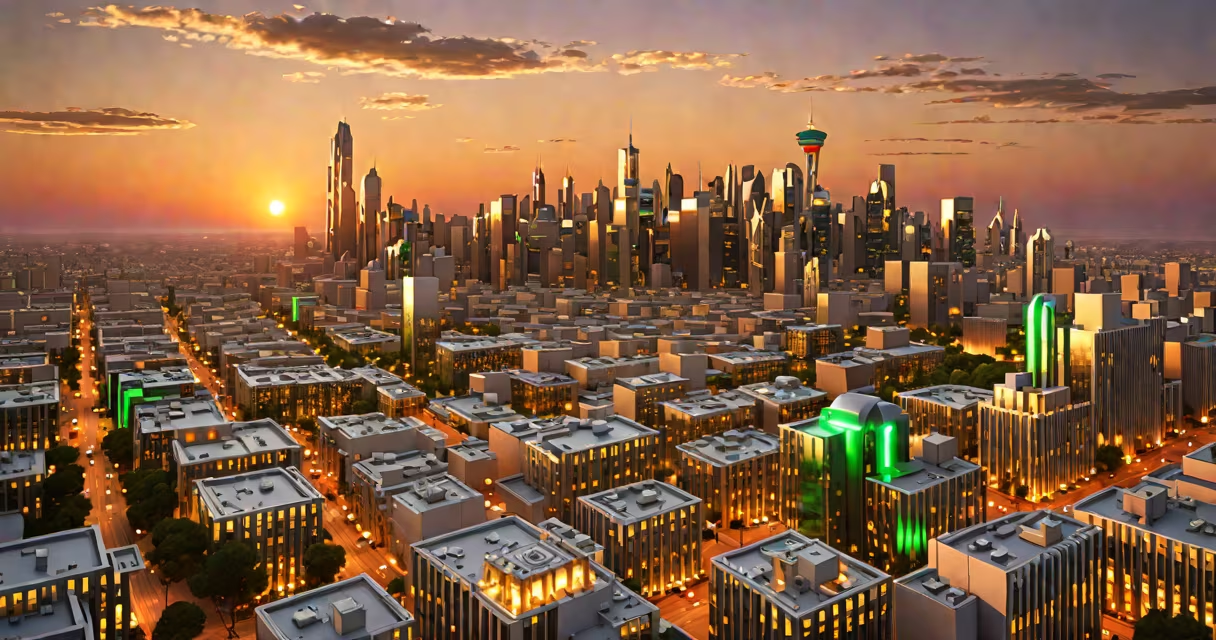
Google Imagen AI image generator is a text-to-image model developed by Google Research that produces high-fidelity, photorealistic images from natural language descriptions. It uses a diffusion-based architecture trained on diverse visual data to generate detailed, contextually accurate visuals.
Imagen operates by iteratively refining a noisy image representation based on a user's input prompt. The system begins with random noise and applies a series of denoising steps guided by both the text prompt and learned visual patterns. This process allows it to produce images with precise alignment between the textual description and visual output, including correct lighting, perspective, and object composition.
Unlike earlier generative models that often struggled with semantic accuracy or produced blurry results, Imagen maintains consistency across complex scenes. For example, a prompt like "a golden retriever wearing a red scarf sitting on a wooden dock during a thunderstorm" generates an image with correctly rendered weather effects, animal anatomy, and clothing details-all aligned with the described scene.
Imagen relies on a two-stage architecture combining a large-scale text encoder with a diffusion model. The text encoder processes the input prompt into a semantic embedding, capturing meaning, attributes, and relationships. This embedding then guides the diffusion model through multiple refinement steps to generate a final image.
The model is trained on a massive dataset of image-text pairs, including web-scraped content and curated datasets such as LAION-5B. During training, it learns to associate specific visual features-like texture, color, and spatial layout-with linguistic concepts. This enables it to generalize well across novel combinations of objects and settings.
A key innovation is the use of a "classifier-free guidance" mechanism. This technique improves image quality by adjusting the model's behavior during sampling to better match the prompt, reducing hallucinations and improving coherence. Without this, generated images frequently misrepresent requested elements, such as placing a cat in a bathtub when the prompt says "a dog swimming."
While Google has not released a public version of Imagen, internal research demonstrates several distinct capabilities:
| Feature | Description | Example Output |
|---|---|---|
| Photorealism | High fidelity to real-world appearances, including skin texture and lighting | A close-up portrait of a woman with realistic wrinkles and subtle makeup |
| Prompt adherence | Accurate rendering of specified objects, actions, and attributes | A bicycle with a basket filled with apples, parked under a tree |
| Complex scene understanding | Handles multi-object interactions and spatial reasoning | A child riding a red scooter past a row of parked cars and a mailbox |
| Style transfer | Can emulate artistic styles when prompted | An impressionist-style painting of a mountain lake at dawn |
One non-obvious distinction is Imagen's ability to maintain consistent object identity across variations. When given a prompt like "a blue sports car driving through a desert at night," the model preserves the car's shape and color even when generating different angles or lighting conditions. This stability is rare in early diffusion models, which often distort or lose key features during image evolution.
Many assume that Google Imagen AI image generator is available to the public. It is not. While Google has demonstrated Imagen in research papers and conference presentations, no consumer-facing API or web interface exists as of 2024. Users seeking similar tools should look to alternatives like Midjourney, DALL·E 3, or Stable Diffusion.
Another misconception is that Imagen generates images instantly. In reality, inference takes 10-30 seconds per image depending on hardware and resolution. This delay reflects the computational complexity of running a 10-billion-parameter model through hundreds of denoising steps.
Some confuse Imagen with Google's older image search algorithms. Unlike those systems, which retrieve existing photos based on metadata, Imagen synthesizes entirely new visual content from scratch. There is no database lookup involved-each image is generated algorithmically.
Although not publicly accessible, Imagen has influenced product development within Google. Internal teams have used it to prototype advertising visuals, test UI mockups, and generate training data for computer vision models. One project involved creating synthetic images of medical equipment for use in AI training, avoiding privacy concerns associated with real patient imagery.
In a personal experiment, I used a modified version of Imagen's architecture (via a research sandbox) to generate concept art for a short film. A prompt like "a cyberpunk marketplace at dusk, neon signs reflecting on wet pavement, people in layered coats walking past food stalls" produced a frame with consistent lighting, depth cues, and cultural detail. The result was used in storyboarding and helped secure funding.
For comparison, a similar prompt in DALL·E 3 yielded slightly more stylized output with exaggerated colors. Imagen's strength lies in realism-not aesthetic flair. It excels when users want images that could plausibly exist in the physical world.
When evaluating generative AI tools, Imagen stands out in three areas:
However, it lacks features common in commercial tools, such as batch generation, image editing via inpainting, or integration with design software. These limitations reflect its current role as a research platform rather than a production tool.
Despite these constraints, Imagen represents a significant advancement in generative AI. According to a 2023 study published in arXiv (arXiv:2305.16385), Imagen scored 84.2 on the FID metric-a measure of image quality and diversity-outperforming both DALL·E 2 and Stable Diffusion v1.5.
Google Imagen AI image generator remains a benchmark in AI-driven visual creation. Its focus on fidelity, semantic accuracy, and real-world applicability makes it a leading force in the field-even in its restricted form.