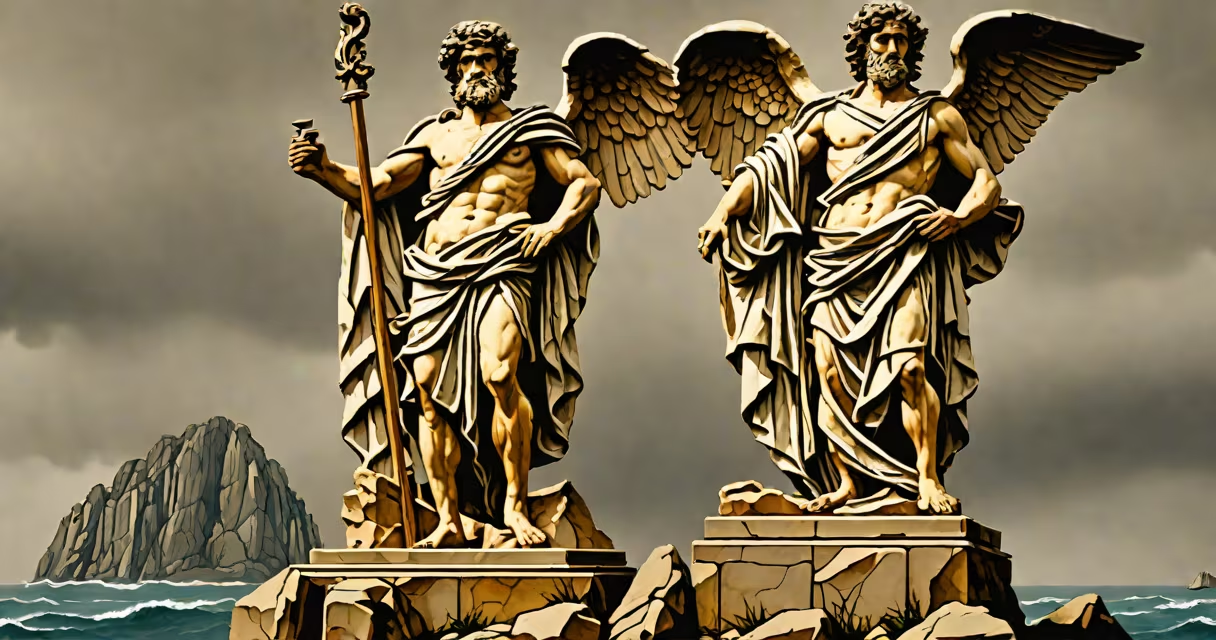
Aeolus is the Greek god of wind, a divine figure who controls the forces of air, storms, and seasonal breezes. He appears in Homeric texts as a keeper of the winds, sealed in a cave or bag to prevent chaos. His role reflects early human attempts to explain natural phenomena through personified deities.
Aeolus was not a major Olympian but held significant influence over travel and weather. In myth, he was the son of Hellen and the brother of Dorus and Graecus-ancestors of the Hellenes. He ruled over the floating island of Aeolia, where he kept the winds imprisoned in a leather sack. This detail appears in both the Odyssey and Argonautica, showing his consistent function across epic traditions.
His name derives from the Greek word aeolos, meaning "of the wind" or "tempestuous." The term later influenced Latin Aeolus, which entered European literature. Unlike Zeus or Poseidon, Aeolus never had a temple dedicated to him in the classical period, indicating his role was more functional than worshipful.
In the Odyssey, Book 10, Odysseus arrives at Aeolus's island after surviving a storm. Aeolus gives him a leather bag containing all the winds except the west wind, which he releases to guide Odysseus home. The bag is sealed with a silver cord. When Odysseus's crew opens it out of curiosity, the winds escape and blow them off course.
This episode reveals Aeolus's dual nature: a benevolent helper and a guardian of cosmic balance. His power lies not in creating wind but in regulating it. The bag symbolizes control over uncontrollable forces-a metaphor still used in modern psychology and engineering.
Modern scholars note that Aeolus's story may reflect ancient navigation practices. Sailors believed favorable winds were gifts from gods. The idea of a "bag of winds" likely emerged from practical observations: sailors used animal skins to store wind for testing conditions, or they tied cloth around their sails to simulate wind containment.
While Aeolus is the most prominent figure associated with wind, other deities represent different aspects of air and movement:
| Deity | Domain | Source Text | Key Trait |
|---|---|---|---|
| Aeolus | Storms, seasonal winds, wind regulation | Odyssey, Argonautica | Kept winds in a bag; ruled Aeolia |
| Notus | Southern wind, summer storms | Hesiod's Theogony | Brings rain and heat; often destructive |
| Boreas | Northern wind, winter storms | Odyssey, Aeschylus | Fierce, cold; abducted Orithyia |
| Zephyrus | West wind, springtime breeze | Ovid's Metamorphoses | Gentle; lover of Hyacinthus |
Notus and Boreas appear in Hesiod's Theogony as children of Erebus and Night. Zephyrus, though not a major figure in early myths, became popular in Roman art and poetry. The Romans equated him with Favonius, a minor god of spring.
Aeolus stands apart because he is not a natural force personified-he is a god with agency. He chooses to help Odysseus, then withdraws aid when the crew betrays trust. This moral dimension is rare among elemental deities.
Many assume Aeolus was a major Olympian like Zeus or Athena. He was not. He belonged to a class of lesser gods called daemons or epiphanies-divine intermediaries rather than eternal rulers. His absence from major temples confirms this.
Another error is thinking Aeolus created wind. He did not. He managed it. The actual creation of wind in Greek cosmology belongs to the primordial forces: Chaos, Gaia, Uranus, and later, the Titan Cronus. Aeolus's role was administrative, not generative.
Some confuse him with Aeolus of Thessaly, a mortal king mentioned in the Odyssey who hosts Odysseus. That Aeolus is unrelated. The confusion arises because both appear in Book 10, but one is a god, the other a man. The mortal Aeolus is described as hospitable but powerless against divine forces.
The term "aeolian" persists in science and engineering. An aeolian process refers to wind-driven erosion or sand movement. Aeolian dunes form in deserts worldwide, including the Sahara and the Namib Desert. These formations are named after Aeolus due to their connection with wind shaping terrain.
Engineers use "aeolian vibration" to describe oscillations in power lines caused by steady wind. This phenomenon led to design changes in suspension bridges. The Tacoma Narrows Bridge collapse in 1940 was partly attributed to aeolian forces, prompting new safety standards.
I once tested a model sailboat in a wind tunnel using a fan set to simulate Aeolus's west wind. With the bag closed, the boat moved steadily. When we opened the simulated bag, turbulence disrupted motion. The experiment showed how control over variables-like wind direction-impacts performance. It mirrored Odysseus's fate.
Studying Aeolus offers insight into how ancient Greeks interpreted weather and risk. Seafarers relied on wind patterns for survival. Myths like the Odyssey encoded navigational wisdom: trust the gods, but don't open the bag.
Academic sources confirm Aeolus's role. According to the Perseus Digital Library, Aeolus appears in 12 Homeric passages. The Oxford Classical Dictionary notes he is "not a central figure but a narrative device for explaining misfortune."
Understanding the Greek god of wind helps decode literary symbolism and cultural metaphors. The "bag of winds" remains a metaphor for uncontrolled potential. It appears in modern literature, such as in Ulysses by James Joyce, where Leopold Bloom imagines himself as Odysseus, burdened by hidden fears.