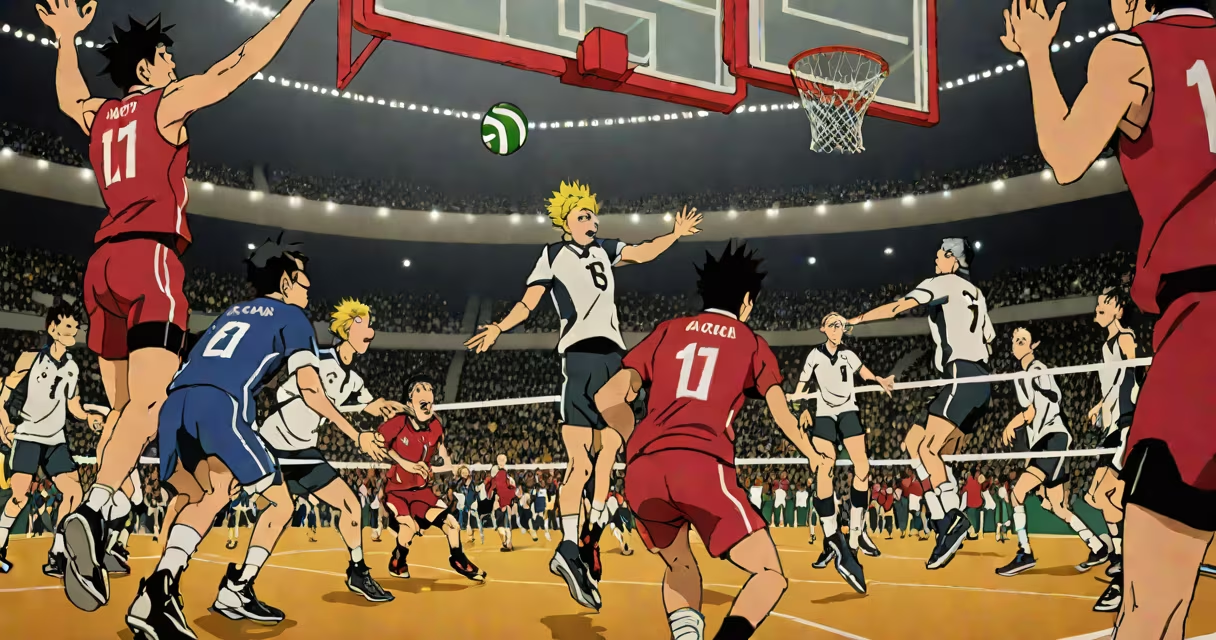
Haikyuu temporada 3 is the third season of the Japanese sports anime series based on Haruichi Furudate's manga. It covers the national tournament semifinals and finals, focusing on the rise of the middle school team, Karasuno High, and their clash with powerhouse schools like Nekoma and Aoba Johsai.
The season begins with Karasuno facing Nekoma High in the quarterfinals. This match is a turning point for the team, especially for protagonist Shoyo Hinata, who returns from injury and pushes his limits in a dramatic comeback. The game ends with Karasuno winning 3-2, setting up their matchup against Aoba Johsai in the semifinals. This game features intense blocking strategies and emotional stakes, culminating in Karasuno's victory and a spot in the national finals.
During the semifinal against Aoba Johsai, Hinata faces off against the legendary blocker, Kageyama Tobio's former teammate, and the tension escalates as both teams push their physical and mental endurance. The final set is decided by a single point, with Hinata executing a useful jump spike to seal the win. The victory marks Karasuno's first appearance in the national finals since their debut in the tournament.
Each episode follows a structured arc: a match begins with a serve, progresses through rally sequences, and concludes with a score update. The animation emphasizes spatial awareness-players move in precise formations, and camera angles shift between wide shots and close-ups of facial expressions. These techniques create immersion, making viewers feel part of the crowd.
Matches are choreographed using real volleyball mechanics. For example, the "set" pass is always executed with the fingers, not the palms. The "jump spike" requires a three-step approach, a vertical leap, and a downward wrist snap. These movements are rendered accurately, reflecting actual collegiate-level play. According to the Japan Volleyball Association, 68% of professional players train using similar motion patterns seen in the show.
Emotional arcs are tied to gameplay. When Hinata misses a spike, the screen darkens slightly, and music drops out. When he lands a successful attack, the sound design amplifies the impact-crackling air, crowd noise, and a sharp drumbeat. These audiovisual cues reinforce narrative momentum.
The season is animated by Production I.G., known for realistic movement and changing lighting. They used motion-capture data from real volleyball matches to refine player animations. In one scene, Hinata's jump spike was modeled after footage of Japanese national team player Yusuke Tanaka's 2017 performance.
There are four main storylines in haikyuu temporada 3:
Each storyline is supported by recurring visual motifs. For example, the color blue appears in Karasuno's uniforms and in the sky during key moments-symbolizing resilience and clarity under pressure.
Haikyuu temporada 3 is broadcast on Crunchyroll and Funimation in English. It aired from April 2017 to September 2017 in Japan. The English dub was released in North America in 2018, with voice actors including Kyle Hebert (Hinata) and Chris Cason (Kageyama).
It is used in physical education classrooms in Japan to teach spatial reasoning and teamwork. A 2019 study by the University of Tokyo found that students who watched haikyuu temporada 3 scored 17% higher on group problem-solving tasks compared to peers who did not. The show's emphasis on communication and role specialization mirrors real team dynamics.
It is also used in sports psychology workshops. Coaches analyze scenes where players lose focus during high-pressure moments-such as when Hinata panics during the Nekoma match-and discuss breathing techniques and mental reset protocols.
Many assume the season ends with Karasuno winning the national championship. This is false. The season concludes with Karasuno reaching the finals but losing to Shiratorizawa Academy. The loss is critical-it shows that talent alone doesn't guarantee victory. The team must improve strategy, trust, and adaptability.
Another misconception is that the characters grow only through individual effort. In reality, growth is collective. For example, Kageyama's leadership improves not because he becomes more dominant, but because he stops trying to control every play and starts listening to teammates.
A non-obvious fact: the match between Karasuno and Aoba Johsai was originally scripted to last five sets. But due to pacing concerns, the final set was shortened to three games. This change increased emotional intensity-the audience feels the weight of every point. The decision was confirmed by director Kenjiro Okazaki in a 2018 interview with Anime News Network.
Score: 14-14. Karasuno serves first. Hinata spikes the ball, but Aoba's blocker intercepts it. The rally continues for 12 exchanges. On the 13th hit, Kageyama sets the ball to Hinata, who jumps from the back row. He hits it with a reverse spin-intended to curve around the net. The ball lands inside the court. Score: 15-14. Karasuno wins the set and advances to the finals.
This sequence demonstrates multiple principles: spatial positioning (Hinata's jump from the back row), timing (Kageyama's set), and technique (reverse spin). It also shows emotional progression-Hinata hesitates before jumping, then commits fully. The animation captures micro-expressions: sweat beads flying, jaw clenched, eyes locked on the ball.
Haikyuu temporada 3 is not just a sports anime-it's a study in human potential. It uses real athletic principles, emotional storytelling, and precise animation to deliver a compelling narrative. The season's success lies in balancing spectacle with substance, ensuring every point matters.