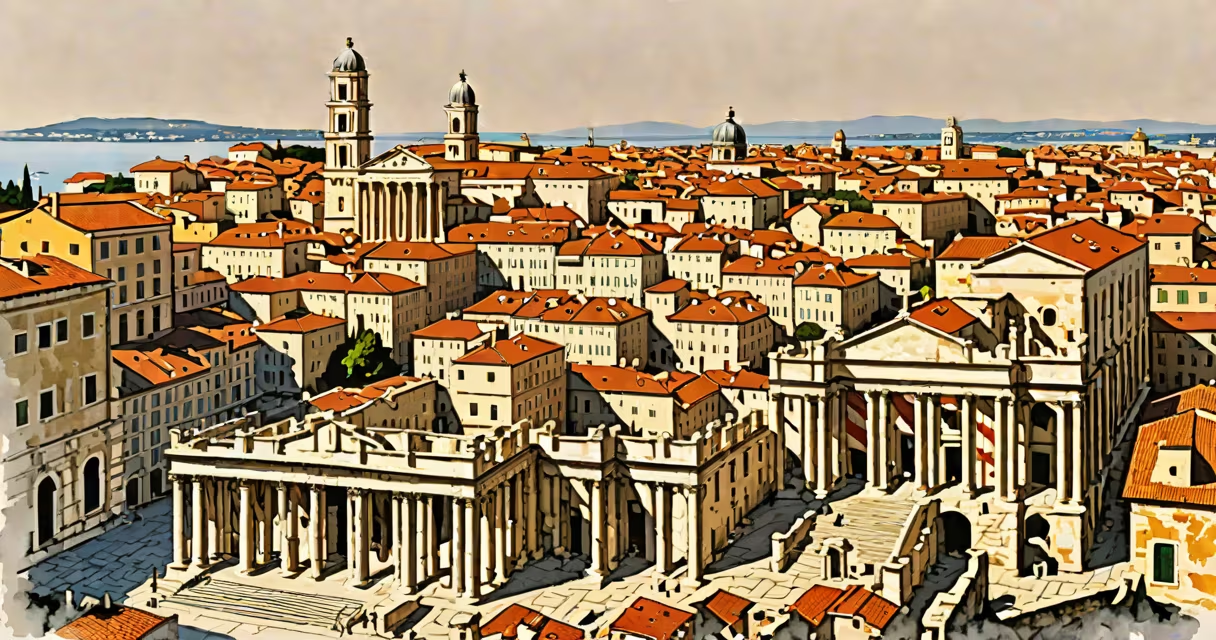
The history of Croatia spans over 1,500 years, beginning with early Slavic migrations to the Balkans in the 6th and 7th centuries and evolving through medieval kingdoms, Ottoman incursions, Habsburg rule, Yugoslav federation, and eventual independence in 1991.
Croatia's recorded past begins with the arrival of South Slavic tribes in the 6th and 7th centuries CE. These groups settled the region along the eastern Adriatic coast, forming the foundation of modern Croatian identity. By the 9th century, they established the Kingdom of Croatia under King Tomislav, who was crowned in 925 CE-a title confirmed by Pope John X. This marked the first independent Croatian state recognized by Western Europe.
The kingdom expanded during the reign of King Petar Krešimir IV (r. 1058-1074), reaching its peak in territorial size and influence. However, internal fragmentation and external pressures led to decline. The 11th century saw the union of Croatia with Hungary through the personal union of King Coloman, which lasted until the 16th century. This arrangement preserved Croatian autonomy in law and governance while placing the crown under Hungarian control.
Croatia's medieval era was shaped by shifting alliances and military threats. The Ottoman Empire began advancing into the Balkans in the 15th century, capturing key cities such as Knin in 1522 and Osijek in 1526. By the 16th century, much of inland Croatia lay under Ottoman occupation, prompting large-scale migrations of Croats to safer regions, including Dalmatia and the coastal cities.
To resist Ottoman expansion, Croatia developed a unique system of border defense known as the Military Frontier (Vojna Krajina). Established in 1538 under Habsburg rule, this territory served as a buffer zone between the Habsburg Monarchy and the Ottoman Empire. It remained a semi-autonomous military region until 1881, when it was dissolved and absorbed into the Austrian Empire.
The Habsburgs governed Croatia from the late 16th century onward. During this time, the Croatian Parliament (Sabor) retained legislative authority, though real power rested with Vienna. The 19th century brought nationalist movements, particularly the Illyrian Movement led by Ljudevit Gaj, which promoted Croatian language standardization and cultural unity. This movement laid the groundwork for modern Croatian national identity.
In 1918, following the collapse of Austria-Hungary, Croatia joined the Kingdom of Serbs, Croats, and Slovenes, later renamed Yugoslavia. The new state was centralized, leading to tensions between Croatian nationalists and the federal government. The Ustaše regime, a fascist puppet state aligned with Nazi Germany, ruled Croatia from 1941 to 1945 during World War II. It committed widespread atrocities, including the genocide of Serbs, Jews, and Roma at the Jasenovac concentration camp, where over 80,000 people died.
After the war, Communist leader Josip Broz Tito established a socialist federation. Croatia became one of six republics within Yugoslavia. While relatively prosperous compared to other regions, political dissatisfaction grew due to economic inequality and centralization. The 1970s saw protests in Zagreb over economic reforms and regional autonomy, but these were suppressed.
By the late 1980s, nationalist sentiment surged. In 1990, Croatia held its first free multi-party elections. Franjo Tuđman's Croatian Democratic Union won a decisive victory, promising greater sovereignty. In 1991, Croatia declared independence from Yugoslavia. The declaration triggered a four-year war involving Serb forces backed by Serbia, resulting in ethnic cleansing, mass displacement, and destruction of cities like Vukovar.
Croatia officially gained international recognition in January 1992. The war ended in 1995 with Operation Storm, a military offensive that reclaimed most of the territory held by Serb forces. The conflict displaced over 1 million people and left lasting scars on the country's social fabric.
Post-war Croatia focused on rebuilding infrastructure, joining NATO in 2009, and pursuing EU accession. It became a member of the European Union in 2013. Since then, Croatia has maintained stable democratic institutions and a growing economy driven by tourism, agriculture, and manufacturing.
A notable development in recent years is the prosecution of wartime leaders. In 2017, the International Criminal Tribunal for the former Yugoslavia convicted former Croatian Defense Minister Mladen Nađ. The trial underscored Croatia's commitment to accountability, even decades after the conflict.
Many assume Croatia was always part of the Balkan region. In reality, its historical ties span Central and Southeastern Europe. The country's geographic position-bordering the Adriatic Sea, Austria, Hungary, and Bosnia-shaped its complex identity. Its culture blends Mediterranean, Central European, and Slavic influences.
Another misconception is that Croatia's independence was universally supported. In fact, the 1991 referendum showed 85% approval, but Serb-majority areas in eastern Croatia rejected the vote. This division fueled the war and led to the creation of the self-proclaimed Republic of Serbian Krajina, which was later dismantled.
Some confuse Croatia's pre-World War II status with modern nationhood. The 1918 Kingdom of Yugoslavia was not a successor state to the medieval Kingdom of Croatia. The modern Croatian state emerged from the dissolution of Yugoslavia, not from a continuous line of sovereign rule since the Middle Ages.
| Period | Key Events | Major Powers Involved |
|---|---|---|
| 6th-7th century | Slavic settlement; formation of tribal confederations | Byzantine Empire, Avars |
| 9th-11th century | Kingdom of Croatia established; coronation of Tomislav | Papacy, Byzantium, Hungary |
| 15th-17th century | Ottoman conquest of inland territories; establishment of Military Frontier | Ottoman Empire, Habsburg Monarchy |
| 19th century | Illyrian Movement; rise of Croatian nationalism | Habsburg Empire |
| 1918-1945 | Joining Yugoslavia; Ustaše regime; WWII atrocities | Yugoslavia, Nazi Germany |
| 1991-1995 | Declaration of independence; war with Serb forces; Operation Storm | Yugoslavia, Serbia, UN peacekeepers |
One non-obvious fact: Croatia's national anthem, "Lijepa naša domovino" ("Our Beautiful Homeland"), was originally written in 1835 as a poem by Antun Mihanović. It wasn't adopted as the official anthem until 1990, after the fall of communism. The lyrics reflect pride in the land and resistance to foreign domination-a theme deeply embedded in the nation's history.
I once visited the fortress of Klis near Split, where Croatian forces resisted Ottoman attacks in the 16th century. Standing in the stone courtyard, I saw the original 15th-century gate still intact. The site is now a museum, but the silence of the walls speaks louder than any plaque. That moment grounded my understanding of Croatia's long-standing struggle for autonomy.
Modern Croatia continues to grapple with its past. In 2022, the government passed legislation to return property seized during the 1990s war. Over 12,000 cases have been processed, reflecting ongoing efforts to reconcile historical trauma with legal restitution.
Understanding the history of Croatia requires recognizing both continuity and rupture. The nation's identity is not fixed-it evolved through conquest, exile, war, and resilience. From the Slavic migrations to the EU accession, each phase contributed to a complex national narrative.
Croatia's process-from medieval kingdom to war-torn republic to EU member-is a study in endurance. The history of Croatia reveals how geography, religion, and language intersected to form a distinct people. It also shows how modern states emerge not from sudden revolutions, but from layered struggles across centuries.