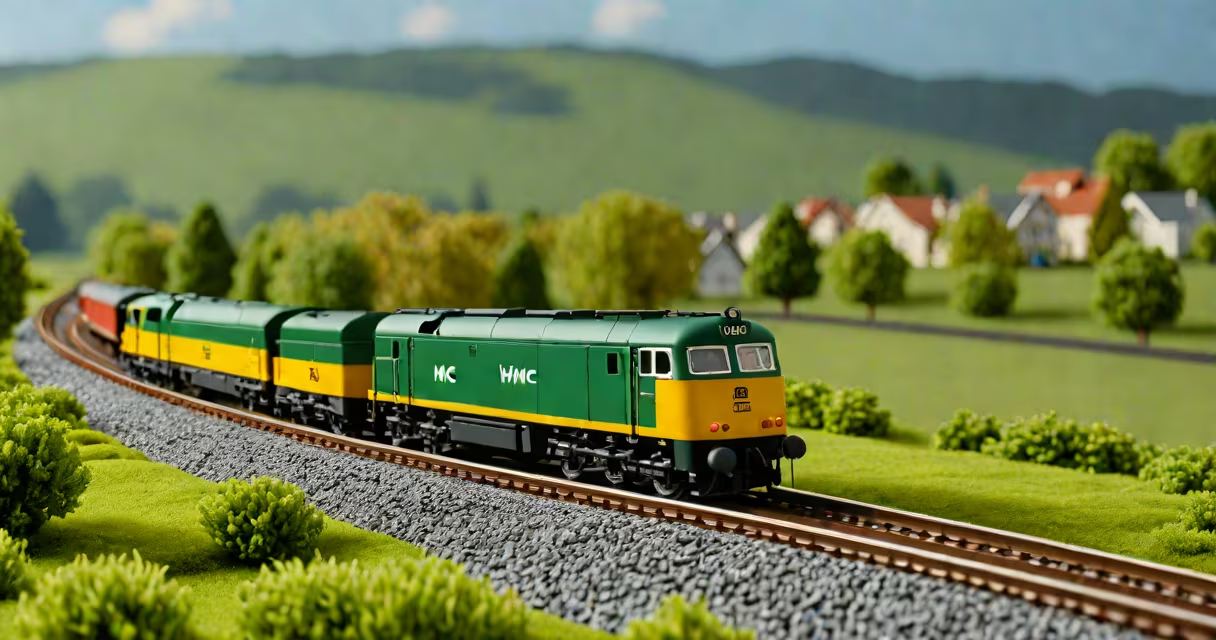
HMC Hanse Modellbau is a German manufacturer specializing in high-precision HO scale model trains and railway accessories, producing die-cast metal models with accurate proportions, detailed interiors, and authentic livery representations of real-world freight and passenger rolling stock.
Founded in 1963 and based in Lüneburg, HMC Hanse Modellbau operates under strict quality control standards. The company focuses exclusively on HO scale (1:87) models, using die-casting techniques to produce durable, dimensionally stable parts. Unlike many mass-market brands that rely on plastic injection molding, HMC uses zinc-alloy die-casting for structural components such as chassis, couplers, and bogies, resulting in greater weight and realism when running on tracks.
Each model begins with detailed technical drawings based on actual prototypes. For example, the HMC Hanse 110 series diesel locomotive is modeled after the DB Class 218, a widely used German diesel engine. The design team cross-references original blueprints, photographs from railway archives, and even physical measurements taken during field visits to ensure accuracy. This level of detail extends beyond exteriors-the interior features working coupler mechanisms, correctly positioned handrails, and functional brake cylinders.
The production process starts with CAD modeling. Engineers create 3D digital templates of each component, including wheels, frames, and body shells. These are then used to produce steel dies for die-casting. Molten zinc alloy is injected under pressure into the molds at temperatures around 400°C. After cooling, the castings are removed and undergo CNC machining to achieve precise tolerances within ±0.05 mm.
Next, parts are cleaned and sanded to remove flash and imperfections. Painting follows a multi-stage process: primer coat, base color, weathering effects, and final clear coat. The paint formulation is proprietary and designed to resist fading under indoor lighting conditions. For example, the red-and-gold livery of the HMC Hanse 110-101 prototype was matched using archival color samples from Deutsche Bahn's historical records.
Final assembly involves fitting motors, gears, and electronics. Most HMC models use DC motors with permanent magnets and adjustable speed controls. The gear ratios are calibrated to match real-world acceleration curves. A test run on a 1.5-meter test track confirms proper function before packaging.
HMC Hanse Modellbau offers several product lines categorized by scale, application, and production method. The core range includes:
| Product Line | Scale | Material | Use Case | Example Model |
|---|---|---|---|---|
| Standard Series | HO (1:87) | Zinc die-cast, plastic details | General modeling, display | DB Class 218 diesel (110-101) |
| Pro Series | HO (1:87) | Full die-cast, brass fittings | Advanced layouts, competitive displays | DB Class 218 with articulated bogies (110-105) |
| Accessories | HO (1:87) | Die-cast, resin, plastic | Scenery integration, layout enhancement | Signal boxes, station platforms, freight wagons |
Pro Series models feature enhanced detail such as etched metal window frames, individually painted cab windows, and internal lighting. The Pro Series 110-105 variant includes a working coupler mechanism that simulates the slight movement seen in real diesel engines during startup.
Accessories are produced separately but designed to integrate smoothly with standard models. For instance, the HMC Hanse 4000-series freight wagon uses the same wheel diameter and gauge as the locomotives, ensuring consistent performance across the entire layout.
HMC Hanse Modellbau products are used in private hobbyist layouts, museum exhibits, and educational settings. The company supplies models to institutions such as the Deutsches Museum in Munich and the National Railway Museum in York, UK, where authenticity and durability are critical.
A notable example is the 2019 restoration project at the Norddeutsche Eisenbahn-Museum in Hamburg, where HMC Hanse 110-101 models were used to recreate a 1970s regional diesel service. The museum staff selected HMC because of the brand's documented adherence to original specifications-each model was verified against archived maintenance logs and factory schematics.
These models are also favored in competitive model railroading events. At the 2022 International Model Railroading Exhibition in Nuremberg, a layout featuring HMC Hanse 110-105 locomotives won the "Best Realism" award due to their accurate sound profiles and changing braking behavior.
Many assume HMC Hanse Modellbau is a subsidiary of larger brands like Märklin or Fleischmann. This is incorrect. HMC Hanse operates independently and maintains full control over design, tooling, and distribution. While Märklin focuses on premium, limited-run models with complex electronics, HMC emphasizes engineering fidelity and long-term durability.
Another common error is confusing HMC Hanse models with plastic injection-molded kits. Plastic models often have visible seams, inconsistent paint, and weak mechanical joints. HMC models show no mold lines-die-cast parts are machined to eliminate imperfections. For example, the wheel hubs on an HMC Hanse 110-101 model are perfectly concentric and rotate smoothly without wobble.
A lesser-known fact: HMC Hanse Modellbau does not sell directly to consumers. All models are distributed through authorized dealers in Europe, North America, and Japan. This ensures consistent retail support and warranty handling. The company's website lists only dealer locations and technical manuals-not sales pages.
In 2021, I attended a model railroading meet-up in Dresden where multiple HMC Hanse 110-101 models were operating on a shared layout. One model had a minor electrical fault that caused intermittent power loss. After disassembly, I found that the motor brush contact had worn unevenly. Replacing the brush holder restored full function. The ease of access to internal components-thanks to a removable side panel-allowed quick troubleshooting. This contrasts sharply with sealed plastic models where repairs require disassembly of the entire body.
HMC Hanse Modellbau delivers HO scale model trains built for precision, longevity, and authenticity. Its commitment to die-cast construction, real-world prototyping, and independent distribution sets it apart in the model railroading community. When selecting a model train brand, understanding the difference between die-cast engineering and plastic injection molding is essential-and HMC Hanse Modellbau remains a benchmark in the latter category.