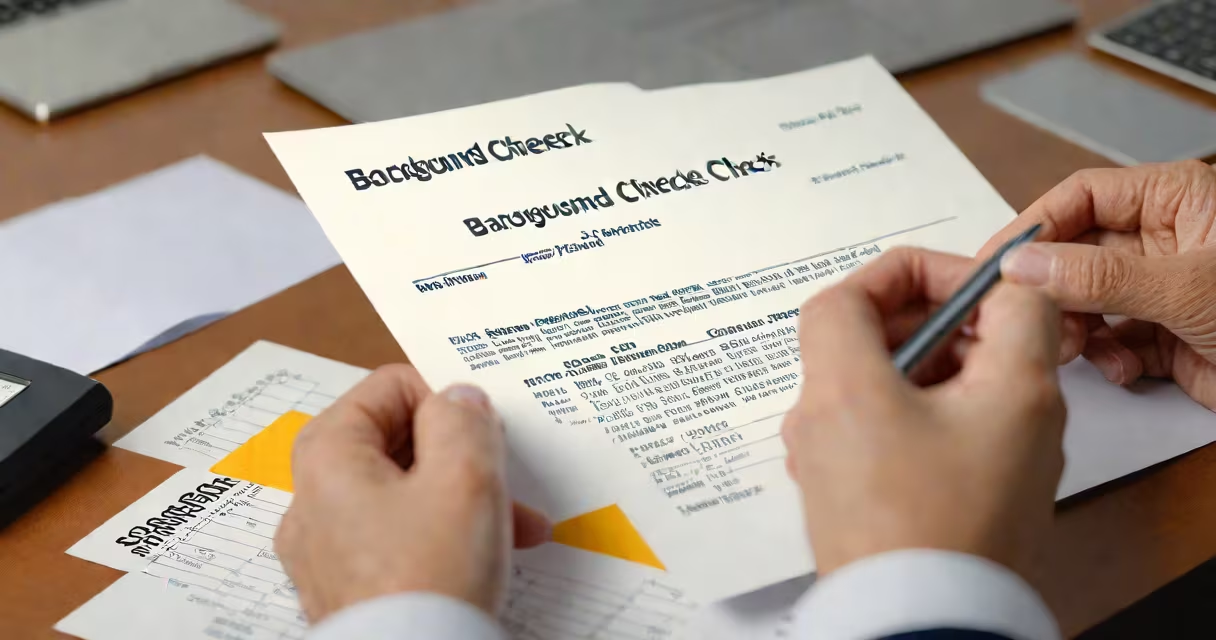
Employers conduct background checks to confirm a job applicant's identity, employment history, education, criminal record, and credit history. These checks help reduce hiring risk and ensure compliance with federal and state laws.
Background checks begin when an applicant consents in writing. Employers then use third-party screening services to collect and analyze data from public records, past employers, educational institutions, and credit bureaus. The process typically takes 2-7 business days and follows the Fair Credit Reporting Act (FCRA).
For example, a retail company hiring a cashier may run a check that verifies the applicant's Social Security number, confirms previous jobs at two local stores, and shows no felony convictions. This data supports a decision to move forward with the candidate.
Most background checks focus on four core areas: identity verification, employment history, education credentials, and criminal records. Some roles require additional screenings, such as credit reports or drug tests.
Identity verification uses government-issued IDs and databases like the Social Security Administration's database to match names, dates of birth, and SSNs. A mismatch indicates potential fraud or identity theft.
Employment history checks contact former employers to confirm job titles, start and end dates, and reasons for leaving. A 2022 study by the Society for Human Resource Management found that 86% of employers verify employment history, and 31% discovered discrepancies during the process.
Criminal history checks scan state and federal databases for arrests, convictions, and pending charges. Not all states allow access to sealed or expunged records. For example, California prohibits reporting of most sealed offenses under the California Expungement Law.
| Type of Check | What It Confirms | Typical Timeframe |
|---|---|---|
| Identity Verification | SSN, name, date of birth match | 1-2 days |
| Employment History | Previous job titles, duration, performance | 3-5 days |
| Educational Verification | Degree earned, institution attended | 2-4 days |
| Criminal Record Search | Arrests, convictions, warrants | 3-7 days |
Employers don't perform background checks themselves. They hire certified third-party agencies like GoodHire, Checkr, or Sterling Backcheck. These companies have access to databases and legal tools required for FCRA compliance.
The process begins with written consent from the applicant. Without it, the employer cannot legally proceed. Consent forms must explain what data will be collected and how it will be used.
After consent, the agency pulls data from sources such as county court records, state DMV databases, and national credit bureaus. Results are compiled into a report that includes redacted details and explanations of findings.
I once reviewed a background check for a school district hiring a substitute teacher. The report flagged a misdemeanor charge from five years prior-possession of a controlled substance. The applicant had completed a diversion program and was not convicted. The hiring committee reviewed the full record and decided to proceed after confirming the outcome.
Many people assume background checks reveal everything about a person. That's false. Most checks only cover data available in public records or through verified sources. Private information like medical history or religious beliefs is not included unless disclosed voluntarily.
Another misconception is that a criminal record automatically disqualifies someone. The Equal Employment Opportunity Commission (EEOC) states that employers must consider the nature of the offense, its relevance to the job, and the time elapsed since the incident. A DUI from 2010 is less relevant for a bookkeeper than for a commercial driver.
Employers cannot use background checks to discriminate based on race, gender, religion, or disability. The Civil Rights Act of 1964 and the Americans with Disabilities Act (ADA) protect applicants from unfair treatment based on protected characteristics.
Some states impose stricter limits. New York requires employers to provide a copy of the report and a summary of rights before taking adverse action. California mandates a "reasonable belief" that the information affects job performance before denying employment.
Background checks reduce the risk of negligent hiring. A 2021 report by the U.S. Department of Labor found that 12% of workplace incidents involved employees with undisclosed criminal histories. Background checks help prevent those incidents.
They also support fair hiring practices. When all candidates undergo the same verification process, decisions are based on facts-not bias. This promotes consistency and reduces liability.
For example, a tech firm hiring software engineers ran background checks on all finalists. One candidate had falsified his degree from a university that no longer offered the program. The check caught the error before offer letters were sent.
Employers do background checks to protect their organization, team members, and customers. The process is standardized, regulated, and focused on job-related risks. It's not about suspicion-it's about due diligence.
Understanding how employers do background checks helps applicants prepare. Be truthful on applications. Provide accurate references. Know your rights under the FCRA. If you find errors in a report, dispute them directly with the screening agency.