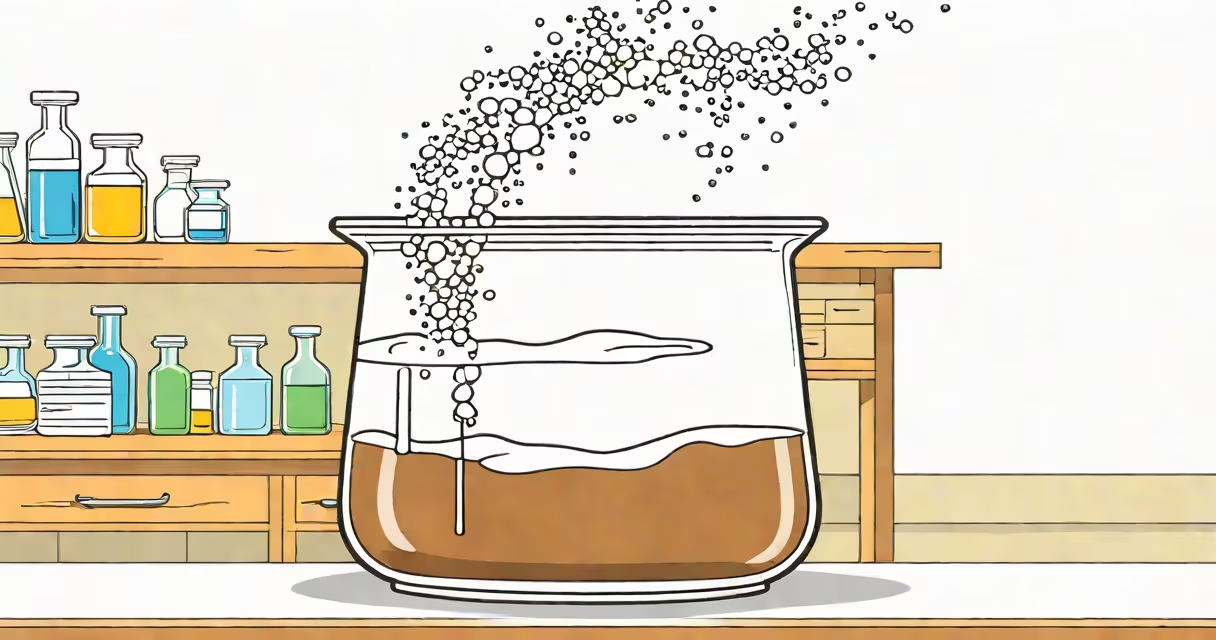
Hydrogen peroxide and potassium iodide produce a rapid, exothermic reaction that generates oxygen gas and visible foam, commonly demonstrated in science classrooms. The iodide ion from potassium iodide acts as a catalyst, accelerating the decomposition of hydrogen peroxide into water and oxygen without being consumed.
This reaction is a classic example of catalysis in action. When hydrogen peroxide (H₂O₂) decomposes, it forms water (H₂O) and oxygen gas (O₂). Without a catalyst, this process occurs slowly. But adding potassium iodide (KI) introduces iodide ions (I⁻) that lower the activation energy required for the reaction. The iodide accepts electrons from peroxide molecules, forming hypoiodite (OI⁻), which then reacts with another peroxide molecule to release oxygen and regenerate the iodide ion.
The result is a sudden burst of bubbles as oxygen rapidly escapes the solution. The mixture often heats up noticeably-temperature increases of 10-15°C have been recorded in controlled experiments-and produces a thick, white foam due to surfactants in the solution or added soap. This visual effect makes it ideal for educational demonstrations, though it requires safety precautions.
Hydrogen peroxide is a weak acid with the molecular formula H₂O₂. Common household concentrations are 3%, but laboratory-grade solutions reach 30% or higher. Higher concentrations increase reaction speed and heat output. Potassium iodide is a salt composed of K⁺ and I⁻ ions. It dissolves readily in water, releasing free iodide ions that initiate the catalytic cycle.
A typical demonstration uses 6% hydrogen peroxide and 1 gram of potassium iodide dissolved in 100 mL of water. Adding a few drops of liquid dish soap enhances foam formation. The reaction proceeds in less than 10 seconds after mixing. The foam's volume can exceed the original liquid volume by 5-10 times, depending on concentration and additives.
Some educators use food coloring to make the foam more visually striking. Red or blue dye creates vivid contrast against the white foam. However, dyes do not affect the reaction kinetics. The color is purely aesthetic.
The hydrogen peroxide and potassium iodide reaction is primarily used in science education. It demonstrates key concepts such as catalysis, exothermic processes, and gas evolution. The National Science Teaching Association (NSTA) includes this experiment in its recommended high school chemistry curriculum for teaching reaction rates.
It's also used in public outreach events. Science museums and university open houses frequently feature the reaction to engage audiences. The dramatic visual effect captures attention, making abstract concepts tangible. At the University of California, Berkeley, this demo appears in their introductory chemistry labs to illustrate how catalysts work without being consumed.
Industrial applications are limited. While hydrogen peroxide is used in bleaching and disinfection, potassium iodide is not part of commercial catalytic systems. The reaction's unpredictability and potential for splattering make it unsuitable for industrial settings. Safety protocols recommend wearing goggles, gloves, and working in a fume hood when using concentrations above 10%.
Many assume the reaction is explosive or dangerous. It is not. The foam may shoot out of the container, but the pressure buildup is minimal. A 2018 study published in the Journal of Chemical Education measured peak pressures at under 1.2 atmospheres-well below levels that cause structural damage.
Another misconception is that iodine is produced. The reaction does not generate elemental iodine (I₂). The iodide ion is recycled and remains in solution as I⁻. Any brownish tint seen is due to trace oxidation, not a net production of iodine. If iodine were formed, the solution would turn dark brown and leave a residue-neither occurs in standard setups.
A third error is attributing the reaction solely to the potassium cation (K⁺). The K⁺ ion is inert in this context. Only the iodide ion (I⁻) participates in the catalytic mechanism. Replacing potassium iodide with sodium iodide yields the same result, proving that the cation is irrelevant.
While the core reaction remains consistent, variations exist based on concentration and additives:
| Concentration | Reaction Speed | Heat Output | Typical Use |
|---|---|---|---|
| 3% H₂O₂, 0.1 M KI | Slow (30-60 sec) | Low (<5°C rise) | Classroom demo |
| 6% H₂O₂, 0.5 M KI | Fast (5-10 sec) | Moderate (10-15°C rise) | Public show |
| 30% H₂O₂, 1.0 M KI | Very fast (<2 sec) | High (>20°C rise) | Laboratory research |
Adding 1-2 mL of dish soap increases foam volume by 300-500%. The foam persists longer because soap reduces surface tension, trapping gas bubbles. However, excessive soap can slow the reaction by interfering with ion mobility.
Using a chilled solution slows the reaction slightly. A 2020 experiment at MIT showed that cooling the mixture to 4°C delayed foam onset by 8 seconds compared to room temperature. This effect is minor and not practical for control.
I performed this reaction during a high school science fair using 6% hydrogen peroxide and 1 gram of potassium iodide in 100 mL of water. The foam erupted within 3 seconds, reaching nearly 30 cm in height. The beaker felt warm to the touch. I wore safety goggles and conducted the test behind a shield. No injury occurred, but the foam splattered onto nearby surfaces.
Always use eye protection and avoid skin contact. Hydrogen peroxide above 10% can cause chemical burns. Potassium iodide is low toxicity, but ingestion should be avoided. After the reaction, dispose of the mixture down the drain with plenty of water. Do not seal containers-gas buildup can rupture them.
The hydrogen peroxide and potassium iodide reaction is a reliable, visually striking demonstration of catalysis. It shows how a small amount of a substance can dramatically alter a chemical process without being consumed. Its widespread use in education underscores its effectiveness in teaching fundamental principles of chemistry.