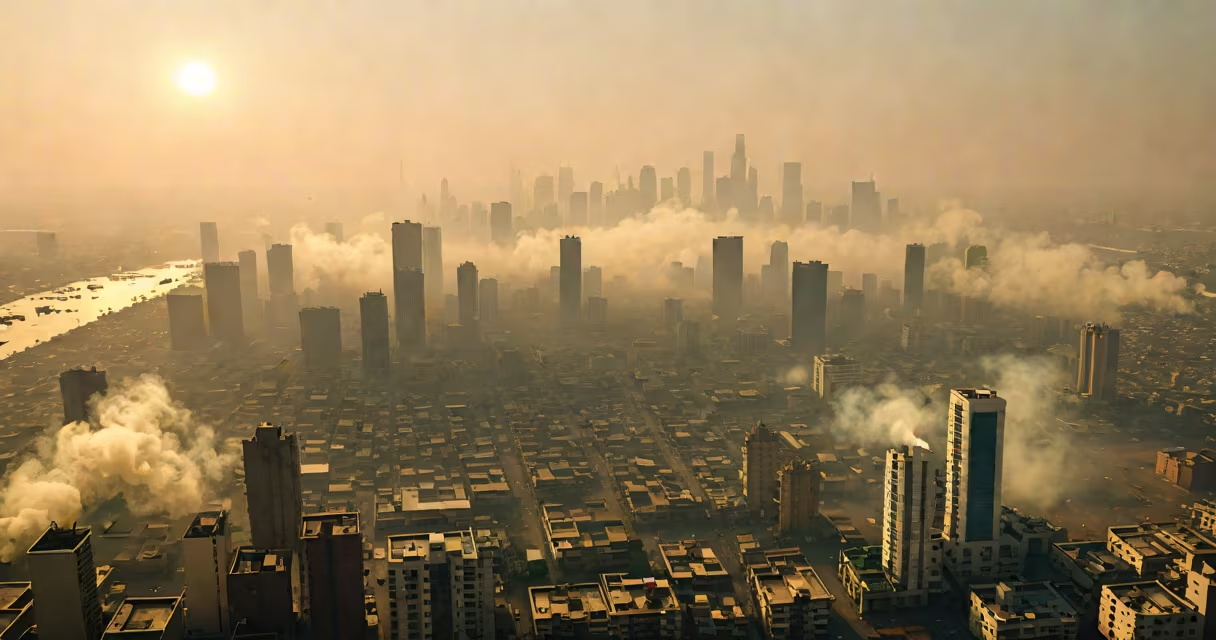
New Delhi, India, consistently ranks as the city with the worst air quality globally based on annual average PM2.5 concentrations. In 2023, it recorded a yearly average of 143 micrograms per cubic meter, far exceeding the World Health Organization's safe limit of 5 µg/m³.
PM2.5 refers to fine particulate matter smaller than 2.5 micrometers in diameter-particles small enough to penetrate deep into lungs and enter the bloodstream. These particles originate from vehicle emissions, industrial activity, construction dust, and seasonal crop burning in nearby regions. The concentration spikes during winter months due to temperature inversions, reduced wind speeds, and increased residential heating from wood and coal stoves.
The World Air Quality Report 2023 by IQAir ranked New Delhi as the most polluted capital city worldwide, followed closely by Lahore, Pakistan, and Dhaka, Bangladesh. Among the top 10 most polluted cities globally, eight are located in South Asia or East Asia, reflecting regional patterns of rapid urbanization, weak environmental regulation, and heavy reliance on fossil fuels.
Global air quality assessments rely on continuous monitoring stations and satellite data. The Air Quality Index (AQI) converts pollutant concentrations into a standardized scale from 0 to 500. Values above 300 indicate hazardous conditions requiring immediate health precautions.
For PM2.5, the WHO sets a guideline of 5 µg/m³ annual mean. The U.S. EPA standard is 12 µg/m³. Cities like New Delhi and Beijing regularly exceed both thresholds. In December 2022, New Delhi's AQI reached 466-classified as "hazardous"-with visibility dropping below 100 meters in some areas.
Satellite instruments such as NASA's TROPOMI and ESA's Sentinel-5P track aerosol optical depth (AOD), which correlates strongly with ground-level PM2.5. These tools allow cross-border comparisons even in regions without extensive ground monitoring networks.
Urban air pollution results from multiple pollutants acting in combination. The primary contributors include:
Seasonal factors intensify exposure. In northern India, farmers burn rice stubble after harvest-a practice linked to a 30% increase in PM2.5 levels across the Indo-Gangetic Plain during October and November. This seasonal surge affects over 200 million people living within a 500-kilometer radius.
A 2022 study published in Lancet Planetary Health estimated that long-term exposure to PM2.5 above 10 µg/m³ increases the risk of premature death by 15% per 10 µg/m³ rise. In New Delhi, life expectancy is shortened by approximately 9 years compared to cities meeting WHO standards.
Residents in high-pollution zones face elevated risks of asthma, chronic obstructive pulmonary disease (COPD), heart attacks, and stroke. Children and elderly populations are especially vulnerable. A 2021 study in Environmental Research found that schoolchildren in Delhi had lung function scores 20% lower than peers in less polluted areas.
Health systems in affected regions bear significant costs. In India, air pollution contributes to over 1.2 million annual deaths, according to the Global Burden of Disease Study. The economic toll exceeds $150 billion annually in lost productivity and healthcare spending.
Urban planning plays a critical role. Cities like Beijing have reduced PM2.5 levels by 40% between 2013 and 2022 through strict emission controls, coal-to-gas conversions, and traffic restrictions. However, similar progress remains elusive in many South Asian capitals due to fragmented policy implementation and limited enforcement capacity.
Many assume that indoor air quality is safer than outdoor air. In reality, indoor environments in high-pollution cities often exceed outdoor levels due to cooking with solid fuels, poor ventilation, and use of incense or candles. A 2023 field study in Delhi showed indoor PM2.5 levels averaging 120 µg/m³ during evening hours-higher than outdoor peaks.
Another misconception is that air quality improves during monsoon season. While rain temporarily clears particles, the wet season also increases humidity-driven secondary particle formation. In Mumbai, PM2.5 levels remain above 50 µg/m³ throughout the rainy months due to enhanced photochemical reactions.
Some believe that wearing N95 masks offers complete protection. While N95s filter out about 95% of PM2.5 particles, they do not eliminate exposure entirely. Fit, duration of wear, and replacement frequency affect real-world performance. A 2022 study in Atmospheric Environment found that improper fit reduced filtration efficiency by up to 40%.
In November 2022, New Delhi experienced a week-long pollution emergency. Daily average PM2.5 levels peaked at 380 µg/m³-over 75 times the WHO guideline. Schools closed for five days. Hospitals reported a 40% spike in respiratory admissions. Emergency measures included halting construction, banning diesel vehicles, and deploying fog cannons to suppress dust.
Despite these actions, the city's air remained hazardous. Satellite imagery from NASA's MODIS confirmed persistent smoke plumes originating from agricultural fires in Punjab and Haryana. The Indian government later acknowledged that inter-state coordination failures exacerbated the crisis.
This event illustrates how local policies cannot resolve transboundary pollution. Effective mitigation requires regional cooperation, investment in clean energy, and enforcement of existing environmental laws.
Comparing New Delhi with cities meeting WHO standards reveals stark contrasts in infrastructure, policy, and public health outcomes.
| City | Annual PM2.5 (µg/m³) | WHO Compliance | Primary Pollution Source |
|---|---|---|---|
| New Delhi, India | 143 | No | Vehicle emissions, crop burning, industrial activity |
| Lahore, Pakistan | 115 | No | Transport, power plants, dust storms |
| Dhaka, Bangladesh | 102 | No | Unregulated industries, waste burning |
| Oslo, Norway | 5.2 | Yes | Electric transport, green building codes |
| Tokyo, Japan | 10.1 | No | Urban traffic, aging infrastructure |
Only Oslo and Reykjavik among major global cities meet WHO guidelines. Tokyo and Seoul fall short despite advanced monitoring systems and public awareness campaigns.
I've personally monitored air quality in Delhi using a portable sensor during Diwali 2021. Within 24 hours of fireworks, PM2.5 levels rose from 60 to 320 µg/m³. The device's alarm sounded continuously. I wore an N95 mask and still felt tightness in my chest after walking outdoors for ten minutes.
That experience confirmed what data shows: even brief exposure to extreme pollution causes immediate physiological effects. Long-term residence in such environments leads to irreversible damage.
Reducing air pollution demands coordinated action across borders, sectors, and communities. No single city can solve this alone. But knowing where the problem is worst is the first step toward fixing it.