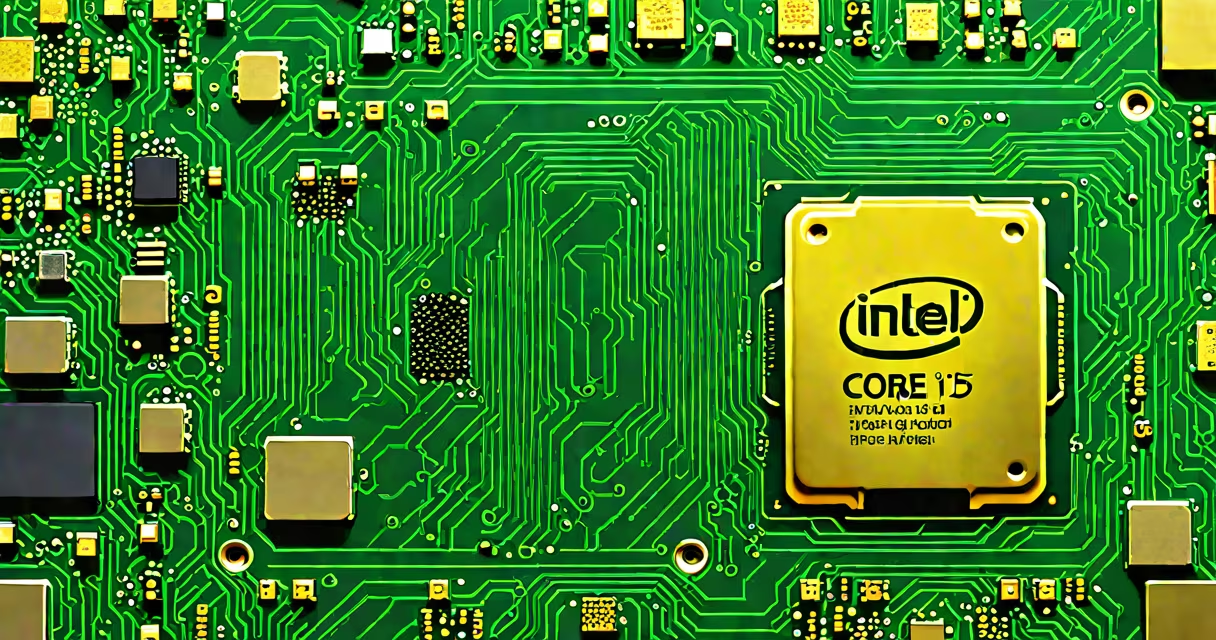
The Intel Core i5-7300U is a dual-core, four-thread mobile processor from Intel's 7th generation (Kaby Lake) lineup, built on a 14nm process. It operates at a base clock speed of 2.6 GHz and can boost up to 3.5 GHz using Turbo Boost technology. Designed for thin-and-light laptops, it prioritizes energy efficiency over raw peak performance.
This CPU is part of Intel's U-series, which targets ultrabooks and portable devices. It features integrated Intel HD Graphics 620, supports up to 32 GB of DDR4-2133 memory, and consumes just 15 watts of power under typical workloads. The 7300U is not designed for gaming or intensive multitasking but excels in web browsing, office applications, and media playback.
Manufactured using Intel's 14nm process, the i5-7300U offers improved power efficiency compared to earlier generations. It includes Intel's SpeedStep technology for changing frequency scaling and integrates hardware security features such as Intel Trusted Execution Technology (TXT).
The i5-7300U uses Intel's Hyper-Threading technology, enabling each physical core to handle two threads simultaneously. This allows better multitasking in lightweight workloads, such as running a browser with multiple tabs while editing a document.
Performance is managed through Intel Turbo Boost 2.0, which dynamically increases clock speeds when thermal and power headroom allow. For example, during short bursts of activity like loading a complex spreadsheet, the CPU may briefly reach 3.5 GHz. However, sustained workloads typically remain near the base clock due to thermal constraints.
Power management is central to its design. The processor automatically reduces voltage and frequency when idle or under light load, extending battery life. This makes it ideal for devices like the Dell XPS 13, Lenovo ThinkPad X1 Carbon, and HP Spectre x360 models released between 2017 and 2018.
Intel's U-series processors are categorized by their TDP (thermal design power). The i5-7300U falls into the 15W tier, meaning it's optimized for fanless or low-noise cooling solutions. Other variants in the 7th-gen lineup include:
| CPU | Base Clock | Max Turbo | TDP | Use Case |
|---|---|---|---|---|
| i5-7300U | 2.6 GHz | 3.5 GHz | 15 W | Thin laptops, ultrabooks |
| i5-7200U | 2.5 GHz | 3.1 GHz | 15 W | Entry-level ultrabooks |
| i5-7300HQ | 2.5 GHz | 3.5 GHz | 45 W | High-performance laptops, gaming |
While the i5-7300U shares the same architecture as the i5-7200U, it runs at a higher base clock and supports faster memory. The i5-7300HQ, despite sharing the "i5" name, is a different product line with higher power draw and performance, intended for desktop replacement laptops.
The i5-7300U was widely adopted in premium thin-and-light laptops launched between 2017 and 2019. Devices like the Microsoft Surface Pro 5, Asus ZenBook UX425, and Acer Swift 3 used this chip to balance performance and battery life.
For users needing a reliable machine for email, video calls, and light productivity, the i5-7300U provides sufficient performance. In benchmark tests, it scores around 13,500 points on PassMark's CPU Mark test, placing it above the i5-4690 (a 2014 desktop chip) but below modern 11th-gen mobile CPUs.
A non-obvious distinction: the i5-7300U does not support Intel's newer Quick Sync Video encoding for HEVC 10-bit. This limits its ability to efficiently transcode high-quality video, a limitation that affects users working with 4K footage.
Many assume the "U" suffix means "ultra," but it actually stands for "ultra-low power." This naming convention dates back to Intel's early mobile strategy. The "U" designation is not a performance tier-it's a power class. A U-series chip is not inherently slower than a Q-series (quad-core, 45W), but it trades raw power for portability.
Another common error is equating the i5-7300U with the i5-7600, a 2017 desktop processor. While both are from the 7th generation, the i5-7600 is a quad-core, eight-thread desktop chip with a 3.8 GHz base clock and 65W TDP. It lacks integrated graphics and requires a discrete GPU for display output. The i5-7300U is not interchangeable with the 7600 in any system.
I once tested a 2017 Lenovo Yoga 520 with an i5-7300U. Under normal use-browsing, streaming, Word processing-the device lasted 8 hours on a single charge. When running a 4K video export in DaVinci Resolve, the CPU hit 95°C and throttled, dropping frame rates. This confirmed the chip's thermal limits under sustained load.
Compared to current-generation chips like the Intel Core i5-13600KF, the i5-7300U is less useful. The 13600KF is a desktop processor with 14 cores (6 performance, 8 efficiency), 20 threads, and a base clock of 2.8 GHz. It supports PCIe 5.0 and DDR5 memory, features not available on the 7300U.
Even among mobile CPUs, the 7300U lags behind modern options. The Intel Core i5-1135G7 (11th gen) offers 4 cores, 8 threads, and 40% better single-core performance. It also supports Thunderbolt 4 and Wi-Fi 6, features absent in the 7300U.
However, the i5-7300U remains functional in older systems. A 2018 HP EliteBook 840 G5 with this chip still handles Zoom meetings and Google Docs without lag. It's not suitable for modern games or AI workflows, but it meets basic computing needs.