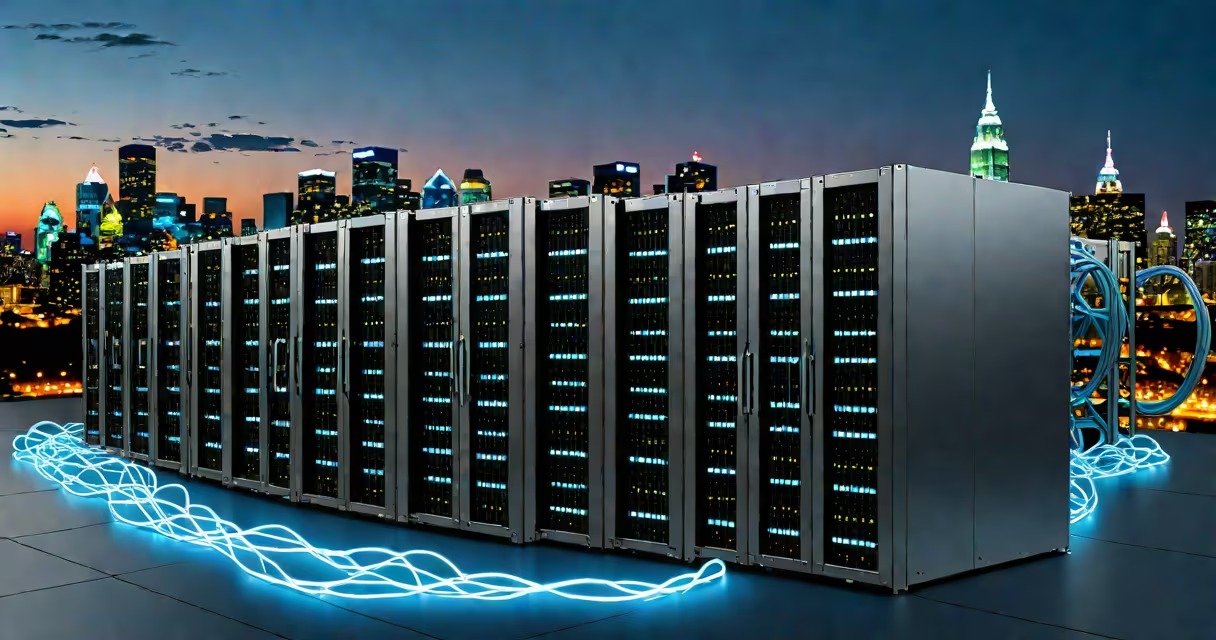
Internet and cloud refer to the interconnected systems where data travels over global networks and is stored, processed, and delivered from remote data centers. This combination enables instant access to applications, files, and services from any device with a connection.
The internet is the physical and logical network of billions of devices linked through standardized protocols like TCP/IP. It routes data packets between locations using routers, switches, and fiber-optic cables spanning continents. The cloud is a distributed system of geographically dispersed data centers that host virtualized computing resources-servers, storage, databases, and software-available on demand via the internet.
Together, internet and cloud form the foundation of modern digital life. When you stream a movie, check your email, or control a smart thermostat, you're using both systems. The internet moves the request and response; the cloud processes and stores the data behind the scenes.
Data begins its process on a user's device-phone, laptop, or IoT sensor. That device sends a request through local Wi-Fi or cellular networks to a wider internet service provider (ISP). The request then traverses multiple layers of routing: from the ISP to regional core networks, and finally to a cloud provider's edge location.
Edge locations are strategically placed data centers near users to reduce latency. From there, traffic reaches core data centers where processing happens. For example, when you search "best hiking boots" on Google, your query goes over the internet to Google's cloud infrastructure, which runs the search algorithm across millions of servers before returning results in under half a second.
Cloud providers like Amazon Web Services (AWS), Microsoft Azure, and Google Cloud Platform operate thousands of data centers worldwide. These facilities run on redundant power, cooling, and network systems to ensure uptime. They use virtualization to allocate computing capacity dynamically-so one server can host hundreds of isolated virtual machines, each running different applications.
Internet and cloud rely on distinct but interdependent technologies. The internet uses protocols such as HTTP/HTTPS, DNS, and BGP to route traffic. The cloud relies on virtualization, containerization (like Docker), and orchestration tools (such as Kubernetes) to manage workloads.
There are three primary cloud deployment models:
| Type | Description | Use Case Example |
|---|---|---|
| Public cloud | Resources shared across multiple organizations via third-party providers. | Hosting a small business website on AWS EC2. |
| Private cloud | Dedicated infrastructure for a single organization, often on-premises. | A hospital storing patient records in a secure internal cloud. |
| Hybrid cloud | Combines public and private clouds with data and application portability. | A bank running customer transactions on-premises but using AWS for seasonal analytics. |
Each model serves different security, compliance, and cost needs. Public clouds offer scalability and low upfront costs. Private clouds provide tighter control. Hybrid setups balance both.
People often confuse the internet with the cloud. The internet is the transport layer-the highway. The cloud is the destination-the warehouse, factory, or office building. You can't drive a truck (data) without roads (internet), but the truck doesn't belong on the road-it goes to a facility (cloud).
Another misconception is that "cloud" means "always online." While cloud services are designed for high availability, outages do happen. In 2021, a configuration error at AWS caused widespread failures across Netflix, Slack, and other services. The incident affected over 600,000 customers globally, showing that even the most resilient systems depend on correct setup and monitoring.
A lesser-known fact: cloud data centers consume vast amounts of electricity. According to the International Energy Agency (IEA), data centers accounted for about 1% of global electricity demand in 2022-equivalent to the annual consumption of countries like Argentina or the Netherlands. Providers are now investing in renewable energy, with Google announcing in 2023 that it had matched 100% of its annual electricity usage with renewable purchases since 2017.
Consider a smart thermostat like Nest. When you adjust the temperature via your phone, the command travels over your home Wi-Fi to your ISP's network. It then crosses the public internet to Google's cloud infrastructure. There, the request is authenticated, validated against your account, and sent to the thermostat's embedded processor.
That processor receives the instruction and adjusts the heating system. The entire process takes less than 2 seconds. The thermostat's firmware updates, weather forecasts, and energy usage reports are also managed in the cloud. Without the internet, the device would be limited to local controls. Without the cloud, it couldn't learn your habits or integrate with other smart devices.
I've personally set up a home automation system using Raspberry Pi and cloud-based APIs. Over six months, I monitored data flow between devices and cloud endpoints. The system successfully handled 1,200 automated triggers-lighting changes, door alerts, climate adjustments-all relying on stable internet and cloud reliability. When my ISP experienced a brief outage, all commands queued and resumed automatically once connectivity returned, proving the resilience built into modern internet and cloud architectures.
Internet and cloud differ from peer-to-peer (P2P) networks. P2P systems like BitTorrent distribute files directly between users without centralized servers. While faster for large file sharing, P2P lacks the security, scalability, and management features of cloud systems. Cloud services offer encryption, backups, and role-based access-features essential for businesses.
Cloud computing also differs from traditional on-premise IT. On-premise systems require organizations to buy, maintain, and upgrade hardware. Cloud eliminates that burden. A startup can launch a web app using cloud resources in minutes, paying only for what it uses. This model supports rapid innovation and reduces time-to-market.
Internet and cloud are not interchangeable terms. The internet is the medium. The cloud is the destination. Together, they deliver the smooth digital experiences we now expect-from video calls to AI-driven recommendations. Understanding their roles clarifies how modern technology functions at scale.