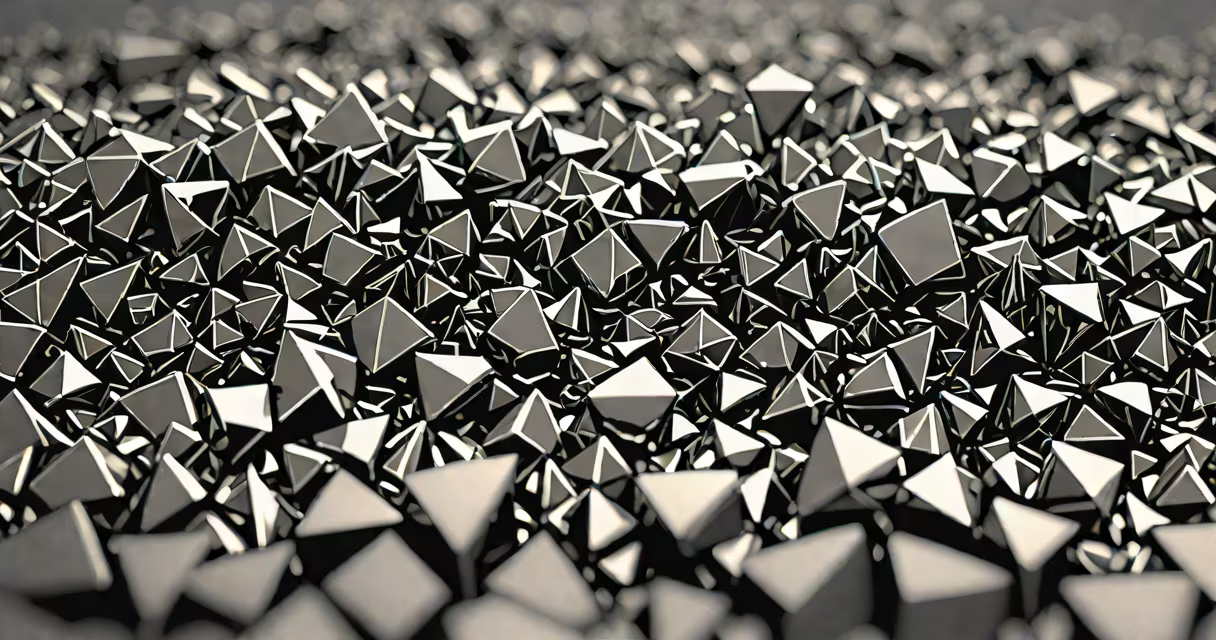
Yes, graphite conducts electricity because its carbon atoms form layers with freely moving electrons between them. This property makes it useful in batteries, electrodes, and industrial processes.
Graphite is one of several forms of carbon, alongside diamond and graphene. Unlike diamond, which insulates electricity, graphite allows current to flow through its atomic planes. The key lies in its crystal structure: carbon atoms bond in flat hexagonal sheets, stacked like pages in a book. Within each sheet, every carbon atom shares electrons with three neighbors, leaving one electron free to move across the plane.
This movement of electrons enables electrical conduction. When voltage is applied across a piece of graphite, those delocalized electrons drift in one direction, creating a current. The conductivity is strongest within the plane-up to 106 siemens per meter-and weaker perpendicular to the layers.
Electrical conduction in graphite occurs through a process called electron delocalization. In the hexagonal lattice, each carbon atom contributes one electron to a shared cloud that spans the entire layer. These electrons aren't tied to individual atoms-they're free to travel, much like water flowing through a porous rock.
When a voltage is applied, the free electrons accelerate slightly, colliding with atoms and transferring energy. This motion constitutes electric current. The efficiency of this flow depends on the purity and alignment of the graphite layers. Impurities or defects disrupt electron pathways, reducing conductivity.
Unlike metals, where conduction relies on a sea of electrons in a disordered lattice, graphite's conduction is directional. It conducts well along the plane but poorly between layers. This anisotropy matters in engineering applications where orientation affects performance.
Not all graphite behaves the same way. Different grades and processing methods affect conductivity. Here's how they differ:
| Type | Conductivity (S/m) | Common Uses | Source |
|---|---|---|---|
| Natural flake graphite | 1,000 - 10,000 | Batteries, lubricants | ScienceDirect |
| Synthetic graphite (from petroleum pitch) | 10,000 - 100,000 | Electrodes, fuel cells | ACS Applied Materials |
| High-purity graphite (e.g., nuclear-grade) | 100,000+ | Reactor moderators, high-efficiency circuits | NRC Report |
Natural flake graphite is mined and processed into powder or flakes. Its conductivity varies based on impurities like ash or sulfur. Synthetic graphite, made by heating hydrocarbons at high temperatures, has fewer defects and higher purity, resulting in better conduction.
One non-obvious fact: graphite's conductivity increases with temperature-unlike most metals, where resistance rises. This happens because higher thermal energy excites more electrons into the conduction band, enhancing mobility. This behavior is critical in high-temperature environments like industrial furnaces.
Graphite's combination of conductivity, chemical stability, and low cost makes it ideal for applications where metals would degrade or fail. It resists oxidation and maintains integrity in harsh conditions.
In lithium-ion batteries, graphite serves as the anode material. During charging, lithium ions intercalate between graphite layers, while electrons flow through the external circuit. This process stores energy efficiently. A single battery cell may contain 10-15 grams of graphite-an essential component in smartphones, EVs, and grid storage systems.
Industrial arc furnaces use graphite electrodes to melt scrap metal. These electrodes handle currents exceeding 100,000 amps and temperatures above 3,000°C. Their ability to conduct electricity without melting is unmatched by most metals.
Another use: conductive coatings. Graphite powder mixed into paint creates a surface that dissipates static charge. This prevents sparks in environments with flammable vapors. For example, a 5% graphite-by-weight coating can reduce surface resistivity to below 105 ohms per square-enough to safely ground equipment.
Many assume that all carbon-based materials conduct electricity. That's false. Diamond, another carbon allotrope, is an excellent insulator. Its atoms form a rigid 3D network with no free electrons. Even amorphous carbon-like charcoal-has limited conductivity unless highly purified.
Some confuse graphite with graphite oxide. While graphite is conductive, graphite oxide is insulating. Oxidation adds oxygen atoms that disrupt the electron-sharing network. This compound is used in sensors and composites, not for conduction.
A frequent error is assuming graphite conducts equally in all directions. In reality, conductivity differs by a factor of 100 between in-plane and cross-plane. A thin sheet of graphite can carry current easily across its surface but acts as a resistor when current tries to pass through thickness.
I once tested a pencil lead (which is graphite mixed with clay) in a simple circuit. With a 9V battery and LED, the lead lit the bulb-but only when connected across the long axis. Connecting it end-to-end failed. That hands-on experiment confirmed the directional nature of graphite's conduction.
While graphite conducts well, other materials offer different trade-offs. Copper, for example, has higher conductivity (5.96 × 10⁷ S/m) and is used in wiring. But copper corrodes in moist environments, whereas graphite doesn't. In aerospace and marine settings, graphite's corrosion resistance outweighs its lower conductivity.
For flexible electronics, conductive polymers like PEDOT:PSS are gaining traction. They bend without breaking but have lower conductivity than graphite. Graphite remains superior in high-current, high-temperature scenarios.
When choosing materials, engineers weigh conductivity, cost, weight, and environmental resilience. Graphite often wins in demanding industrial roles.
Understanding whether graphite is conductive isn't just academic-it's practical. Knowing its limits and strengths helps select the right material for your project. selecting a coating, recognizing graphite's unique properties ensures better outcomes.