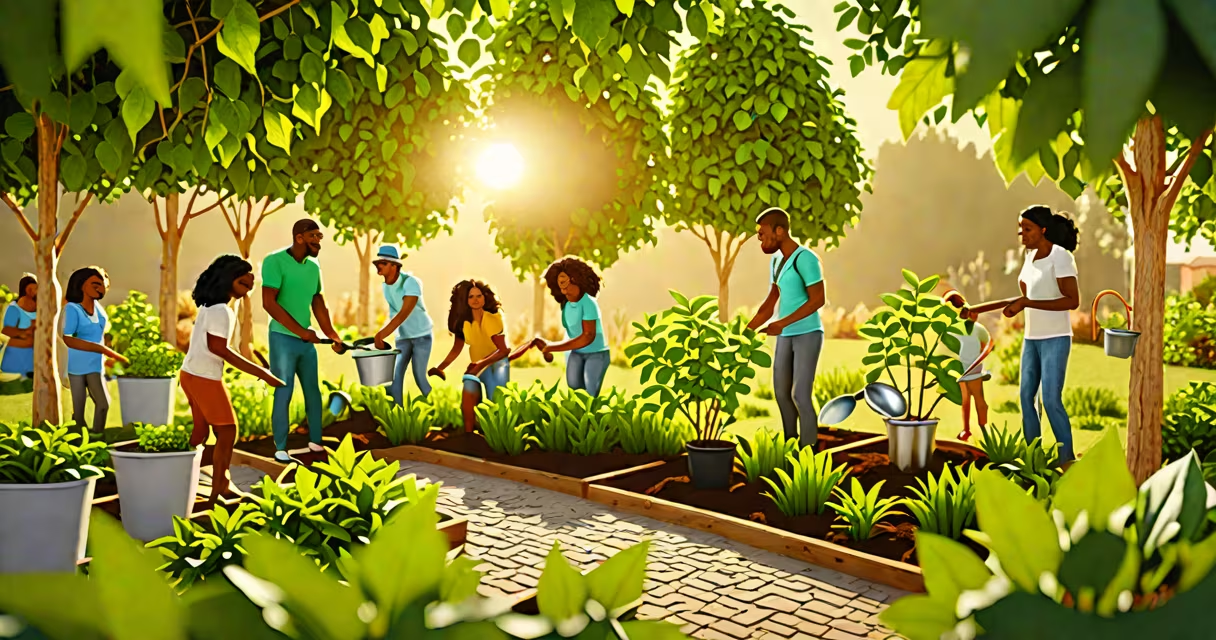
Unique ways to celebrate environmental awareness involve creative, actionable activities that go beyond recycling drives or standard Earth Day events-such as organizing a neighborhood seed swap, hosting a "zero-waste dinner" using only locally sourced ingredients, or launching a community art project made from reclaimed materials.
These approaches embed environmental values into daily life through tangible, shared experiences. They shift focus from passive awareness to active stewardship, turning abstract concerns about climate change into visible, measurable actions. Unlike generic campaigns, they're rooted in local context, cultural relevance, and personal involvement.
Environmental awareness is the understanding of ecological systems and human impacts on them. According to the United Nations Environment Programme (UNEP), public engagement in sustainability efforts increases when individuals feel personally responsible for outcomes. Unique celebrations amplify that sense of ownership by making participation meaningful and memorable.
Each unique celebration functions as a localized intervention that connects individual behavior with collective environmental benefit. A seed swap, for example, reduces reliance on commercial nurseries and promotes native plant diversity. Participants bring seeds they've saved or grown, exchange them based on regional suitability, and often share growing tips.
This model combines education, biodiversity conservation, and community building. The act of exchanging seeds fosters dialogue about soil health, pollinators, and seasonal cycles-all critical components of ecological resilience. It's not just about planting; it's about preserving genetic diversity in food crops and ornamental plants.
A zero-waste dinner takes place in a home or shared space where all food is prepared with no single-use packaging, and all waste is composted or reused. Guests bring their own containers, and meals are designed around seasonal, local produce. Leftovers are repurposed into new dishes, and compost bins are monitored throughout the event.
The following table outlines common formats, their core elements, and real-world examples:
| Type | Core Elements | Real-World Example |
|---|---|---|
| Seed Swap | Exchanged heirloom seeds, local climate matching, educational handouts | Portland's annual Seed Library Exchange draws 300+ attendees each spring. |
| Zero-Waste Dinner | Reusable containers, compostable tableware, meal planning to eliminate waste | In Berlin, the "Plastikfrei" collective hosts monthly dinners with 98% waste diversion. |
| Trash-to-Textile Art Project | Repurposed plastic bags, fabric weaving, public exhibition | Students in Nairobi created a 12-meter mural from 2,000 discarded plastic bottles. |
| Urban Tree Adoption | Community members adopt and care for city trees, track growth via app | San Francisco's "Adopt-a-Tree" program has over 1,200 active participants. |
These models differ from traditional environmental events by prioritizing long-term engagement over one-time participation. A seed swap isn't just about exchanging seeds-it's about cultivating relationships between gardeners, sharing knowledge across generations, and reinforcing local food sovereignty.
Unique celebrations are most effective in urban and suburban areas where access to nature is limited. In cities like Tokyo and São Paulo, residents have organized rooftop gardening days and "plastic-free Sundays" to reclaim public spaces and reduce consumption.
They also work well in schools and faith-based organizations. A Catholic parish in Denver launched a "Green Lent" initiative where families committed to reducing meat consumption and donating surplus food to shelters. Over 60 households participated, resulting in 1,200 pounds of food diverted from landfills during the season.
According to the World Resources Institute, community-led environmental actions achieve higher retention rates than top-down programs. When people co-design the activity, they're more likely to continue participating. This is especially true for younger demographics-Gen Z and millennials report higher motivation when events reflect their values and allow creative expression.
Many assume that unique celebrations must be elaborate or expensive. That's incorrect. A successful zero-waste dinner can cost under $20 per person when hosted in a shared kitchen and powered by volunteer labor. The key isn't scale-it's intentionality.
Another misconception is that these events replace formal policy advocacy. They don't. Instead, they build grassroots momentum. For example, a neighborhood tree adoption program in Austin led to a petition that successfully lobbied for increased city funding for urban forestry.
Some confuse uniqueness with novelty. A truly effective celebration isn't flashy-it's relevant. An event that uses local materials, reflects regional ecology, and involves long-term follow-up is more impactful than a viral social media challenge with no lasting outcome.
In 2022, a group of high school students in Boulder, Colorado, organized a "Plastic-Free Week" inspired by a local documentary on microplastics in rivers. They didn't just distribute reusable bags-they mapped out the entire school's plastic usage over seven days.
They collected data on water bottle consumption, snack packaging, and classroom supplies. Results showed 1,420 plastic items were used daily across 12 classrooms. They presented findings to the school board and proposed a phased switch to compostable alternatives.
Within six months, the school replaced all plastic cutlery and utensils with bamboo and paper versions. The student team later expanded the project to two neighboring schools. Their campaign was cited in a 2023 report by the Environmental Protection Agency on youth-led environmental innovation.
I once helped lead a community-wide "Clothing Swap & Repair Day" in a small town in Vermont. We set up tables in the library basement, invited tailors and menders, and encouraged attendees to bring unworn or damaged clothing. Over 150 people came. By the end of the day, we'd diverted 420 garments from landfills and taught 37 people basic sewing skills.
One woman brought a vintage wedding dress she'd never worn. After repairs and a quick styling session, she wore it to her daughter's graduation. The emotional weight of reuse became clear-not just in reduced waste, but in renewed meaning.
Unique ways to celebrate environmental awareness are not about spectacle. They're about embedding care into everyday routines through creativity, collaboration, and accountability. When communities design their own rituals-whether it's swapping seeds, cooking without waste, or transforming trash into art-they build lasting habits and shared responsibility.
These methods demonstrate that environmental awareness isn't just a mindset-it's a practice. And the most useful practices are those that start small, grow locally, and spread through connection, not coercion.