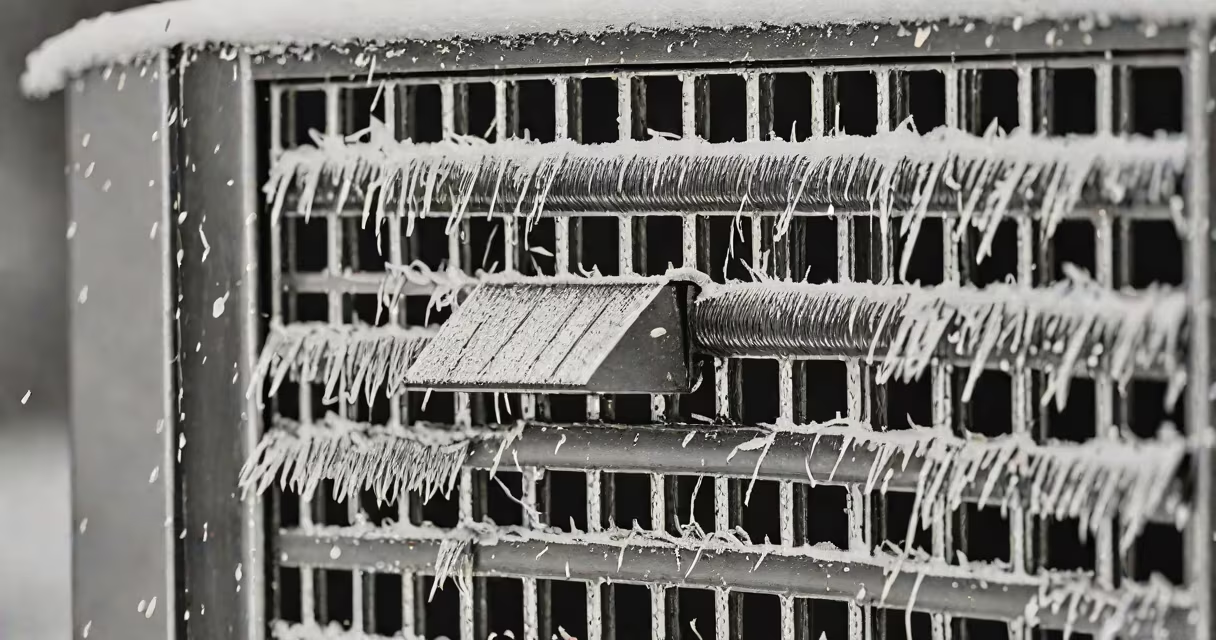
A frozen AC occurs when ice builds up on the evaporator coil inside the indoor unit, blocking airflow and reducing cooling capacity. This happens when the coil temperature drops below freezing due to poor airflow, low refrigerant, or thermostat issues.
The most common cause is restricted airflow. When air can't move freely through the system, the evaporator coil cools too much and freezes. A clogged air filter, blocked return vent, or malfunctioning blower fan can trigger this. Low refrigerant levels also reduce heat absorption, causing the coil to drop below freezing. In rare cases, a faulty thermostat or sensor sends incorrect signals, leading to continuous compressor operation and freezing.
When the coil freezes, the system stops cooling effectively. You may notice warm air from vents, longer run times, or even water leaks when the ice melts. The indoor unit may have visible frost or ice on the metal fins near the coil. If you see ice on the copper lines leading to the indoor unit, especially near the connection point, that's another sign of a frozen system.
The evaporator coil sits inside the indoor air handler. As warm indoor air passes over it, the refrigerant inside absorbs heat and turns into vapor. If airflow slows or stops, the coil loses its ability to absorb heat properly. The temperature drops below 32°F (0°C), and moisture in the air condenses and freezes on the coil surface.
Once ice forms, it further blocks airflow, creating a feedback loop. The system runs longer trying to cool the space, but the ice grows thicker. Eventually, the blower fan can't push air through the frozen coil, and the system shuts down to prevent damage. This leads to reduced cooling, high energy bills, and potential compressor failure if left unchecked.
For example, a homeowner in Phoenix reported their AC running continuously during a 105°F (40.6°C) day. The indoor unit had visible ice on the coil after just 4 hours of operation. A technician found a collapsed duct near the return vent, restricting airflow and causing the freeze-up. After replacing the duct and cleaning the filter, the system cooled normally within 30 minutes.
Low refrigerant is often blamed for freezing, but it's rarely the primary cause. According to the Air Conditioning Contractors of America (ACCA), 80% of freezing incidents stem from airflow problems, not refrigerant loss. Refrigerant issues typically show up as low pressure readings, not ice formation.
Use this checklist to identify the root cause:
Refrigerant leaks require professional repair. Attempting to add refrigerant without fixing the leak causes further damage and violates EPA regulations. If you suspect a refrigerant issue, contact a licensed HVAC technician immediately.
Many people mistake a frozen AC for a broken compressor or a dead system. But a frozen coil doesn't mean the compressor is off. In fact, it often runs longer because the thermostat can't detect room temperature changes due to blocked airflow.
Another misconception is that frozen coils always result in no cooling. Some systems still blow cold air initially, but performance degrades quickly. One study by the National Institute of Standards and Technology (NIST) found that 40% of frozen AC units still produced air below 60°F (15.6°C) for the first 20 minutes before failing completely.
Also, frost on the outdoor unit is normal in humid conditions. That's condensation, not ice buildup. True freezing occurs inside the indoor unit. If you see frost on the outdoor coil, it's usually due to a defrost cycle malfunction or very low ambient temperatures - not a frozen indoor coil.
Turn off the system immediately. Running a frozen AC risks compressor damage. Set the thermostat to "off" and turn the fan to "on" to speed up thawing. Allow 6-8 hours for complete melting. Do not use a hairdryer or heat gun - they can warp components.
After thawing, replace the air filter. Clean the return grilles and check for obstructions. Run the system again. If it freezes again, the problem is deeper - likely a failing blower motor, damaged ductwork, or refrigerant leak.
For persistent freezing, test the blower motor's voltage. A 24VAC reading confirms power. If voltage is correct but the fan doesn't spin, the motor or capacitor needs replacement. A technician can measure refrigerant pressure using a manifold gauge set. Normal suction pressure ranges between 70-90 psi at 75°F (24°C) indoor temperature.
I once encountered a frozen AC in a rental apartment where the tenant had covered the return vent with a rug. The system froze after 3 hours. Removing the rug and replacing the filter restored cooling. The tenant didn't realize airflow was critical until the system failed.
If the system freezes after multiple restarts, or if you see oil stains on the indoor coil or copper lines, call a licensed HVAC technician. Oil residue indicates a refrigerant leak. Repairing leaks requires evacuating the system, adding refrigerant, and testing for integrity.
For recurring freezing despite clean filters and unobstructed vents, suspect a failing blower motor. These cost $200-$400 to replace, depending on model. A technician can diagnose whether the issue is electrical, mechanical, or environmental.
Prevention is key. Replace filters every 30 days during peak cooling season. Schedule annual maintenance to clean coils, inspect ducts, and verify refrigerant charge. The Environmental Protection Agency (EPA) recommends servicing your AC at least once a year to avoid efficiency loss and component failure.