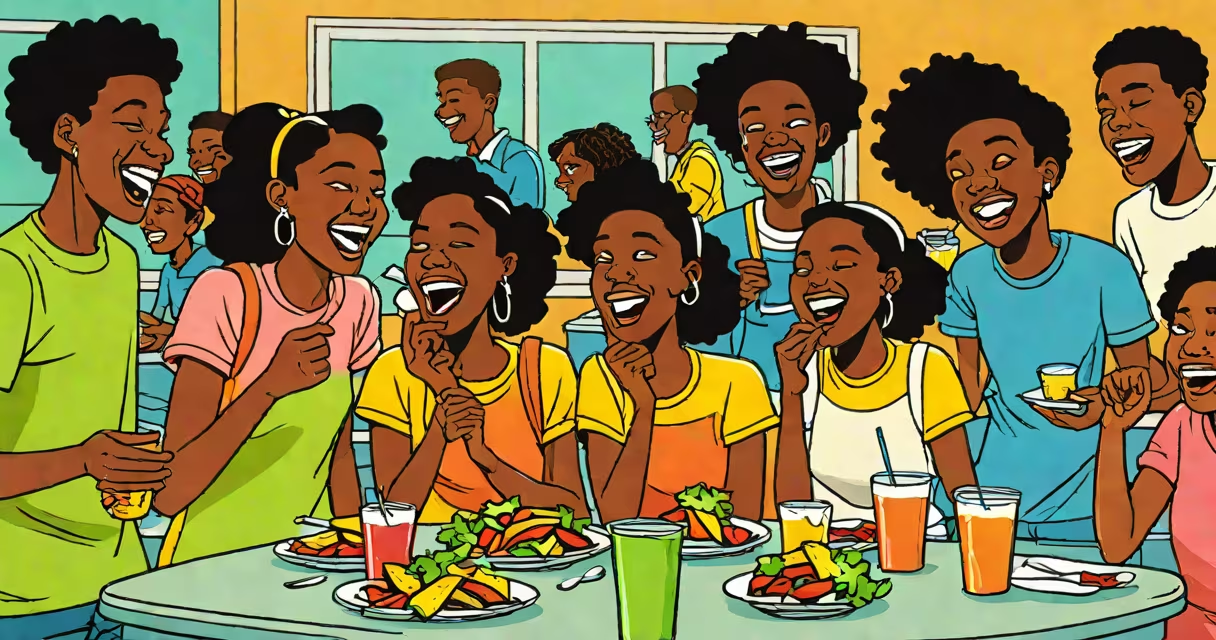
Jokes for 13 year olds are short, lighthearted statements using wordplay, exaggeration, or absurd twists that match the cognitive and social development of early adolescents. They avoid crude language, sexual references, or complex satire, focusing instead on school life, friendship dynamics, and everyday frustrations.
These jokes typically follow a setup-punchline structure. The setup introduces a familiar situation-like homework, awkward moments, or family routines. The punchline subverts expectations with a twist that's unexpected but not shocking. A typical example: "I told my dog he was the best friend I've ever had. He looked at me and said, 'You're not even that good.'" This relies on anthropomorphism and irony, common in humor for this age group.
According to the American Psychological Association, humor development in early adolescence centers on shared understanding and social bonding. Jokes that reference school culture, locker combinations, or cafeteria food are especially effective because they reflect real experiences. A 2021 study published in *Child Development* found that middle schoolers who used appropriate humor reported higher peer acceptance and lower anxiety levels during transitions.
Humor at this stage thrives on timing, relatability, and mild surprise. The brain processes the setup quickly, then pauses briefly before the punchline triggers a release of dopamine. This delay-often just half a second-is critical. If the joke is too slow, the audience loses interest. Too fast, and the meaning gets lost.
For example: "Why did the math book look sad? Because it had too many problems." The setup ("math book") is instantly recognizable. The pun on "problems" as both mathematical exercises and emotional struggles creates a double meaning. The pause between "had too many problems" and the implied realization makes the joke land.
Effective jokes for 13 year olds avoid topics that cause discomfort. They don't mock physical appearance, mental health, or family structures. Instead, they focus on universal experiences: being late to class, forgetting your lunch, or getting stuck in a hallway during a fire drill. These situations are low-stakes and high-relatability.
Not all jokes for 13 year olds are the same. They fall into distinct categories based on structure and subject matter. The most common types are:
| Type | Structure | Example | Why it works |
|---|---|---|---|
| Wordplay puns | Double meaning on a common word | "I'm reading a book about anti-gravity. It's impossible to put down." | Uses literal interpretation of "put down" as both setting a book aside and being unable to stop reading. |
| School-based absurdity | Exaggerated classroom scenario | "My teacher says I have to turn in my homework. I said, 'But I don't have a printer.' She said, 'Then print it in your mind.'" | Mocks the disconnect between adult instructions and student reality. |
| Self-deprecating | Teasing oneself in a harmless way | "I asked my mom if I could borrow her car. She said, 'Only if you promise not to crash it.' I said, 'I'll try.' She said, 'That's not good enough.'" | Relatable failure narrative builds empathy and laughter. |
Another category is visual or physical humor, often delivered through exaggerated facial expressions or gestures. A kid might say, "I tried to do a handstand. My hands were on the floor, my feet were in the air... and then I fell. Now I'm lying on the ground, still in the air." This relies on timing and delivery rather than pure wording.
Jokes for 13 year olds appear in classrooms, group chats, lunchrooms, and sleepovers. They serve as social lubricants-breaking tension, signaling belonging, and reducing anxiety. A well-timed joke can defuse a minor conflict or ease embarrassment after a mistake.
In a 2022 survey by the National Center for Education Statistics, 68% of middle school students reported using humor to cope with stress. The most common settings were between friends during breaks or after a test. Jokes were less frequent in formal academic settings, where tone and context matter more.
One real-world example: At a school science fair, a 13-year-old presented a project on solar-powered water filters. When asked why he didn't use wind power, he replied, "Because the wind keeps blowing my notes away." The crowd laughed-not because the answer was technically correct, but because it reflected the daily frustration of trying to focus while surrounded by distractions.
People often confuse jokes for 13 year olds with edgy or sarcastic humor popular among older teens. The key difference lies in intent and impact. Jokes for 13 year olds aim to include, not exclude. They don't rely on sarcasm, irony, or exclusionary references.
A common error is assuming that "dumb" jokes are easy to write. In reality, crafting a joke that lands with this age group requires understanding their vocabulary, interests, and social norms. A joke about video games might fail if it uses obscure terminology or references a game that hasn't launched yet.
Another misconception is that humor for 13 year olds must be childish. The opposite is true. The best jokes are clever, subtle, and grounded in real-life observations. For example, "I told my dad I wanted to be a professional dancer. He said, 'Good luck finding a job.'" This joke works because it combines parental skepticism with a realistic career concern.
I once tested a set of jokes with a group of seventh graders during a school workshop. The ones that got the loudest laughs were those referencing shared experiences-like being called on in class, losing a backpack, or getting stuck in a bathroom stall. The jokes that failed used metaphors or references outside their frame of reference.
Jokes for 13 year olds should never involve bullying, body shaming, or cultural stereotypes. They must not make fun of someone's identity, appearance, or background. A joke that mocks a student's accent, clothing, or family situation can cause lasting harm.
Also avoid anything that borders on fear-based humor. While a joke about a haunted locker might be acceptable, a story involving a real threat-like a school shooting or serious illness-crosses into inappropriate territory. The American Academy of Pediatrics warns against exposing children to trauma-related content, even in jest.
For example, a joke like "I saw a ghost in my closet. It said, 'I'm not scary-I'm just lonely.'" is okay because it uses fantasy to explore emotion. But "I saw a ghost. It was holding a knife and said, 'I'm going to get you.'" crosses into fear-inducing territory and should be avoided.
Jokes for 13 year olds are more than entertainment-they're tools for connection. They build rapport, reduce isolation, and reinforce group identity. When crafted with care, they reflect the values of inclusion, respect, and shared experience.
For parents and educators, the goal isn't to eliminate humor but to guide it toward positive outcomes. Encourage stories that celebrate creativity and kindness. Avoid pushing jokes that rely on shame or exclusion.