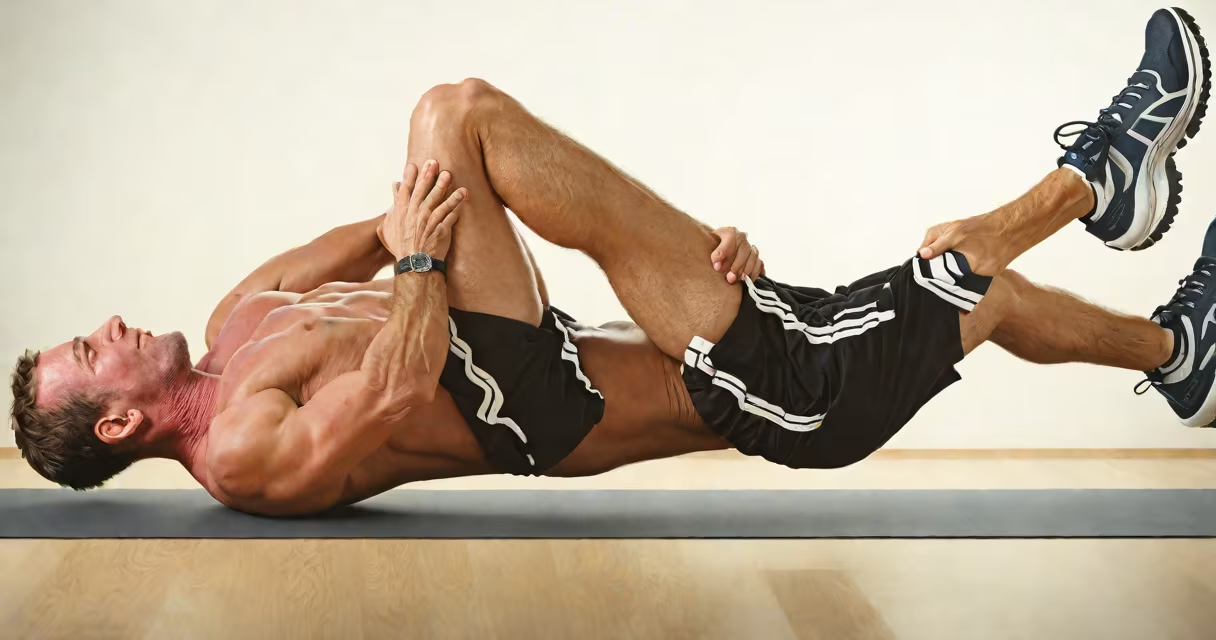
Lower ab strengthening exercises target the lower portion of the rectus abdominis muscle, improving core stability, reducing lower back strain, and enhancing functional movement patterns. These movements focus on controlled contraction of the lower abdomen during hip flexion and pelvic control.
These exercises differ from general crunches or sit-ups by emphasizing precise muscle activation rather than full trunk flexion. The goal is to isolate the lower abs while minimizing involvement of the upper abs and hip flexors. This specificity improves neuromuscular control and supports better posture and athletic performance.
Research from the Journal of Strength and Conditioning Research confirms that exercises like the dead bug and hanging leg raise produce higher electromyographic (EMG) activity in the lower rectus abdominis compared to traditional crunches. EMG measures muscle electrical activity, indicating how effectively a muscle contracts during a movement.
During lower ab exercises, the primary action is controlled hip flexion with minimal lumbar spine movement. The lower rectus abdominis contracts to stabilize the pelvis and maintain neutral spine alignment. This reduces shear forces on the lower back during changing tasks.
For example, in a lying leg raise, the hips remain flat against the floor while the legs are slowly lifted toward vertical. The lower abs contract to prevent the pelvis from tilting forward. If the lower back arches, the exercise becomes ineffective and risks injury.
A 2018 study published in the International Journal of Sports Physical Therapy found that participants who performed lower ab-specific exercises for eight weeks showed a 27% increase in lower abdominal strength and a 31% improvement in pelvic control during single-leg balance tests.
The most effective lower ab exercises emphasize pelvic control and minimal momentum. Below are key movements supported by biomechanical analysis:
| Exercise | Primary Muscle Targeted | Key Form Cue | Reps/Sets |
|---|---|---|---|
| Lying Leg Raise | Lower rectus abdominis | Pelvis stays flat; avoid arching lower back | 12-15 reps, 3 sets |
| Hanging Leg Raise | Lower rectus abdominis, transverse abdominis | Use controlled motion; don't swing | 10-12 reps, 3 sets |
| Dead Bug | Lower abs, deep core stabilizers | Keep lower back pressed into floor throughout | 10-15 reps per side, 3 sets |
| Reverse Crunch | Lower rectus abdominis | Engage lower abs to lift hips off floor | 12-15 reps, 3 sets |
Each movement prioritizes control over speed. Momentum reduces muscle activation and increases risk of strain. For example, swinging during a hanging leg raise shifts load to the hip flexors and lower back.
One common mistake is over-relying on the upper abs during reverse crunches. To correct this, place hands under the lower back to feel the lower abs engage. When done correctly, the pelvis lifts slightly, and the lower back remains in contact with the floor.
Lower ab strengthening exercises are used to improve posture, support spinal health, and improve performance in sports requiring core stability-such as running, swimming, and weightlifting. They also aid in rehabilitating lower back pain linked to weak core musculature.
They are not a substitute for full-body conditioning or fat loss. While they build muscle endurance and strength, visible results depend on caloric balance and consistent training. A 2020 review in Frontiers in Physiology concluded that isolated ab work contributes minimally to fat reduction-only about 2% of daily energy expenditure is burned during such exercises.
Many people confuse lower ab exercises with "six-pack" routines. However, visible abdominal definition requires low body fat percentage, not just muscle development. Even with strong lower abs, a layer of subcutaneous fat may obscure the muscle contour.
One widespread error is believing that high-repetition crunches or sit-ups train the lower abs effectively. Biomechanical studies show these movements activate the upper and middle rectus abdominis more than the lower section. The lower abs are more engaged during movements that involve hip extension or pelvic control.
Another misconception is that lower ab exercises alone will fix poor posture or chronic lower back pain. While they contribute to core stability, long-term improvements require addressing movement patterns, ergonomics, and physical activity levels.
I once observed a client perform 100 leg raises daily for six weeks, expecting visible changes. Despite improved lower abdominal endurance, their posture didn't improve, and their lower back pain worsened. Upon assessment, their hip flexors were overactive, and they lacked pelvic control. After switching to dead bugs and controlled leg raises, their symptoms resolved within four weeks.
Include lower ab strengthening exercises 2-3 times per week, allowing 48 hours between sessions for recovery. Perform them after a warm-up and before heavier compound movements to maximize neuromuscular readiness.
Start with 3 sets of 10-12 repetitions per exercise. Focus on form, breath control, and muscle sensation. As strength improves, progress by increasing time under tension-e.g., lowering legs slowly over 4 seconds-or adding resistance via ankle weights.
For advanced variation, try the seated knee tuck on a stability ball. This combines lower ab activation with balance challenge. The added instability recruits deeper core muscles, including the transverse abdominis, which acts as a natural corset around the spine.
When combining lower ab work with cardio and strength training, prioritize consistency over intensity. A 2019 study in Medicine & Science in Sports & Exercise found that participants who trained core muscles twice weekly saw greater improvements in balance and movement efficiency than those doing daily sessions.