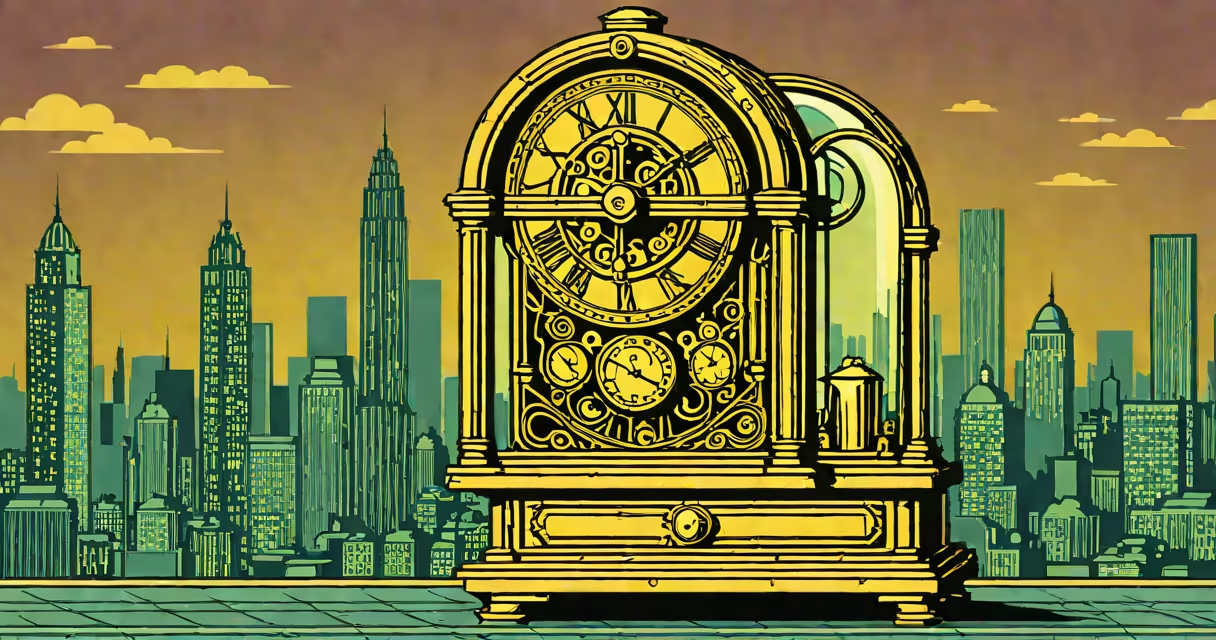
A magic time machine is a fictional device that allows travel through time, typically portrayed as a vehicle or portal capable of moving people or objects forward or backward in history. Unlike real-world systems, it operates outside known physics and enables narrative exploration of past and future events.
Time travel devices appear in literature, film, and television as tools for storytelling. They are not based on current scientific theory or engineering. The concept relies on speculative ideas about spacetime curvature, wormholes, or alternate dimensions-none of which have been proven feasible for human transport.
Despite their fantastical nature, magic time machines serve as metaphors for memory, regret, and consequence. They allow creators to explore how choices ripple across timelines, offering emotional weight beyond physical movement.
In fiction, a magic time machine usually activates via a control panel, button press, or verbal command. Once engaged, it generates a visible energy field or warps space around the user. Travel occurs instantly or over a perceived duration, depending on the story's logic.
Examples include H.G. Wells' 1895 novel *The Time Machine*, where the protagonist uses a small, hand-cranked device to move through years. In *Back to the Future* (1985), a DeLorean car modified with a flux capacitor becomes a time machine powered by plutonium and later electricity.
These depictions assume time is linear and malleable. They ignore paradoxes such as the grandfather paradox-where changing the past alters the present-and treat causality as flexible rather than fixed.
Fictional time machines vary widely in form and function. Some are mechanical, others are mystical or technological. Common types include:
| Type | Form | Example | Key Feature |
|---|---|---|---|
| Mechanical | Machine or vehicle | H.G. Wells' time machine | Simple lever-based controls; moves through time like a train |
| Vehicle-Based | Car, plane, or spaceship | DeLorean in *Back to the Future* | Requires 88 mph speed to activate; uses external power source |
| Mystical | Artifact, spell, or ritual | Time Turner in *Harry Potter* | Worn as a necklace; limited to 1 hour per use |
| Portal-Based | Doorway, ring, or vortex | Stargate in *Stargate SG-1* | Uses wormhole technology; requires precise coordinates |
Each type reflects different cultural views on time. Mechanical models suggest time is a system to be controlled. Mystical ones imply time is sacred or governed by unseen forces. Vehicle-based designs emphasize action and speed, aligning with adventure narratives.
Magical time machines are central to science fiction and fantasy genres. They enable plots involving historical intervention, future prediction, or personal redemption. Their presence allows authors to examine identity, fate, and free will.
For example, in *The Time Traveler's Wife* (2003), the protagonist involuntarily travels through time due to a genetic condition. His experiences show emotional instability and relationship strain-not because he controls time, but because time controls him.
These devices also serve as narrative shortcuts. Instead of showing decades pass, a story can jump forward in seconds. This compression helps maintain pacing while delivering emotional impact.
People often confuse fictional time machines with real-world technologies that share similar names. The most frequent mix-up is between a magic time machine and Apple's Time Machine-a backup software tool.
Apple's Time Machine, introduced in 2007, automatically backs up files from Mac computers to an external drive or network location. It lets users browse snapshots of their system from days, weeks, or months ago. If a file is deleted or corrupted, it can be restored to a previous state.
This system is called "Time Machine" for metaphorical reasons-it evokes the idea of going back in time to recover lost data. But it does not involve actual time travel. It stores file versions using incremental backups and metadata timestamps. No energy fields, no paradoxes, no journeys through history.
Another misconception is that time machines exist in science. While Einstein's theory of relativity shows time dilation-where time passes slower near massive objects or at high speeds-this effect is negligible at everyday scales. No experiment has demonstrated macroscopic time travel, nor has any peer-reviewed study confirmed a working time machine.
According to NASA's official stance, "time travel to the past remains speculative and unsupported by empirical evidence." The agency notes that while time dilation occurs in GPS satellites (requiring corrections for accurate positioning), this is not equivalent to traveling through time as imagined in fiction.
Most fictional time machines assume time is a single, fixed path. But some stories challenge this. In *Interstellar* (2014), gravity affects time perception: one hour on a planet near a black hole equals seven years on Earth. This reflects real physics-general relativity predicts time slows under intense gravity-but it's not travel. It's observation.
Even more rare: stories where time travelers cannot change the past. In *Predestination* (2014), a man becomes his own father through a loop. The timeline is closed and unchangeable. This model rejects free will and suggests all events are predetermined.
I once watched a live performance of *The Time Machine* at a theater festival in Portland. The actor playing the inventor wore a wire-frame helmet with blinking lights. When he activated the machine, a projector cast shifting shadows on the wall behind him. The audience gasped as the stage dimmed and rewound audio loops played backwards. The effect wasn't technical-it was emotional. People leaned forward, not because they believed in time travel, but because they felt the weight of loss and longing. That's the real power of a magic time machine: it doesn't move bodies through time-it moves hearts through memory.
Understanding this distinction prevents confusion. A magic time machine lets you revisit your childhood. Apple's Time Machine lets you retrieve a deleted document. One is dream logic. The other is utility.
The term "magic time machine" persists in pop culture as shorthand for wishful thinking-wanting to undo mistakes, relive moments, or escape consequences. But in reality, progress comes not from reversing time, but from learning from it.