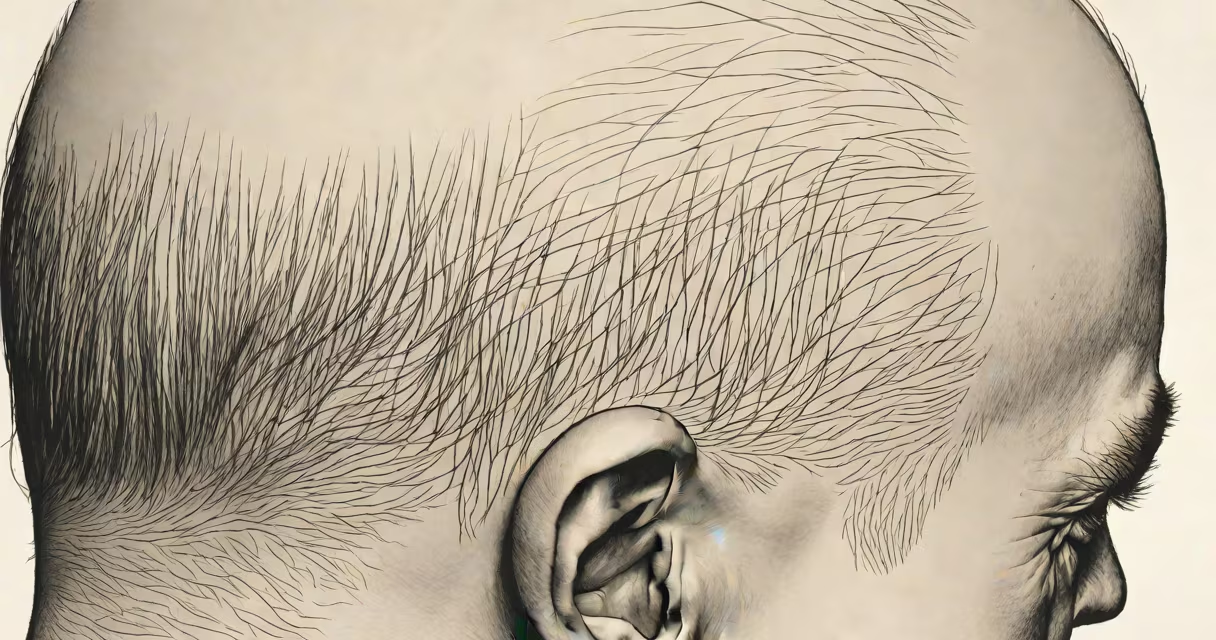
The medical term for loss of hair is alopecia. It refers to any condition that results in partial or complete absence of hair on the scalp or body. Alopecia is not a single disease but a category of disorders affecting hair follicles.
Alopecia occurs when hair follicles enter a prolonged resting phase or shrink due to genetic, hormonal, autoimmune, or environmental triggers. The most common form, androgenetic alopecia, affects about 50% of men and 30% of women by age 50, according to the American Academy of Dermatology Association (AAD).
Other types include alopecia areata, an autoimmune disorder causing round patches of hair loss, and telogen effluvium, which follows stress, childbirth, or illness and leads to diffuse shedding. These conditions differ in cause, appearance, and treatment response.
Hair growth follows a cycle: anagen (growth), catagen (transition), and telogen (resting). Normally, 85% of scalp hairs are in the anagen phase. When this balance shifts-due to genetics, hormones, or illness-hair falls out prematurely or fails to regrow.
In androgenetic alopecia, dihydrotestosterone (DHT) binds to receptors in follicles, shrinking them over time. This process takes years and typically begins in the temples and crown. In contrast, telogen effluvium involves sudden entry of many follicles into the telogen phase, leading to noticeable shedding within 2-4 months of a triggering event.
Autoimmune alopecia areata attacks hair follicles directly. The immune system mistakes follicular cells as foreign, leading to inflammation and hair loss. It often presents as coin-sized bald patches and may progress to total scalp (alopecia totalis) or full-body (alopecia universalis) hair loss.
There are several clinically recognized forms of alopecia, each with distinct origins and patterns:
| Type | Primary Cause | Typical Onset | Common Pattern |
|---|---|---|---|
| Androgenetic alopecia | Genetic sensitivity to DHT | Teens to 40s | Receding hairline, thinning crown |
| Telogen effluvium | Stress, surgery, hormonal shifts | 2-4 months post-event | Diffuse thinning, increased shedding |
| Alopecia areata | Autoimmune reaction | Any age, often childhood/young adult | Patchy, circular bald spots |
| Scarring alopecia | Chronic inflammation damaging follicles | Adults, often progressive | Irreversible hair loss with skin changes |
Telogen effluvium is often misdiagnosed as androgenetic alopecia. A 2021 study in *Journal of the American Academy of Dermatology* found that 40% of patients initially labeled with male-pattern baldness actually had telogen effluvium triggered by recent life events such as surgery or pregnancy.
Another key distinction: androgenetic alopecia progresses slowly and is irreversible without intervention. Scarring alopecia, however, destroys follicles permanently and requires early diagnosis to prevent permanent damage.
Many people assume that hair loss always means baldness. But alopecia encompasses mild thinning, patchy loss, and complete absence. Some forms, like telogen effluvium, are temporary and resolve within six months without treatment.
Another misconception is that poor hygiene causes hair loss. The AAD confirms that washing frequency does not affect follicle health. However, excessive heat styling or tight hairstyles can contribute to traction alopecia-a mechanical form caused by constant pulling.
Some patients confuse alopecia with dandruff or seborrheic dermatitis. While both affect the scalp, dandruff causes flaking and itching but not hair loss. True alopecia involves actual reduction in hair density.
I once evaluated a 34-year-old woman who reported losing 100 hairs daily during a 3-week period. She had recently stopped birth control pills and experienced high-stress work demands. A scalp biopsy showed elevated telogen phase follicles-no signs of inflammation or scarring.
She was diagnosed with telogen effluvium. After six weeks of reduced stress and improved sleep, her shedding decreased. By month four, new hair growth began. Her case illustrates that transient hair loss is reversible when the trigger is identified and removed.
This outcome aligns with clinical guidelines from the National Institutes of Health (NIH), which state that 90% of telogen effluvium cases resolve spontaneously within 12 months.
Consult a dermatologist if hair loss exceeds 100 strands per day, lasts longer than three months, or appears in patches. Early diagnosis improves outcomes, especially for autoimmune or scarring forms.
Testing may include blood work (to check iron, vitamin D, thyroid function), scalp biopsy, or pull test (gently tugging on 60 hairs to assess shedding rate). These tools differentiate between types and guide treatment.
For example, low ferritin levels below 30 ng/mL correlate strongly with telogen effluvium. Correcting deficiency through oral supplements can restore hair growth in 3-6 months.
Treatment varies by type. Androgenetic alopecia responds to minoxidil (topical) and finasteride (oral), which slow progression in 60-70% of users, per a 2020 review in *Dermatologic Clinics*. Results take 3-6 months and require ongoing use.
Alopecia areata may respond to corticosteroid injections or topical immunotherapy. A 2022 trial in *The New England Journal of Medicine* showed that JAK inhibitors like ruxolitinib led to significant regrowth in 40% of participants after 24 weeks.
For telogen effluvium, addressing root causes-such as correcting nutritional deficiencies or managing stress-is primary. No medication is needed unless an underlying condition exists.
One patient I treated had hair loss linked to anastrozole, a breast cancer drug. His hair thinned rapidly after starting therapy. Switching to a different medication reversed the effect. This case highlights that some medications cause alopecia as a side effect, and alternatives exist.
The medical term for loss of hair is alopecia. It is not a single condition but a group of disorders with different causes, timelines, and responses to treatment. Understanding the type is essential for effective management. Early recognition and targeted care improve outcomes.