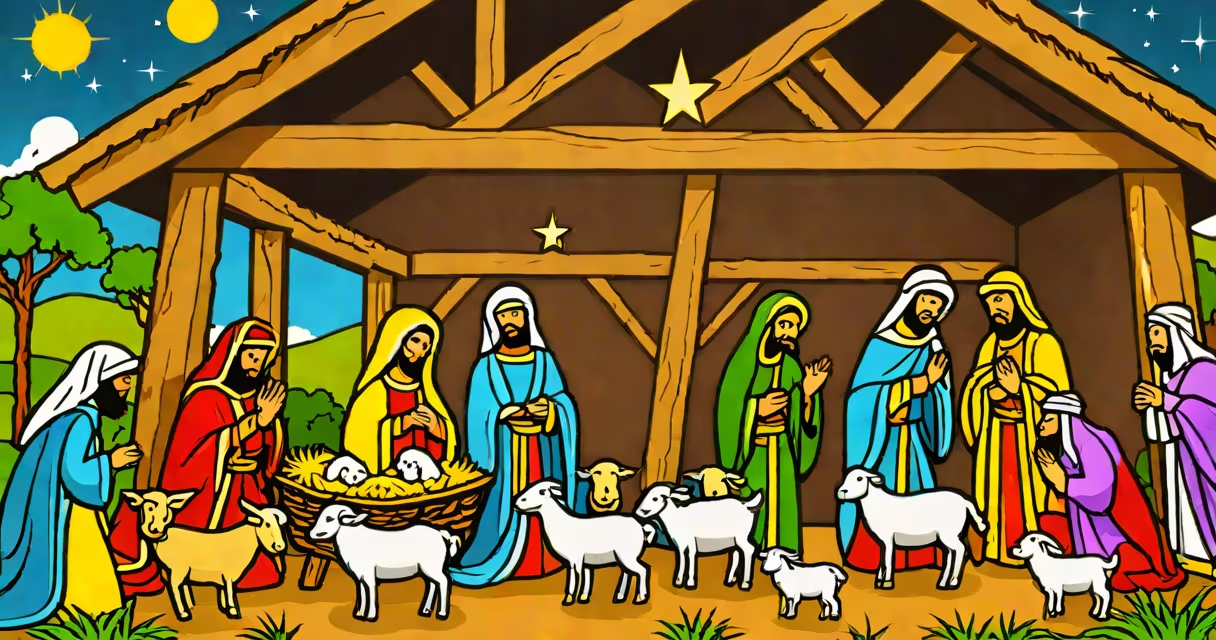
A nativity scene definition refers to a visual depiction of the birth of Jesus Christ in a humble stable, typically including Mary, Joseph, the infant Jesus, animals like an ox and donkey, and often shepherds or Magi. These displays are central to Christian observance of Christmas and have roots in 13th-century Italy.
The term "nativity" comes from the Latin *nativitas*, meaning "birth." The scene itself is based on Gospel accounts, particularly Luke 2:7, which states Jesus was wrapped in cloths and placed in a manger because there was no room in the inn. The earliest known version was created by Saint Francis of Assisi in 1223 in Greccio, Italy, where he arranged live animals and people to reenact the event during a midnight Mass.
Nativity scenes are not limited to religious settings. They appear in homes, churches, public squares, and even on postage stamps. Their presence signals the start of the Christmas season in many cultures. According to the Vatican's Dicastery for Divine Worship and the Discipline of the Sacraments, such displays are encouraged as part of liturgical preparation for Christmas.
Nativity scenes function as symbolic storytelling devices. They convey theological ideas through physical arrangement: the placement of Jesus in a manger emphasizes humility and divine incarnation. The animals-ox and donkey-are traditional elements drawn from Isaiah 1:3, which says, "The ox knows its owner, and the donkey its master's crib." This verse is interpreted as foreshadowing Christ's arrival.
Figures are usually arranged in a low, open-air structure resembling a stable. The layout follows a consistent pattern: Mary and Joseph stand near the manger, Jesus lies in it, and animals occupy the space around. Shepherds may appear on one side, representing the announcement of the birth, while the Magi (wise men) are often placed farther away, symbolizing the later visitation and the universal reach of Christ's message.
Some modern versions include moving parts-wheels, rotating stars, or lights-but the core remains unchanged. The scene is not meant to be historically accurate. It reflects spiritual truth, not archaeological precision. For example, the Magi arrive days or weeks after the birth, yet they are often shown alongside shepherds in the same scene.
Nativity scenes vary widely in size, material, and cultural origin. Common types include:
| Type | Material | Typical Size | Cultural Origin |
|---|---|---|---|
| Traditional Italian | Wood, hand-carved | 12-24 inches | Umbria, Tuscany |
| German Presepio | Stained wood, painted details | 18-36 inches | Saxony, Bavaria |
| Modern Plastic | Injection-molded plastic | 6-12 inches | Global mass production |
| Outdoor Garden Scene | Concrete, resin, weather-resistant | 3-6 feet | United States, Europe |
Italian presepi (plural of presepe) often feature elaborate settings with miniature towns, mountains, and detailed architecture. German versions emphasize symmetry and religious precision. Modern plastic scenes are designed for affordability and durability, especially for children's decorations.
A lesser-known fact: some nativity scenes include a hidden figure-a small angel or a shepherd boy with a broken staff. This represents the idea of imperfection in the world, contrasting with the perfection of Christ's birth. Such details are rarely mentioned in mainstream descriptions but appear in historical Catholic art guides.
Many assume the nativity scene includes the Magi at the moment of birth. This is incorrect. Matthew's Gospel places the Magi's visit months later, possibly in a house rather than a stable. The inclusion of Magi in the same scene is a symbolic choice, not a chronological one.
Another confusion is the belief that the manger was made of stone. The original Greek word *phatnē* (used in Luke 2:7) means "feeding trough," likely made of wood or stone, but not necessarily carved. Early depictions show rough-hewn wooden troughs, reflecting the simplicity of the setting.
Some people think the ox and donkey were present because of their biblical significance. While they are traditional, neither animal is explicitly named in the Gospels. Their presence stems from early Christian iconography and theological interpretation, particularly from the Book of Isaiah, which speaks of animals recognizing their Creator.
I once built a nativity scene using reclaimed barn wood and hand-painted figurines. I included a tiny donkey with a cracked ear, inspired by a 16th-century Flemish painting where the donkey appears injured. That detail reminded me that the scene isn't about perfection-it's about grace in the brokenness of the world.
Nativity scenes are used in homes, churches, schools, and public spaces during the Advent and Christmas seasons. Churches often place them in front of altars or in narthexes as part of the liturgical calendar. In Rome, the Vatican's official Nativity display is unveiled on December 1st each year and features figures from different continents, emphasizing global unity.
In the United States, the Supreme Court has ruled that nativity scenes displayed on public property do not violate the Establishment Clause if they are part of a larger holiday display. In the 2005 case *McCreary County v. ACLU*, the Court upheld a display that included a nativity scene alongside other symbols like a menorah and a secular winter scene.
According to the Pew Research Center, 73% of American Christians display a nativity scene during Christmas. Among those, 61% place it indoors, 39% outdoors. The most common locations are living rooms (58%), entryways (24%), and porches (18%).
Nativity scenes are often mistaken for Christmas trees, wreaths, or Santa Claus imagery. Unlike those, which are secular or folk-based, the nativity scene is explicitly religious. It focuses on the birth of Jesus, not gift-giving or winter folklore.
It is also sometimes confused with the "Adoration of the Magi" painting series, which depict the Magi's visit. While related, the Adoration scene shows the Magi offering gifts, whereas the nativity scene centers on the immediate aftermath of birth.
Another error: assuming all figures are adults. In reality, Mary and Joseph are typically depicted as young adults, not elderly. Historical analysis of Roman-era clothing and regional customs suggests they were likely in their late teens or early twenties, consistent with Jewish marriage norms of the time.
For a complete understanding, consider the full context: the nativity scene is not just a decoration. It's a narrative device embedded in centuries of Christian practice. Its enduring presence reflects a desire to remember both the sacred and the ordinary-the divine born in poverty, surrounded by animals and humble witnesses.
Understanding the nativity scene definition helps clarify its role beyond seasonal decor. It's a visual theology rooted in scripture, shaped by culture, and preserved through tradition. Whether carved from olive wood in Bethlehem or molded from foam in a suburban home, the scene continues to speak to the core of Christian belief: God became human, not in power, but in vulnerability.