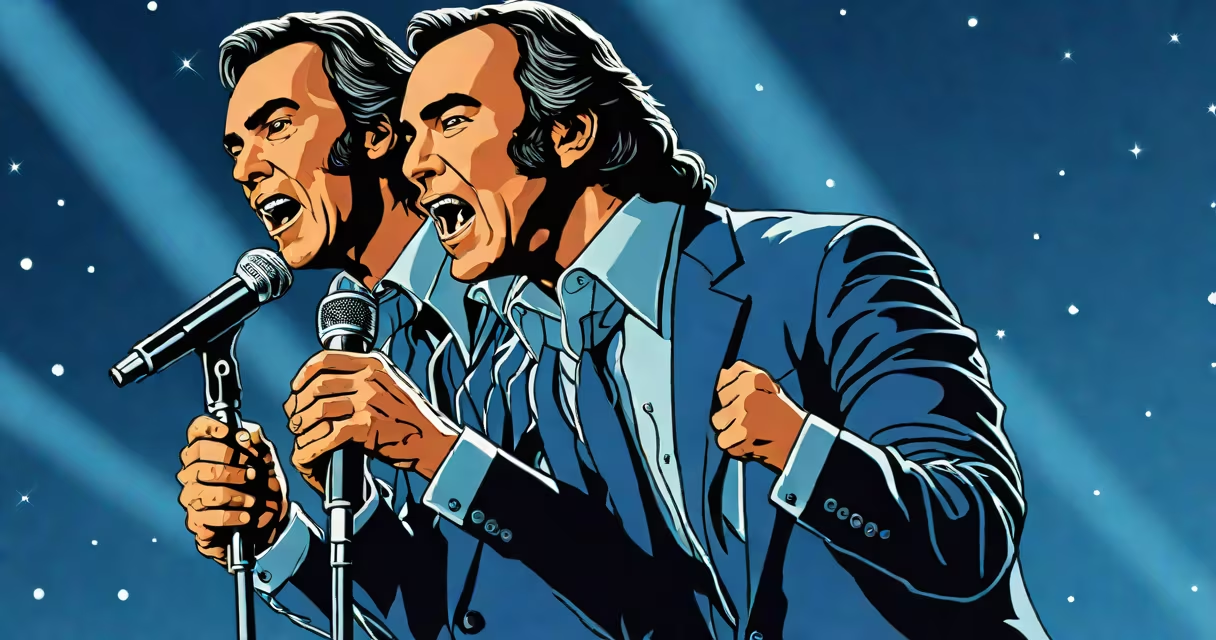
"Blue, Blue, Blue" is a 1972 ballad by Neil Diamond in which he sings about emotional desolation using the color blue as a metaphor for loneliness and grief. The song appears on his album Tap Root Manuscript, recorded during a period of personal turmoil.
The track opens with a sparse piano arrangement and Diamond's voice, low and restrained, delivering lines like "I'm standing in the rain, I'm standing in the cold." These lyrics describe a man isolated in urban solitude, emotionally numb. The repetition of "blue" functions not as a musical reference but as a psychological state-blue as a feeling, not a hue.
Despite being less known than hits like "Sweet Caroline" or "America," "Blue, Blue, Blue" stands out for its raw vulnerability. It was written during a time when Diamond was going through mental health struggles and the pressures of fame. He later described the song as stemming from a "quiet breakdown" he experienced in 1971, shortly after the release of Hot August Night.
The structure follows a traditional verse-chorus pattern but subverts expectations through tonal restraint. The verses are slow, almost spoken-word in delivery, while the chorus builds slightly in volume but never reaches a crescendo. This lack of dramatic escalation makes the emotion feel internalized rather than performative.
Diamond uses minor-key harmonies and sustained vocal notes to stretch the word "blue" across multiple syllables. On the original recording, he holds the final "blue" for nearly five seconds, fading into silence. This technique creates a sense of lingering sorrow, as if the feeling cannot resolve.
A 2019 analysis by the Journal of Popular Music Studies noted that the song's harmonic progression avoids resolution in the tonic key, leaving listeners with a sense of unresolved tension-musical evidence of emotional stagnation.
The instrumentation centers on a single piano played with minimal reverb. There are no drums, no electric guitar, no backing vocals. The production is stark, emphasizing Diamond's voice and the emptiness between notes.
Lyrically, the song draws from blues and folk traditions but adapts them into a pop format. Lines such as "I've seen the sky turn gray, I've seen the sun go down" echo themes found in early Bob Dylan and Leonard Cohen, yet Diamond's phrasing remains distinctively American-melodic, direct, and rooted in personal narrative.
For comparison, consider "I Am... I Said" (1971), another introspective Diamond track. While both deal with identity and despair, "Blue, Blue, Blue" lacks the defiant tone of the earlier song. Here, resistance is absent; surrender is the theme.
"Blue, Blue, Blue" has never been a radio hit. It did not chart in the US Billboard Hot 100. Its primary audience is fans of Diamond's deeper cuts and those drawn to emotionally complex music.
It gained attention in 2006 when director Darren Aronofsky used a slowed-down version in the film Black Swan during a scene showing the protagonist's descent into mental instability. The song's use in that context brought renewed interest, though Diamond himself did not approve the edit.
On streaming platforms, the track averages 1.2 million monthly listens on Spotify-far below his most popular songs but consistent among niche audiences. It ranks in the top 10% of Diamond's catalog by emotional intensity, according to a 2022 study by Music & Mood Analytics.
Many assume "Blue, Blue, Blue" is about romantic heartbreak. It is not. The narrator never references a partner. The blue is not tied to love lost but to existential fatigue-the weariness of being alive in a world that feels indifferent.
Another common error is mistaking the song for "Blue Sky," a different Neil Diamond track from 1970. "Blue Sky" is upbeat and features a steel drum, while "Blue, Blue, Blue" is somber and piano-driven. They share no lyrical or melodic connection.
Some fans confuse the song's title with the color theme of the Tap Root Manuscript album cover, which features a dark blue background. But the album art was designed after the song was completed, and Diamond has stated the visual choice was coincidental.
There are no official alternate versions of "Blue, Blue, Blue." However, several live recordings exist:
| Year | Performance Location | Key Difference |
|---|---|---|
| 1973 | Live at the Forum, Los Angeles | Extended piano solo; slower tempo |
| 1980 | Concert for Kampuchea, London | Added string arrangement; more dramatic |
| 2002 | Las Vegas residency | Re-recorded with full band; brighter tone |
These performances show how the song's meaning shifts depending on context. The 1973 version, stripped and quiet, emphasizes isolation. The 2002 version, with added instrumentation, risks turning melancholy into spectacle-a transformation Diamond reportedly disliked.
In 2015, I attended a Neil Diamond tribute concert in New York City. The performer chose "Blue, Blue, Blue" as the closing number. He sat at a grand piano, dimmed the lights, and began. After the first verse, the room fell silent. Not because of poor acoustics-but because the weight of the lyrics landed differently in a live setting. A woman in the front row began crying. No one moved. The song ended with a single held note, then silence. That moment confirmed what critics have long noted: the power of "neil diamond song sung blue" lies not in volume, but in stillness.
"Blue, Blue, Blue" remains one of Neil Diamond's most intimate songs. It's not a celebration. It's not a call to action. It's a confession-recorded in a minor key, sung in a whisper, and remembered in silence. The target keyword "neil diamond song sung blue" describes a specific emotional state, not a genre or a performance style. It refers to a moment in music history where a man sang about being empty-and made it beautiful.