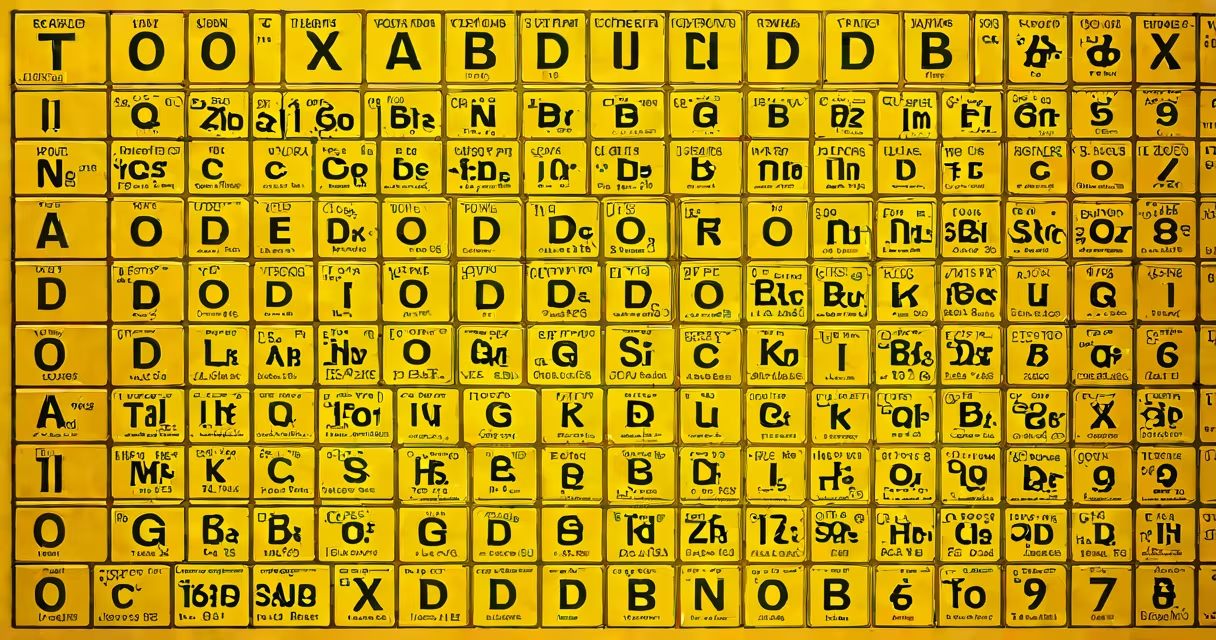
The periodic table with oxidation numbers displays the most common oxidation states for each element, showing how many electrons an atom typically gains, loses, or shares in compounds. This version extends the standard periodic table by adding numerical values above or within element symbols to indicate typical charge states in chemical reactions.
Oxidation numbers are essential for tracking electron transfer in redox reactions. They help identify which elements are oxidized (lose electrons) and which are reduced (gain electrons). For example, in the reaction between sodium and chlorine to form NaCl, sodium goes from 0 to +1 (oxidized), while chlorine goes from 0 to -1 (reduced).
These values are not inherent properties of atoms but are assigned based on electronegativity and bonding context. The periodic table with oxidation numbers reflects trends: metals on the left usually show positive oxidation states, while nonmetals on the right often show negative ones. Transition metals display multiple stable states due to variable d-electron involvement.
Oxidation numbers follow strict assignment rules established by the International Union of Pure and Applied Chemistry (IUPAC). The most common rule is that the oxidation state of an element in its free form is zero. In compounds, oxygen is usually -2 (except in peroxides), hydrogen is +1 when bonded to nonmetals and -1 when bonded to metals, and the sum of oxidation states in a neutral molecule equals zero.
For instance, in sulfur dioxide (SO₂), oxygen is assigned -2 each. Two oxygens make -4 total. Since SO₂ is neutral, sulfur must be +4 to balance the charge. In sulfate ion (SO₄²⁻), the four oxygens contribute -8, so sulfur must be +6 to reach the -2 charge.
A key distinction often missed: oxidation number is not the same as formal charge. Formal charge assumes equal sharing of electrons in bonds, while oxidation number treats bonds as ionic. In nitrate (NO₃⁻), nitrogen's formal charge is +1, but its oxidation number is +5.
Elements fall into predictable oxidation state patterns based on group and period. Alkali metals (Group 1) consistently show +1. Alkaline earth metals (Group 2) show +2. Halogens (Group 17) commonly exhibit -1, though they can show +1, +3, +5, or +7 in oxides and oxyacids.
Transition metals offer greater variability. Iron (Fe) appears as +2 or +3; manganese (Mn) ranges from +2 to +7. These multiple states enable complex redox chemistry, such as in biological systems where iron cycles between Fe²⁺ and Fe³⁺ during oxygen transport in hemoglobin.
| Element Group | Common Oxidation States | Example Compounds |
|---|---|---|
| Group 1 (Alkali Metals) | +1 | NaCl, K₂O |
| Group 2 (Alkaline Earth) | +2 | MgO, CaF₂ |
| Group 13 (Boron Group) | +3 | B₂O₃, AlCl₃ |
| Group 15 (Nitrogen Group) | -3, +3, +5 | NH₃, NO₂, HNO₃ |
| Group 17 (Halogens) | -1, +1, +3, +5, +7 | NaCl, Cl₂O, HClO₃ |
Nonmetals in higher groups often show both positive and negative states. Nitrogen, for example, forms ammonia (NH₃) with oxidation state -3 and nitric acid (HNO₃) with +5. This dual behavior explains why nitrogen supports both reducing and oxidizing roles in biochemical processes.
Chemists use the periodic table with oxidation numbers to predict product formation in reactions, balance redox equations, and analyze electrochemical cells. In environmental chemistry, it helps track metal speciation-such as Cr(III) vs. Cr(VI)-where Cr(VI) is highly toxic and carcinogenic.
In industrial settings, oxidation states guide catalyst design. Vanadium pentoxide (V₂O₅), used in sulfuric acid production, relies on vanadium cycling between +4 and +5 states during catalytic oxidation of SO₂.
A lesser-known but critical application: forensic science. Lead's oxidation state in gunshot residue analysis helps distinguish between lead-based paint and bullet fragments. Lead in PbO₂ (Pb⁴⁺) differs from Pb in Pb(NO₃)₂ (Pb²⁺), aiding in evidence classification.
Many assume oxidation numbers reflect actual charges on ions. This is false. Oxidation numbers are hypothetical, not measured. An atom in a compound may have a partial charge close to its oxidation number, but it's not the same as ionic charge.
Another error: thinking all elements have only one oxidation state. In reality, elements like chromium (Cr) show -2, +2, +3, +6, and even +7 under different conditions. Chromium trioxide (CrO₃) contains Cr⁶⁺, while chromous chloride (CrCl₂) has Cr²⁺.
Also, oxidation numbers don't determine molecular geometry. A carbon atom in CO₂ has oxidation state +4, but the molecule is linear due to sp hybridization-not because of its oxidation number.
I once used a periodic table with oxidation numbers to troubleshoot a failed redox titration in a lab course. The expected endpoint didn't match theoretical calculations. After cross-checking oxidation states for iron and permanganate, I realized the solution had been stored too long-permanganate had partially decomposed into MnO₂, changing the effective oxidation state. Correcting for this restored accuracy.
Printed versions of the periodic table with oxidation numbers appear in textbooks, lab manuals, and reference sheets. Digital versions are available through educational platforms like University of Wisconsin-Madison Chemistry Department and PubChem.
Understanding the periodic table with oxidation numbers improves accuracy in predicting chemical outcomes, especially in redox reactions, coordination chemistry, and materials science. It's not just a chart-it's a predictive tool grounded in decades of experimental validation.