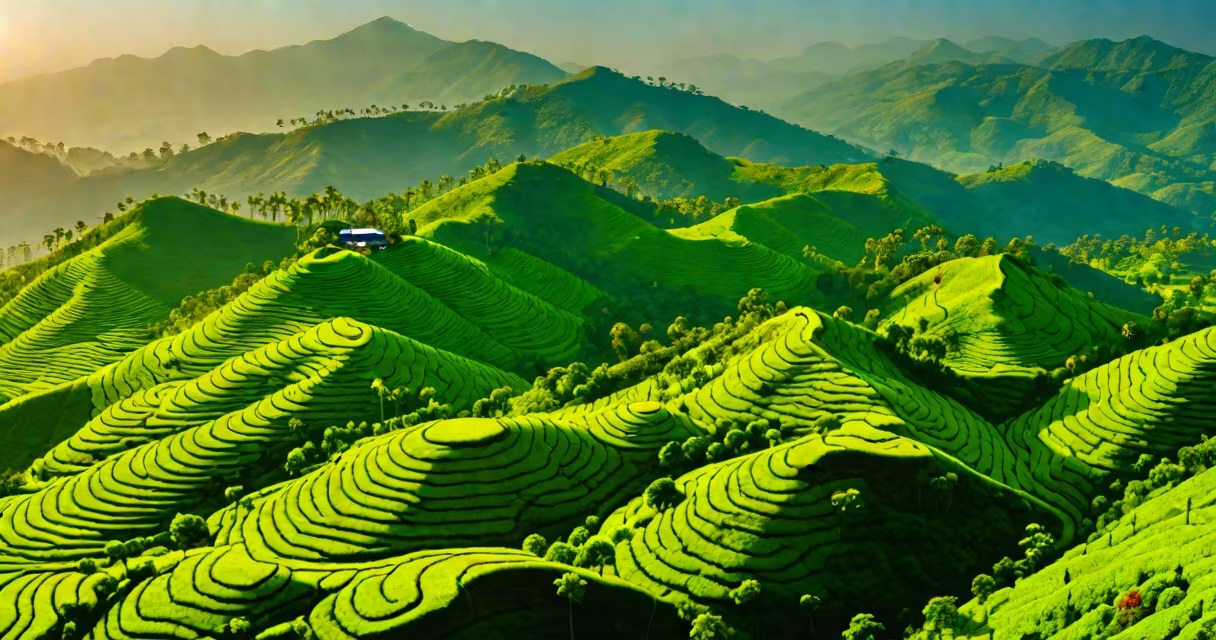
Munnar is a hill station in Kerala, India, known for its rolling tea plantations, cool climate, and mist-covered Western Ghats. Located at 1,600 meters above sea level, it serves as a major tourist destination for nature lovers and those seeking high-altitude tranquility.
Settled in the Western Ghats, Munnar lies at the convergence of three rivers-Muthirapuzha, Nallathanni, and Kundala-giving it a unique hydrological profile. The region's elevation and tropical monsoon climate support dense evergreen forests and extensive tea cultivation. Over 200 tea estates operate in the area, contributing to Munnar's identity as a global tea hub.
Most visitors arrive between October and May, when temperatures range from 10°C to 25°C. The monsoon season (June-September) brings heavy rainfall, which nourishes the region's vegetation but limits access to certain trails and viewpoints. The peak tourist months are December through February, when fog blankets the hills and the air feels crisp and still.
Each attraction in Munnar functions as a node within a larger eco-tourism network. Tea plantations double as educational sites, offering guided tours that explain harvesting cycles, processing methods, and sustainable farming practices. Visitors can sample freshly brewed tea or purchase leaves directly from estate shops.
Nature reserves like Eravikulam National Park operate under strict conservation guidelines. Entry requires permits issued through the Kerala Forest Department. These permits limit daily visitor numbers to protect endangered species such as the Nilgiri tahr, a mountain goat endemic to the region. The park's highest point, Anamudi (2,695 meters), is the tallest peak in South India.
Many attractions are accessible via local buses or shared taxis. The Munnar-Kumily road connects several key sites, including Mattupetty Dam and Top Station. Private vehicles are permitted only on designated routes; off-road driving is banned to prevent soil erosion and habitat disruption.
The following table outlines the main categories of places to visit in Munnar, their defining features, and typical visitor experiences.
| Type | Examples | Key Features | Visitor Experience |
|---|---|---|---|
| Tea Estates | Valley View, Tata Tea Estate, Kanan Devan Hills | Planted in terraces, offer factory tours and tasting sessions | Guided walks through rows of Camellia sinensis plants; afternoon tea served in colonial-style cottages |
| Natural Reserves | Eravikulam National Park, Chinnar Wildlife Sanctuary | Home to rare flora and fauna; require entry permits | Early-morning jeep safaris; birdwatching with expert guides |
| Water Bodies | Meenmutty Waterfalls, Mattupetty Dam | Often accessed via forest trails; some offer boating | Swimming in natural pools; photography at golden hour |
| Historical Sites | St. Mary's Church, Munnar Railway Station | Colonial-era buildings; some still in use | Photography of vintage architecture; audio guides available |
Eravikulam National Park stands out for its ecological significance. According to the Wildlife Institute of India, it hosts over 300 species of flowering plants and 120 bird species. The park's conservation efforts have helped stabilize the Nilgiri tahr population, which dropped below 100 individuals in the 1970s but now numbers around 700.
Many assume Munnar is synonymous with tea. While tea production dominates the economy, the region's biodiversity extends far beyond plantations. Over 400 species of butterflies inhabit the area, including the rare Great Orange Tip, which relies on specific host plants found only in Munnar's montane forests.
Another misconception is that all hill stations in India are similar. Munnar differs from places like Mussoorie or Ooty in its climate, topography, and cultural context. Unlike the dry, dusty air of northern hill stations, Munnar maintains consistent humidity due to its proximity to the Arabian Sea. This affects everything from visitor comfort to plant growth patterns.
A lesser-known fact: Munnar was once a British military outpost. The British established a sanatorium in 1860 to treat soldiers suffering from heat exhaustion. Today, the site is part of the Munnar Heritage Trail, which includes restored bungalows and old railway tracks.
On a typical weekend, a group of six travelers from Kochi booked a shared taxi to Mattupetty Dam. They left at 7:30 a.m., arriving at 9:15 a.m. The dam, constructed in 1955, holds 12 million cubic meters of water and feeds irrigation channels across the region.
After paying ₹20 per person at the gate, they walked along a 1.2-kilometer trail lined with rhododendron trees. At the dam's edge, they spotted kingfishers diving into the reservoir. A local vendor sold them steamed rice cakes and hot ginger tea for ₹150 total.
They returned by 1:30 p.m., avoiding the afternoon thunderstorms common in the area. The entire trip cost ₹1,200 per person, including transport, entry, and food. This mirrors average spending for a half-day outing in Munnar.
I visited Munnar in March 2023 during a monsoon transition. I stayed at a homestay near the town center and spent two days exploring the area. On my second morning, I hiked to the summit of Chokkampatti Hill. The path was steep, with stone steps worn smooth by decades of foot traffic. At the top, I saw a lone woman praying at a small shrine dedicated to Lord Shiva. She didn't speak, but her presence felt like a quiet affirmation of the place's spiritual weight.
That moment reminded me that Munnar isn't just a collection of sights-it's a living field shaped by centuries of human and natural interaction. The silence between birdsong, the scent of wet earth, and the way sunlight filters through clouds-all contribute to a sense of stillness that's hard to replicate elsewhere.
For travelers planning a trip, consider visiting during the shoulder seasons-late September or early November-to avoid crowds while still enjoying clear weather. Booking accommodations in advance is essential, especially during the winter holidays.
Understanding the full range of places to visit in Munnar goes beyond checking off landmarks. It involves engaging with the environment, respecting local regulations, and recognizing the balance between tourism and conservation. quiet mountain paths, Munnar delivers a layered experience rooted in geography, history, and ecology.