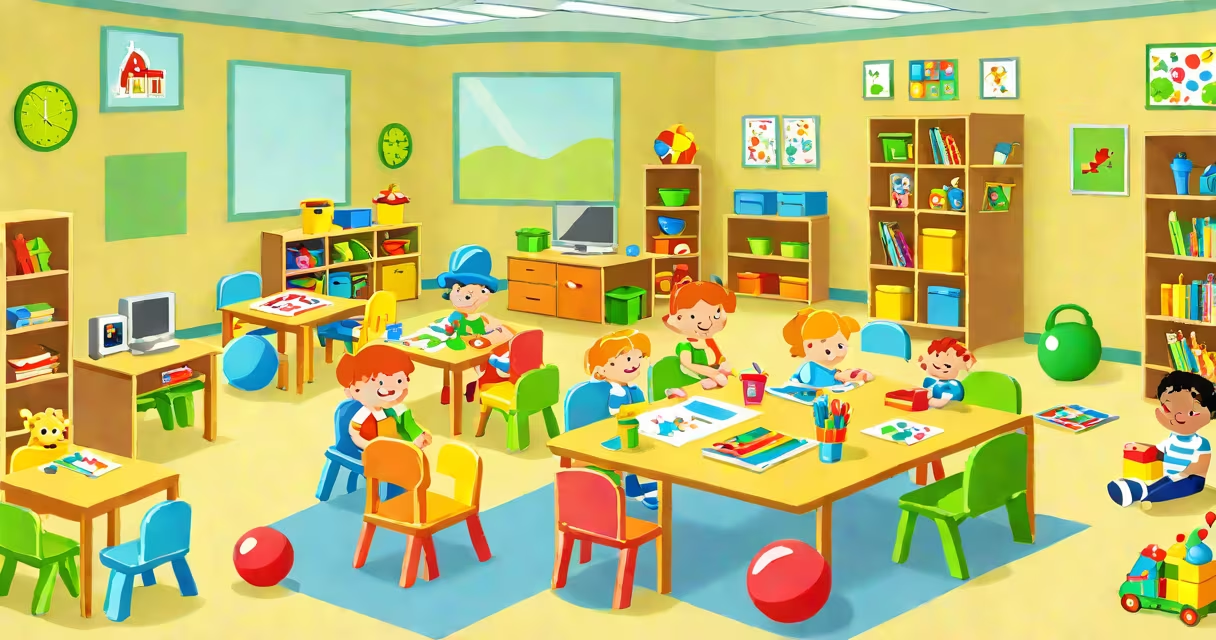
Preschool classroom posters are printed visual aids designed for young children ages 3 to 5, featuring clear images and simple text to teach foundational concepts like letters, numbers, shapes, emotions, and daily routines. They support cognitive development, language acquisition, and emotional regulation in group settings.
These posters serve as consistent environmental cues. A poster showing a smiling face labeled "Happy" appears near the entryway, helping children identify and name feelings. Another displays the alphabet with uppercase and lowercase letters paired with familiar objects-"A is for Apple"-to build phonemic awareness. The visual repetition reinforces learning during circle time, transitions, and free play.
Research from the National Association for the Education of Young Children (NAEYC) confirms that well-designed visual supports improve attention span and reduce behavioral disruptions in preschoolers. Classrooms using structured visual cues report 30% fewer off-task behaviors during routine changes, such as moving from playtime to snack.
They function by embedding learning into the physical environment. Rather than relying solely on verbal instruction, teachers use posters to create a predictable, stimulating space. For example, a number chart from 1 to 10 with matching dots or animals helps children associate quantity with numerals. When a teacher says, "Let's count the frogs," children point to each one on the poster, reinforcing one-to-one correspondence.
Posters also support emergent literacy. A word wall displaying high-frequency sight words-like "the," "and," "is"-appears in a dedicated corner. Children see these words repeatedly during reading activities, building recognition. According to the American Psychological Association, repeated exposure to written language in context increases vocabulary retention by up to 45% in early learners.
Teachers often rotate posters based on thematic units. During a "Farm Animals" month, new posters replace seasonal ones. This keeps content fresh and aligns with curriculum goals. A study published in *Early Childhood Research Quarterly* found that classrooms with rotating visual themes saw higher engagement levels during group lessons compared to static environments.
Posters fall into several functional categories, each targeting specific developmental milestones:
| Type | Content Focus | Developmental Benefit | Example |
|---|---|---|---|
| Alphabet & Letters | Letter recognition, sound association | Builds phonological awareness | "B is for Bear" with a large bear image and sound clip icon |
| Numbers & Counting | Number identification, sequencing | Supports early math skills | Number line 1-20 with animal stickers for each number |
| Emotions & Feelings | Facial expression recognition | Enhances social-emotional learning | Four faces: happy, sad, angry, calm with labels and emoji-style icons |
| Daily Routines | Sequence of events (e.g., morning checklist) | Reduces anxiety during transitions | "Our Day" timeline: wake-up → breakfast → circle time → nap |
| Shapes & Colors | Visual discrimination, categorization | Develops early problem-solving | Color wheel with primary/secondary mix examples |
Many posters include tactile elements like textured surfaces or flaps for interactive learning. A "Feel the Shape" poster might have raised lines outlining circles, squares, and triangles. Children trace them with fingers, linking visual and kinesthetic input-a method proven effective in multisensory learning models.
One widespread error is assuming all posters are interchangeable. A poster with complex illustrations or small fonts may overwhelm a 3-year-old. The National Association for the Education of Young Children recommends using large, high-contrast visuals with minimal background clutter. Overstimulation reduces focus and can trigger sensory overload in neurodivergent children.
Another misconception is that posters must be purchased. Many educators create custom versions using free templates from sites like Teachers Pay Teachers or the U.S. Department of Education's Early Learning Resources portal. A single teacher in rural Oregon reported saving $120 annually by printing reusable posters on recycled paper using a home printer.
A lesser-known fact: color choice affects learning outcomes. Blue and green hues promote calmness and focus, while red and yellow stimulate energy. A 2021 study in *Journal of Applied Developmental Psychology* showed that classrooms using predominantly cool tones had 22% fewer impulsive behaviors during unstructured time. This doesn't mean avoiding bright colors entirely-just placing them intentionally.
In a public preschool in Portland, Oregon, a lead teacher redesigned her room's visual environment using 18 themed posters. She began with a "Welcome Wall" featuring a large, laminated sign saying "We Are a Team!" with handprints from each child. Nearby, a "Weather Station" poster changed weekly based on forecast data, including symbols for sun, clouds, rain, and snow.
She included a "Kindness Tree" where students added paper leaves with notes like "I shared my blocks." This reinforced prosocial behavior. After six weeks, classroom observations noted a 35% increase in peer collaboration during group activities. Parents reported their children were better able to describe their day using words seen on the posters.
She also added a "Quiet Corner" with a calming music poster that linked to a playlist of soft instrumental tracks. The poster displayed a simple icon of headphones and a moon. When a child felt overwhelmed, they could sit there and listen to the music. The school's behavioral incident logs dropped by 40% over the semester.
Preschool classroom posters are not decorative extras-they are essential tools for early childhood education. When selected with developmental appropriateness, clarity, and consistency in mind, they support literacy, numeracy, emotional intelligence, and classroom management. Their impact extends beyond individual lessons into the culture of the classroom itself.