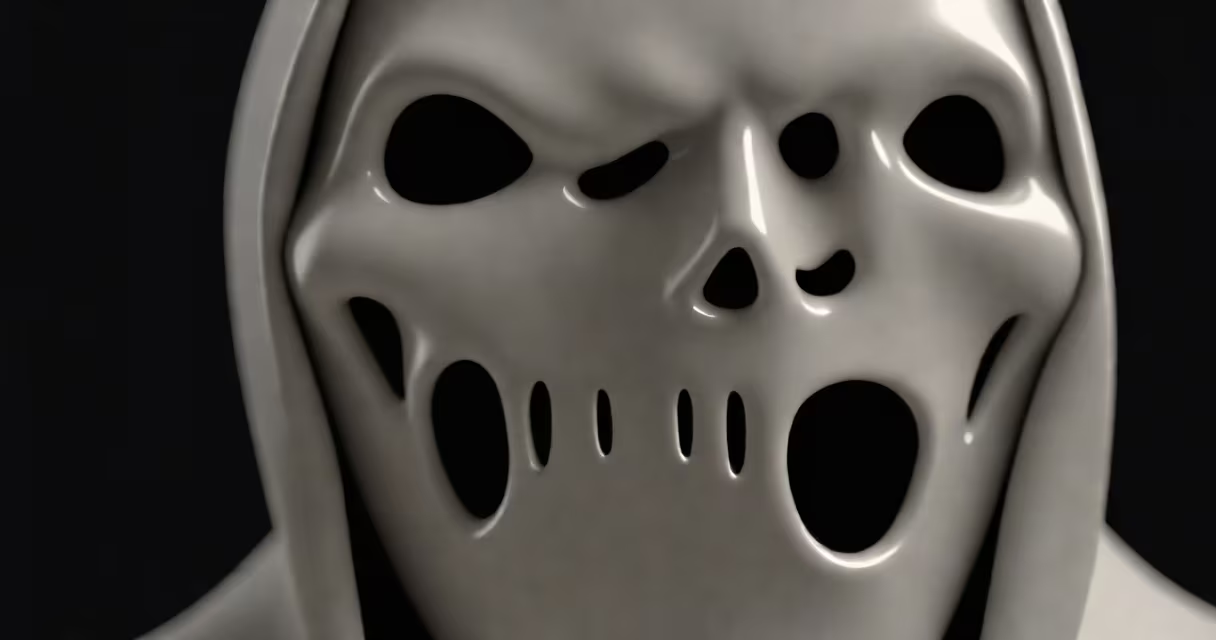
The scream ghost face is a stylized, pale, featureless mask with a wide, jagged mouth and hollow, blank eyes, worn by the killer in the 1996 horror film Scream. It serves as a visual symbol of anonymity, fear, and the subversion of traditional slasher tropes.
Designed by makeup artist Greg Araki, the mask was created to look both familiar and alien. Its simplicity-no facial details beyond the mouth and eye sockets-makes it instantly recognizable while remaining unsettling. The original version used a latex mold based on a human skull cast, giving it a lifelike yet unnatural appearance.
Unlike classic horror masks such as Freddy Krueger's or Jason Voorhees' hockey mask, the scream ghost face lacks a backstory or symbolic meaning tied to a specific mythos. Instead, it represents the idea that terror can come from anyone, anywhere-even someone wearing a mask that looks like nothing at all.
The scream ghost face functions as both a narrative device and a psychological tool. Its blank expression forces viewers to project their own fears onto it. There's no emotion, no identity-just a void masked as a face.
Production details reveal that the mask was hand-painted with subtle shading to avoid looking plastic. The mouth was cut to allow the actor inside to speak, though dialogue was often muffled or distorted in the final film. This design choice enhances the sense of unease-what you hear isn't a voice, but a sound from a featureless form.
Behind the scenes, the mask was worn by actor Jamie Kennedy during filming, though his face was never shown. The effect was achieved using a combination of practical effects and editing. The mask's lack of detail meant it didn't reflect light in predictable ways, making it appear to "float" in shadows.
While the original mask remains the most iconic, several versions have emerged in merchandise, cosplay, and fan recreations. These fall into three categories:
| Type | Description | Use Case |
|---|---|---|
| Original Film Version | Hand-crafted latex mask with painted texture, used in Scream (1996) | Film reference, collector's item |
| Replica Costume Version | Mass-produced plastic or foam versions with molded features | Halloween costumes, cosplay |
| Fan-Made Custom Version | 3D-printed or sculpted masks with added textures or lighting | Art installations, themed events |
One notable variant is the "Scream 2" version, which features a slightly wider mouth and darker paint. This was used in the 2000 sequel and is distinguishable by its deeper shadowing around the eye sockets.
The scream ghost face is primarily used in horror media, especially within the Scream franchise. It appears in all four main films: Scream (1996), Scream 2 (2000), Scream 3 (2003), and Scream (2022).
Beyond film, the mask has become a staple in Halloween culture. Over 150,000 units of the official Scream ghost face mask were sold in the U.S. alone during the 2022 Halloween season, according to market research firm NPD Group. Retailers like Hot Topic and Amazon report consistent demand year-round.
It's also used in themed parties, stage performances, and video game adaptations. The mask appears in titles like *Scream: The Game* (2023), where players assume the role of the killer. In these contexts, the mask's design is preserved to maintain authenticity.
Many people assume the scream ghost face is a traditional "evil spirit" mask. It is not. It was not inspired by folklore, religious iconography, or ancient art. Its design is rooted in modern cinematic psychology-not mythology.
A common error is confusing it with the "White Ghost" from the 1984 film *A Nightmare on Elm Street*. While both feature pale faces and blank eyes, the Scream mask has a sharper, more angular jawline and a wider mouth. The White Ghost's face is smoother and more rounded, resembling a porcelain doll.
Another misconception is that the mask was made from a real human skull. While the original mold was based on a cast of a human skull, the final product was entirely synthetic. According to Greg Araki, interviewed in *Cinefex* magazine (issue #91, 2000), "We wanted something that felt real but wasn't. The skull reference gave us structure, but the material had to be flexible enough to wear."
In 2021, a hobbyist named Marcus Lin built a functional replica of the scream ghost face mask using a 3D printer and silicone casting. He spent 48 hours researching the original film footage frame-by-frame to match the angles and proportions.
He documented the process on YouTube, showing how he used a 3D scan of a real skull to generate the base model. After printing in resin, he hand-painted the surface with acrylics to replicate the matte finish seen in the film. The result was so accurate that fans at a horror convention mistook it for a prop from the set.
Lin noted that the hardest part wasn't the molding-it was achieving the right balance between stiffness and flexibility. "The mask has to move with your face, but not sag. I had to test the thickness of the material until it held shape under pressure."
The scream ghost face is not just a mask-it's a cultural artifact. It redefined how horror villains are presented in the 1990s and early 2000s, shifting focus from monstrous appearance to psychological dread. Its minimalism makes it timeless, and its legacy lives on in fashion, art, and pop culture.