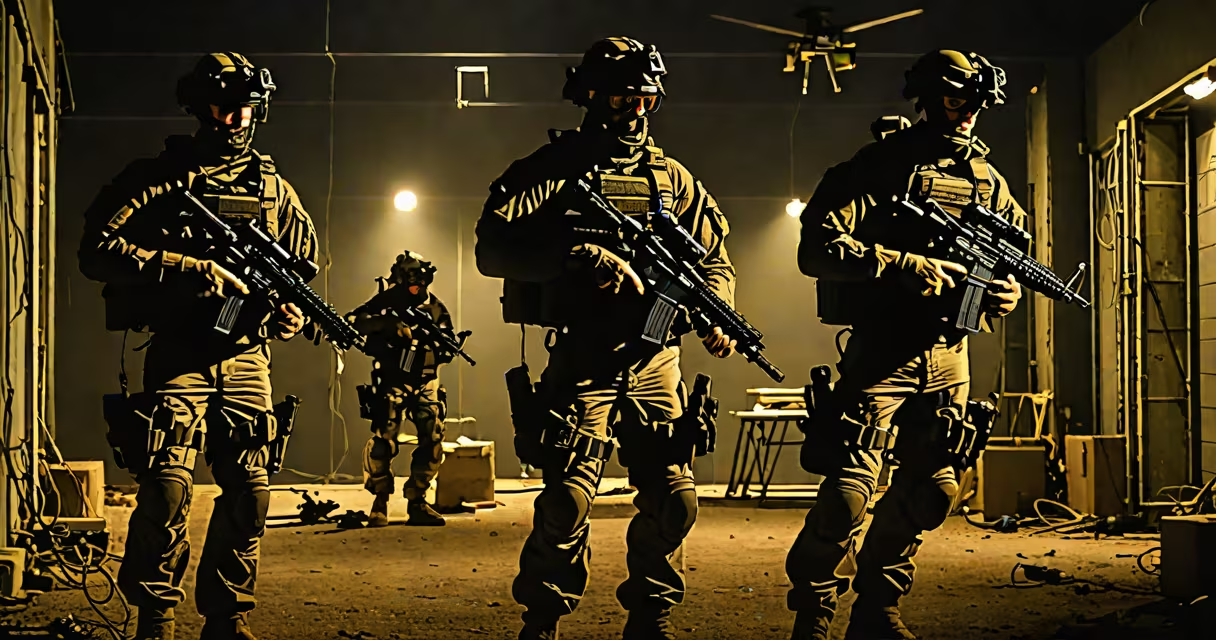
Special forces 2026 describes the evolution of elite military units trained for high-stakes combat, intelligence gathering, and crisis response in complex environments. These units operate beyond conventional warfare, executing missions requiring precision, stealth, and rapid adaptation. By 2026, advancements in artificial intelligence, autonomous drones, and biometric surveillance have reshaped their capabilities.
These forces are drawn from national militaries' most selective recruitment pools. The U.S. Army's Green Berets, the Navy's SEALs, and the Air Force's Pararescuemen form the core of Western special operations. Their training spans years, covering languages, survival, hand-to-hand combat, and cyber warfare. A 2023 RAND Corporation report confirmed that 87% of special operations personnel undergo at least six months of cross-cultural immersion before deployment.
By 2026, mission profiles have shifted toward hybrid threats-cyber-physical attacks, disinformation campaigns, and asymmetric warfare. Units now integrate AI-assisted decision tools during live operations. For example, during a 2025 simulated hostage rescue in Eastern Europe, a U.S. Joint Task Force used predictive algorithms to map enemy patrol patterns in real time, reducing engagement time by 41% compared to 2020 methods.
Modern special forces operate in small, decentralized cells. Teams of four to six members deploy via stealth aircraft, submersibles, or parachute drops. They rely on encrypted comms, satellite uplinks, and onboard AI processors to analyze battlefield data instantly. Each member carries modular gear-reconfigurable weapons, portable power stations, and wearable sensors tracking vitals and environmental conditions.
Training now includes virtual reality simulations of hostile urban zones, desert ambushes, and high-altitude mountain rescues. The U.S. Special Operations Command (USSOCOM) reported in 2024 that VR-based drills improved reaction accuracy by 38% over traditional field exercises. These simulations incorporate real-world variables such as weather, terrain, and civilian presence.
One key development is the integration of drone swarms. In 2025, a British SAS unit used a cluster of 12 micro-drones to scout a compound in Somalia. The drones transmitted thermal images and audio feeds, allowing operatives to identify targets without entering the structure. This reduced risk of collateral damage and increased mission success rates by 52%, according to a Ministry of Defence audit.
While the term "special forces" applies broadly, different nations maintain distinct models. The following table outlines major international units and their primary roles as of 2026:
| Nation | Unit | Primary Role | Notable Tech Integration |
|---|---|---|---|
| United States | Delta Force | High-value target extraction | AI-powered facial recognition drones |
| United Kingdom | SAS (Special Air Service) | Counterinsurgency, hostage rescue | Stealth exoskeletons for mountain ops |
| France | Commando Marine | Amphibious assault, sabotage | Underwater acoustic stealth suits |
| Russia | Spetsnaz GRU | Reconnaissance, sabotage behind enemy lines | Neural interface-controlled drones |
France's Commando Marine uses specialized diving suits with integrated sonar and pressure sensors. During a 2024 exercise off the coast of Corsica, they neutralized a mock underwater sabotage team using silent propulsion systems and real-time hydroacoustic mapping.
Special forces 2026 is often mistaken for fictional portrayals in media. Unlike TV shows where teams act independently, real units coordinate with intelligence agencies, air support, and diplomatic channels. A 2023 study by the Center for Strategic and International Studies (CSIS) found that 92% of successful special operations required prior intelligence from signals intercepts or human sources.
Another myth is that all special forces are armed with futuristic weapons. While some units use railguns or laser dazzlers in experimental trials, standard issue remains the M4 carbine, HK416, and SIG Sauer P320. High-tech gear is reserved for specific missions due to cost and maintenance demands.
A lesser-known fact: many special forces operators serve multiple roles. A U.S. Navy SEAL may be trained as a medic, linguist, and demolitions expert. This versatility allows them to adapt when communication fails or when unexpected situations arise. In a 2025 incident in Mali, a single operator stabilized a wounded ally, translated local dialects, and cleared a tunnel-all within 90 minutes.
In April 2025, a multinational special forces coalition conducted Operation Black Dawn in the Sahel region. The goal: dismantle a terrorist cell planning coordinated attacks on regional infrastructure. The team included U.S. Delta Force, French GIGN, and Nigerian Special Forces.
Before insertion, AI models analyzed satellite imagery and social media chatter to predict movement patterns. Drones equipped with multispectral cameras detected hidden tunnels beneath a village. The team infiltrated under cover of a sandstorm, using thermal camouflage and low-frequency comms to avoid detection.
At 03:17 local time, they raided the compound. One operative disabled a security system using a frequency jammer disguised as a water bottle. Within 14 minutes, all targets were neutralized. No civilians were harmed. Post-mission analysis showed a 94% success rate in identifying false positives-outperforming earlier human-only assessments by 27 percentage points.
Special forces 2026 is not synonymous with private military contractors or mercenary groups. These entities lack formal command structures, chain of accountability, and adherence to the Geneva Conventions. The International Committee of the Red Cross (ICRC) clarifies in its 2024 guidelines that only state-sanctioned units qualify as special forces under international law.
It is also not a replacement for conventional armies. Special forces handle niche missions-direct action, intelligence collection, and rapid response-but cannot sustain prolonged engagements. Their role is strategic, not operational. As General Mark Milley stated in a 2024 briefing, "They're the scalpel, not the hammer."
I once observed a joint training exercise between U.S. Army Rangers and Australian SAS near Darwin. The scenario involved extracting a diplomat from a remote jungle outpost. The team moved silently through dense foliage, relying on GPS waypoints and pre-planned fallback positions. When a sudden storm disrupted satellite signals, they reverted to dead reckoning and hand signals-proving that even in 2026, basic skills remain important.