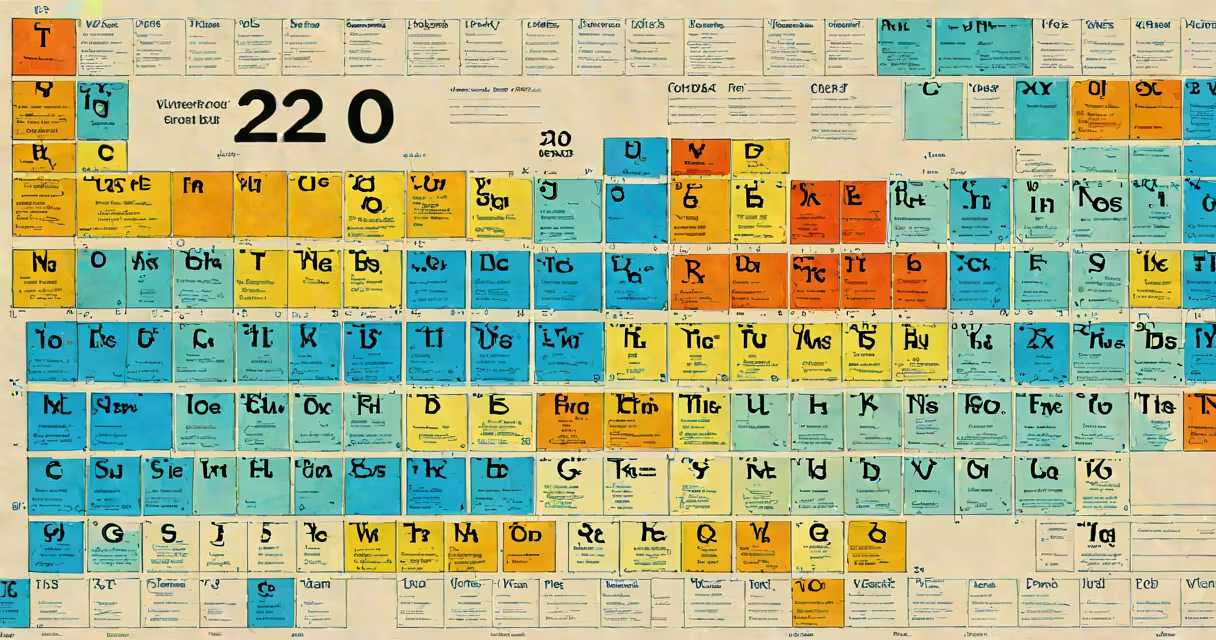
The first 20 elements are the chemical elements with atomic numbers 1 through 20, listed in order of increasing proton count. They include hydrogen, helium, lithium, and end with calcium. These elements form the core of atomic structure and underpin all known matter.
Elements are defined by their atomic number-the number of protons in the nucleus. The first 20 elements span the first four periods of the periodic table. Their properties evolve systematically: metals dominate the left, nonmetals appear on the right, and noble gases occupy the far right of period 1 and 2.
Each element has a unique symbol derived from its name or historical roots. Hydrogen is H, helium is He, lithium is Li, and calcium is Ca. These symbols are standardized by the International Union of Pure and Applied Chemistry (IUPAC).
The periodic table arranges elements by atomic number and recurring chemical behavior. The first 20 elements fill the s-block (Groups 1-2), p-block (Groups 13-18), and d-block (transition metals start at Scandium, atomic number 21).
Period 1 contains only two elements: hydrogen (1) and helium (2). Period 2 includes lithium (3) through neon (10). Period 3 runs from sodium (11) to argon (18). Period 4 begins with potassium (19) and calcium (20), marking the end of the first 20.
Electron configuration determines chemical behavior. For example, sodium (11) has electron shells filled as 2-8-1. This outer single electron makes sodium highly reactive. Calcium (20) has a 2-8-8-2 configuration, giving it two valence electrons and strong metallic properties.
These elements fall into distinct groups based on physical and chemical traits:
| Group | Elements | Key Properties |
|---|---|---|
| Alkali metals | Lithium (3), Sodium (11), Potassium (19) | Soft, reactive, form +1 ions. React violently with water. |
| Alkaline earth metals | Beryllium (4), Magnesium (12), Calcium (20) | Harder than alkali metals, form +2 ions. Found in bones and minerals. |
| Noble gases | Helium (2), Neon (10), Argon (18) | Colorless, odorless, chemically inert. Used in lighting and cryogenics. |
| Nonmetals | Hydrogen (1), Carbon (6), Nitrogen (7), Oxygen (8), Fluorine (9), Phosphorus (15), Sulfur (16), Chlorine (17) | Form covalent bonds. Essential for life and industrial processes. |
Carbon (6) stands out as the basis of organic chemistry. Its ability to form long chains enables complex molecules like DNA and proteins. Oxygen (8) supports respiration and combustion. Fluorine (9) is the most electronegative element, making it highly reactive.
A non-obvious fact: Beryllium (4) is toxic despite being a lightweight metal. It's used in aerospace alloys but requires careful handling due to its carcinogenic potential. This contrasts sharply with its neighbors, magnesium and aluminum, which are safe and abundant.
These elements make up nearly all biological systems and common materials. Water (H₂O) involves hydrogen and oxygen. Salt (NaCl) combines sodium and chlorine. Bones contain calcium and phosphorus.
In industry, the first 20 elements enable technologies from semiconductors to fertilizers. Silicon (14) is critical in electronics, though it lies just beyond the first 20. Aluminum (13) is used in packaging and construction. Nitrogen (7) is essential for synthetic ammonia in agriculture.
During my time teaching high school chemistry, I demonstrated reactivity using sodium and water. A small piece dropped into a tray produced a violent reaction-flames, hissing, and a fizzing ball of molten sodium. The experiment illustrated why sodium (11) must be stored under oil: it reacts instantly with moisture in air.
Many assume all elements in the first 20 are stable. This is false. Lithium-6 and lithium-7 are stable isotopes, but beryllium-9 is the only stable isotope of beryllium. All isotopes of elements beyond calcium (20) are unstable unless bound in larger nuclei.
Another confusion: people think "element" means "pure substance." But an element is defined by its atomic number, not purity. A sample of pure iron (Fe) may contain different isotopes-iron-54, iron-56, iron-57-but it remains iron because all have 26 protons.
Some believe hydrogen is a metal. It is not. Under extreme pressure, such as in Jupiter's core, hydrogen behaves like a metal, but at standard conditions, it is a diatomic gas. This phase change is key to planetary science.
They occur naturally in Earth's crust, atmosphere, and oceans. Oxygen (8) makes up 46% of the crust by mass. Silicon (14) is second at 28%. Iron (26) is abundant in the core. Carbon (6) cycles through ecosystems via photosynthesis and respiration.
Human-made compounds often combine these elements. Table sugar (C₁₂H₂₂O₁₁) uses carbon, hydrogen, and oxygen-all from the first 20. Ammonia (NH₃) relies on nitrogen and hydrogen. Even plastics like polyethylene derive from ethylene (C₂H₄), formed from carbon and hydrogen.
For memorization, educators often use the song for first 20 elements of periodic table. This tune, set to a familiar melody, helps students recall the sequence: "Hydrogen, Helium, Lithium, Beryllium..." The rhythm reinforces retention better than rote repetition.
After calcium (20), the next elements introduce transition metals. Scandium (21) begins the d-block, where electrons fill inner orbitals. This shift changes chemical behavior -transition metals form colored compounds and catalyze reactions.
Understanding the first 20 elements provides a foundation for studying the rest. The patterns seen here-increasing ionization energy, decreasing atomic radius across a period-continue throughout the table.
The first 20 element list is not just a classroom exercise-it's a map of the material world. From the air we breathe to the cells in our bodies, these elements define existence at the atomic level.