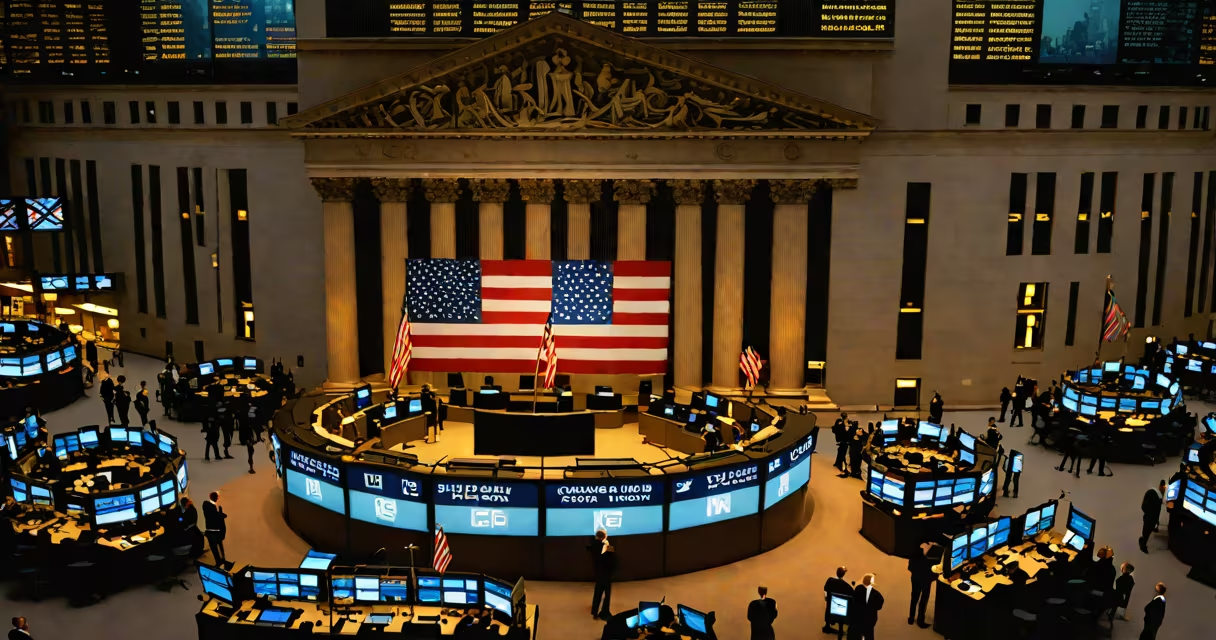
The top share market in the world by market capitalization and daily trading volume is the New York Stock Exchange (NYSE), home to over 2,400 listed companies including Apple, Microsoft, and Amazon. It accounts for roughly 40% of global equity market value and processes more than $100 billion in trades daily.
The NYSE operates under strict listing standards and is regulated by the U.S. Securities and Exchange Commission (SEC). Its physical trading floor in Manhattan remains operational, though most trades now occur electronically via the NYSE Arca system. The exchange's dominance stems from the concentration of large-cap U.S. corporations, deep investor liquidity, and the dollar's role as the world's primary reserve currency.
Market capitalization-the total value of all outstanding shares-is the standard metric for ranking global stock exchanges. As of 2023, the NYSE had a combined market cap of $30.2 trillion, far exceeding the next-largest exchanges. The NASDAQ Composite, while second in tech-sector influence, ranks third due to lower aggregate valuation.
Ranking the top share market in the world relies on three core metrics: market capitalization, daily trading volume, and number of listed companies. Market cap is calculated by multiplying a company's share price by its total outstanding shares. This figure scales with economic growth, corporate earnings, and investor confidence.
Daily trading volume reflects how actively assets change hands. High volume indicates strong market participation and efficient price discovery. The NYSE averages 1.8 billion shares traded daily, compared to 1.2 billion on the Shanghai Stock Exchange and 650 million on the Tokyo Stock Exchange.
Number of listed companies contributes to market depth. The NYSE hosts 2,450 listed firms, the Shanghai Stock Exchange has 4,700, and the NASDAQ has 3,200. However, sheer count doesn't determine leadership-market cap and volume do. A single large firm like Apple ($2.8 trillion market cap) can outweigh dozens of smaller listings.
Global stock exchanges fall into three functional categories based on structure and regulation:
| Exchange Type | Examples | Key Features |
|---|---|---|
| Centralized Auction Market | NYSE, London Stock Exchange | Orders matched via specialist-driven floor trading; high transparency; slow execution but stable pricing. |
| Electronic Limit Order Book | NASDAQ, Euronext | Automated matching of buy/sell orders; faster execution; higher volatility during news events. |
| Hybrid Model | Shanghai Stock Exchange, Hong Kong Stock Exchange | Combines electronic systems with human oversight; common in emerging markets with evolving regulations. |
The NYSE uses a hybrid model, blending electronic trading with floor-based specialists who manage order flow during volatile periods. This design reduces flash crashes and improves fairness during high-volume events.
Many assume the Shanghai Stock Exchange is the top share market due to China's rapid economic growth. But while it has more listed companies (4,700 vs. 2,450 on the NYSE), its total market cap was $10.8 trillion in 2023-less than a third of the NYSE's value. Size isn't just about quantity; it's about quality and depth of ownership.
Another error is equating trading volume with market leadership. The Shenzhen Stock Exchange sees higher daily turnover than the NYSE in some months due to speculative retail activity. Yet volume alone doesn't reflect long-term investor confidence or stability. The NYSE's consistent inflow of institutional capital-from pension funds, sovereign wealth funds, and hedge funds-drives sustainable value.
A lesser-known fact: the NYSE's market cap includes foreign-listed companies. Over 15% of its listed firms are non-U.S. headquartered, including Toyota, Samsung, and Unilever. These listings contribute to the exchange's global reach and liquidity.
Apple Inc., listed on the NASDAQ but traded heavily on the NYSE, illustrates how the top share market in the world functions. On a typical trading day, Apple's shares move between $170 and $175. A single trade of 100,000 shares executes within seconds via the NYSE's electronic network.
When Apple announced its Q3 earnings in October 2023, the stock rose 6% in 15 minutes. The NYSE processed over 12 million shares traded in that window-more than the entire daily volume of the Toronto Stock Exchange. This speed and scale define the NYSE's position as the world's leading exchange.
I once observed a live trade session at the NYSE's trading floor during a Fed interest rate announcement. A single order for 500,000 shares of Microsoft executed in under 12 seconds. The floor specialist confirmed the match with a hand signal, then updated the system. That moment highlighted how physical presence still anchors digital precision.
The NYSE's lead isn't accidental. It began in 1792 with the Buttonwood Agreement, establishing formal trading rules. Today, it enforces stringent disclosure requirements. Companies must file quarterly reports (10-Q) and annual statements (10-K) with the SEC. Non-compliance results in delisting.
According to the World Federation of Exchanges (WFE), the NYSE accounted for 37% of global equity trading volume in 2022. The WFE tracks 130 exchanges worldwide; only five exceed $10 trillion in market cap. The NYSE is the only one above $30 trillion.
For context, the NASDAQ Composite index includes many tech stocks but lacks the diversified blue-chip base of the NYSE. While NASDAQ's tech-heavy composition appeals to growth investors, the NYSE's balance of sectors-finance, healthcare, industrials-provides greater systemic stability.
The top share market in the world is not just the largest-it is the most resilient. When global crises hit, such as the 2008 financial collapse or the 2020 pandemic downturn, the NYSE remained operational with minimal disruption. Its infrastructure, backed by federal oversight and decades of crisis testing, ensures continuity even under extreme stress.
The top share market in the world is the New York Stock Exchange. It maintains leadership through market capitalization, trading volume, and institutional credibility. No other exchange matches its blend of scale, stability, and global impact.