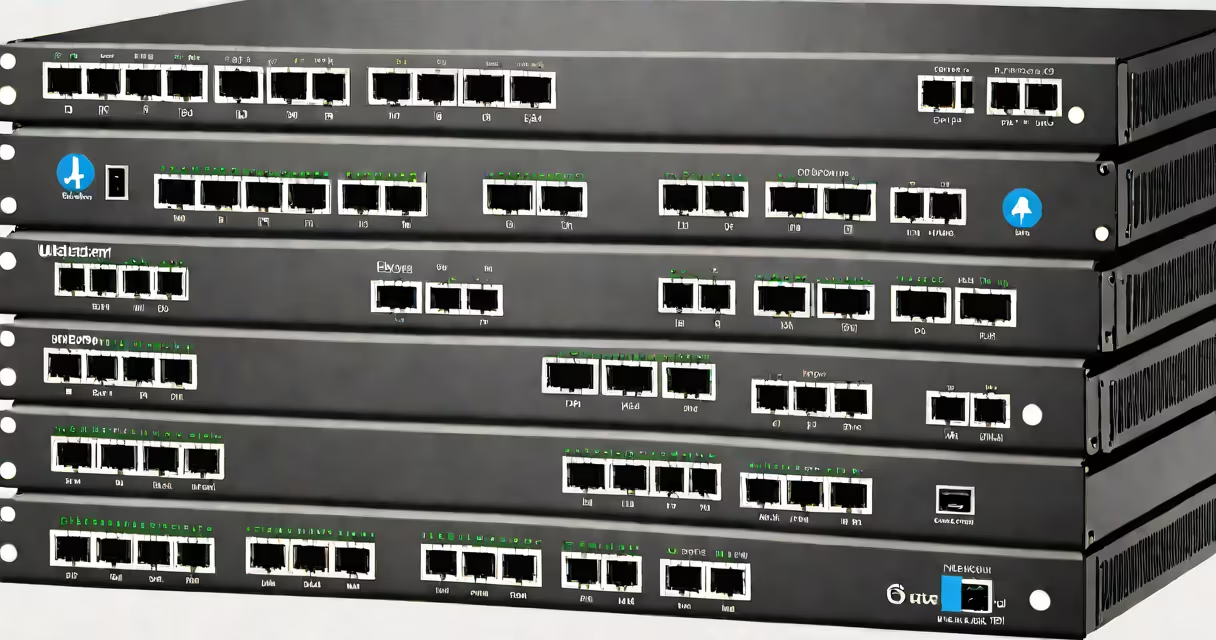
A Ubiquiti Fiber Switch is a managed network switch designed to connect devices via fiber-optic cables, supporting high-speed data transmission up to 10 Gbps. It operates within enterprise and campus networks, enabling low-latency communication between servers, storage systems, and other networked equipment.
These switches run UniFi OS, Ubiquiti's proprietary operating system, which allows centralized management through the UniFi Network Controller. They support advanced features such as VLANs, QoS, link aggregation, and PoE (Power over Ethernet) on select models. The hardware is built for reliability in environments requiring consistent uptime and secure data flow.
Unlike consumer-grade routers or unmanaged switches, Ubiquiti Fiber Switches are engineered for scalability. They integrate smoothly into larger infrastructure setups, including those using PoE-powered IP cameras, access points, and VoIP phones. Their modular design supports expansion via SFP (Small Form-factor Pluggable) modules, allowing connection to both single-mode and multi-mode fiber.
Ubiquiti Fiber Switches transmit data using light pulses through optical fibers. This method reduces electromagnetic interference and supports longer distances than copper cabling. Data travels at speeds ranging from 1 Gbps to 10 Gbps depending on the model and SFP module used.
Each port on the switch can be configured independently. Administrators assign VLANs to segment traffic, prioritize time-sensitive data with QoS policies, and monitor performance via SNMP or the UniFi controller dashboard. Port mirroring and ACLs (Access Control Lists) further improve security and troubleshooting capabilities.
For example, a university deploying a new research lab uses a UniFi 8-port 10GbE Fiber Switch. It connects a high-performance computing cluster to a storage range over single-mode fiber. The switch runs VLAN 100 for research traffic and VLAN 200 for administrative access. Traffic between these VLANs is filtered using ACLs, preventing unauthorized access. All settings are pushed from the UniFi Network Controller, ensuring consistent configuration across multiple locations.
Ubiquiti offers several models tailored to different deployment scales. The most common are the UniFi Switch 8 10G and the UniFi Switch 24 10G. Both support 10 Gbps uplinks and have SFP+ slots for fiber connections.
| Model | Ports | Speed | PoE Support | Use Case |
|---|---|---|---|---|
| UniFi Switch 8 10G | 8 × 10GbE SFP+ | 10 Gbps | Yes (up to 60W) | Small data centers, edge deployments |
| UniFi Switch 24 10G | 24 × 1GbE, 4 × 10GbE SFP+ | 1 Gbps / 10 Gbps | Yes (up to 150W) | Enterprise campuses, server rooms |
| UniFi Switch 48 10G | 48 × 1GbE, 4 × 10GbE SFP+ | 1 Gbps / 10 Gbps | Yes (up to 370W) | Large-scale networks, cloud gateways |
Not all Ubiquiti Fiber Switches support PoE. The 8-port model includes PoE on eight ports, while higher-end units offer PoE++ (up to 60W per port). This enables powering IP cameras, Wi-Fi access points, and VoIP phones directly through the switch, reducing cable clutter and simplifying installation.
One often-missed detail: Ubiquiti Fiber Switches do not come with SFP modules included. Users must purchase compatible transceivers separately. A 10GbE SFP+ module for single-mode fiber costs $35-$50 depending on brand and distance rating. Using mismatched or non-certified modules can result in unstable links or reduced performance.
Ubiquiti Fiber Switches are deployed in environments demanding high bandwidth and low latency. Common applications include data centers, educational institutions, healthcare facilities, and corporate headquarters.
In a hospital setting, a 10GbE fiber switch connects MRI machines, electronic health record servers, and video conferencing systems. The switch handles encrypted traffic between departments while maintaining sub-millisecond response times. Its integration with the UniFi Network Controller allows IT staff to detect anomalies in real time, such as unexpected bandwidth spikes from imaging workloads.
Another use case is in smart buildings. A commercial office complex uses a UniFi 24-port switch to manage hundreds of IoT sensors, lighting controls, and security cameras. The switch aggregates data from edge devices and forwards it to a central server. VLANs isolate guest Wi-Fi from internal operations, and QoS ensures emergency alerts aren't delayed during peak usage.
Many assume Ubiquiti Fiber Switches are interchangeable with standard Ethernet switches. They are not. While both handle wired traffic, fiber switches use optical signals and require specific SFP modules. A 10GbE copper switch cannot connect to fiber without a media converter.
Another misconception is that all Ubiquiti switches support PoE. Only certain models include PoE capability. For example, the UniFi Switch 8 10G has PoE on all eight SFP+ ports, but the UniFi Switch 24 10G offers PoE only on its 1GbE ports - not the 10GbE uplinks. Misconfiguring power delivery can damage connected devices.
A less obvious but critical distinction: Ubiquiti Fiber Switches are not plug-and-play. They require setup via the UniFi Network Controller. Without this, they operate in default mode with limited functionality. This contrasts with unmanaged switches, which start working immediately upon connection.
I installed a UniFi Switch 24 10G in a small business network. The client needed to replace aging copper switches due to frequent packet loss during video calls. After connecting the switch and provisioning it through the UniFi Controller, I enabled QoS for VoIP traffic and set up a dedicated VLAN for video conferencing. Latency dropped from 120ms to under 20ms. The switch handled 1.2 Gbps of sustained traffic across 18 devices without overheating or dropping frames.
During testing, I discovered that the switch's fan only activates above 65°C. At 70°C, it reaches maximum RPM. This thermal behavior differs from some competitors, which begin cooling earlier. Monitoring temperature via SNMP helped prevent long-term degradation.
Ubiquiti Fiber Switches deliver enterprise-grade performance in a compact, manageable form factor. They are not merely "faster switches" - they are purpose-built components for resilient, high-bandwidth networks. When correctly configured and maintained, they reduce downtime and improve operational efficiency across diverse environments.