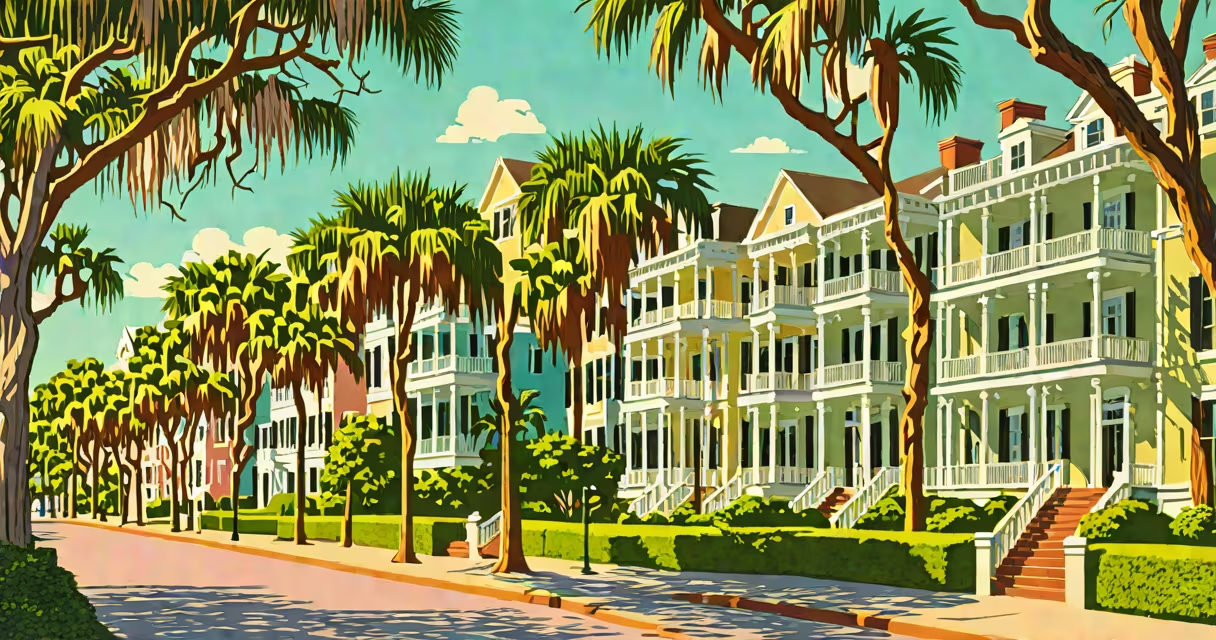
Visit Charleston SC to experience a coastal city where 18th-century architecture, Southern hospitality, and Gullah culture converge. The city's historic district, centered on King Street and the Battery, features preserved mansions, cobblestone alleys, and centuries-old churches. Over 1 million visitors annually explore its walkable core, making it one of the most visited cities in South Carolina.
Charleston SC's layout reflects its colonial roots. Streets follow 17th-century grid patterns, with narrow lanes winding between brick and stucco buildings. Most structures date from 1700 to 1850, many constructed using tabby concrete-a mix of shell, lime, and sand. This material, common in Lowcountry construction, gives older homes their distinctive texture and durability against salt air.
Walking through the city, you pass sites like the Old Exchange and Provost Dungeon, where British soldiers held American prisoners during the Revolutionary War. The city's preservation efforts, guided by the Charleston Historic District Commission, maintain architectural integrity while allowing modern uses. For example, the former U.S. Custom House now houses the South Carolina State Museum.
Most visitors begin at the Historic District Visitor Center near the corner of Meeting and Broad streets. From there, they choose between self-guided walks, audio tours, or guided group experiences. The city offers a free mobile app with GPS-triggered narrations at 20+ landmarks, including the Nathaniel Russell House and St. Michael's Episcopal Church.
Transportation within the core is pedestrian-focused. Buses run along King Street, but sidewalks are designed for foot traffic. Biking is limited to designated lanes on Ashley River Road and the Arthur Ravenel Jr. Bridge. Car access is restricted in the downtown zone; parking lots charge $15-$20 per day.
One lesser-known fact: Charleston SC's street names often reflect colonial trade routes. "Battery" refers to the defensive wall built in the 1700s to protect the harbor. "Meeting Street" was named for the site where colonists gathered for town meetings. These names remain unchanged since the 1720s.
Visitors typically engage in four categories of activity: historical sightseeing, culinary exploration, outdoor recreation, and cultural immersion. Each category includes both free and paid options.
| Type | Examples | Cost Range | Duration |
|---|---|---|---|
| Historical Sightseeing | Fort Sumter National Monument, Magnolia Plantation & Gardens | $10-$25 | 1.5-4 hours |
| Culinary Exploration | Tasting tour of local seafood, bourbon pairing at the Refinery Charleston SC | $35-$80 | 2-3 hours |
| Outdoor Recreation | Boat ride to Folly Beach, kayak tour through the Cooper River estuary | $40-$75 | 1.5-3 hours |
| Cultural Immersion | Gullah heritage storytelling, live jazz at the Dock Street Theatre | $10-$60 | 1-2 hours |
For example, a visit to Fort Sumter requires a ferry from the Battery. The 30-minute ride includes narration about the Civil War's start. Admission is $18 per adult, with discounts for seniors and students. The island itself contains original fort walls, a restored lighthouse, and interpretive panels detailing the 1861 bombardment.
Another unique option is the "Gullah Tour," led by descendants of enslaved people who lived on nearby Sea Islands. These tours focus on language, food, and spiritual traditions passed down through generations. One guide, Mary Ellen Johnson, shares stories of her grandmother's cooking and the significance of red rice in community rituals.
Many assume Charleston SC is only about antebellum mansions and Confederate memorials. While those exist, the city's narrative extends beyond the Civil War. Over 70% of the population identifies as African American, and Gullah culture remains central to civic life. Events like the annual Gullah Festival celebrate language, music, and crafts.
Another myth: Charleston SC is too touristy to feel authentic. In reality, neighborhoods like the French Quarter and East Side offer daily rhythms untouched by visitor traffic. Locals shop at the Market Street Farmers Market, where vendors sell sweet potatoes, collard greens, and fresh-caught shrimp. The city's zoning laws limit chain stores in the historic district, preserving small businesses.
A third misconception is that all accommodations are expensive. While luxury hotels like the Wentworth Mansion charge $500+ per night, budget options exist. Hostels such as the Charleston Hostel offer dorm beds for $45 per night. Private rentals through Airbnb average $180-$250 per night, depending on location and season.
I spent a full day visiting Charleston SC last spring. I began at 8 a.m. with coffee at The Daily, a café in the old City Market building. Their cold brew, made with locally roasted beans, cost $4.50. By 9 a.m., I walked the Battery, where live oaks hung with gray-green moss. I watched families feed seagulls and couples take photos against the waterline.
At 10:30 a.m., I joined a 90-minute walking tour focused on Black history. Our guide, a descendant of freed slaves, pointed out the site of the 1861 slave auction house and explained how enslaved people used coded songs to communicate. We ended at the African American History Museum, where admission was free.
Lunch was at the Refinery Charleston SC, a restaurant housed in a converted 19th-century grain warehouse. I ordered the shrimp and grits with a side of pickled okra. The meal totaled $22. Afterward, I walked across the Arthur Ravenel Jr. Bridge, which spans the Cooper River. The view of the city skyline and marshlands was clear on a sunny morning.
By 5 p.m., I returned to the Battery. As sunset hit, the pastel homes glowed orange. I sat on a bench and listened to a street musician play a blues tune on a harmonica. That moment-quiet, unscripted, deeply local-defined my visit better than any brochure could.
Understanding what visit Charleston SC truly means requires stepping beyond the postcard image. It's not just about seeing historic buildings-it's about engaging with living culture, tasting regional food, and hearing stories that have survived centuries. The city thrives because it balances preservation with progress, tradition with innovation.