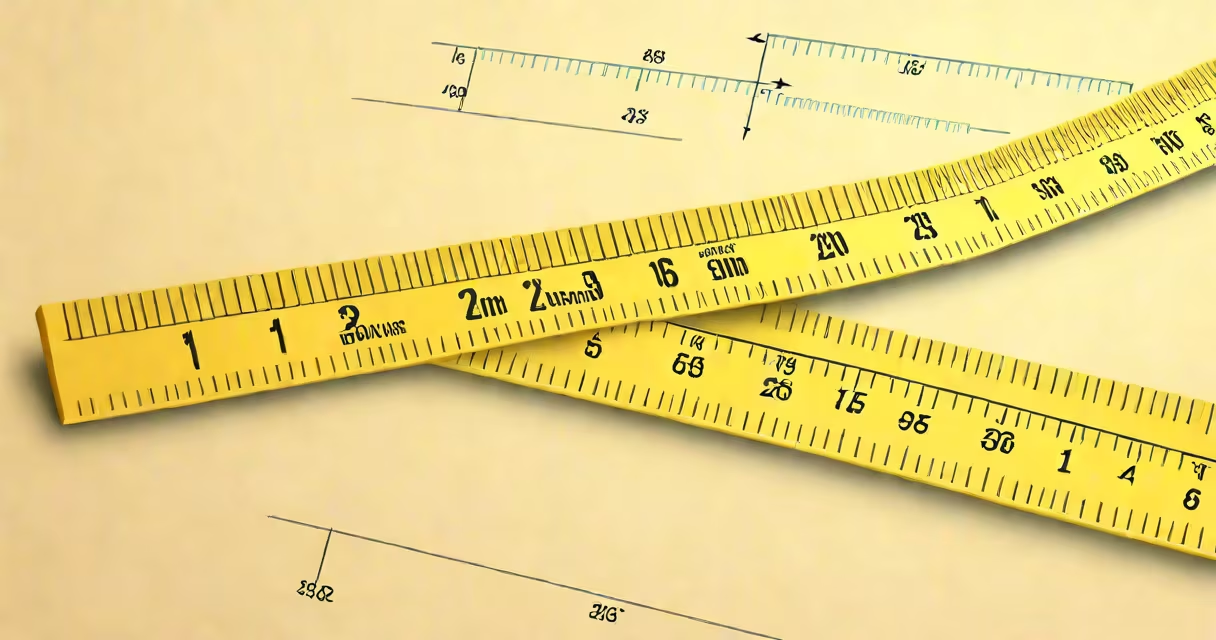
Centimeters on a ruler are metric units of length, with each centimeter marked by a longer line and labeled with a number. The space between each numbered line represents 1 centimeter, and smaller lines between them divide each centimeter into 10 equal parts-millimeters.
A standard ruler measures 30 centimeters, or 300 millimeters, and is divided into evenly spaced marks. The longest lines correspond to whole centimeters, while shorter lines represent half-centimeters (5 mm) and millimeters (1 mm). This layout allows precise measurement of small objects, such as paper, pens, or craft materials.
For example, if an object ends at the third short line after the 5 cm mark, it measures 5.3 cm. This precision makes centimeters ideal for schoolwork, DIY projects, and technical drawings where accuracy matters.
Each centimeter on a ruler equals 0.01 meters, or 10 millimeters. The metric system uses base-10 divisions, so moving from one centimeter to the next increases by exactly 1 cm. This consistency simplifies calculations and conversions.
On most rulers, the numbers are printed below the centimeter lines. For instance, the line labeled "1" is exactly 1 cm from the edge. The next line after "1" is 1.1 cm, then 1.2 cm, and so on. The 10th line after "1" reaches "2," marking the start of the next centimeter.
When measuring, align the object's edge with the 0 cm mark. If the object extends past a centimeter line, count the number of millimeter lines beyond that point. A pencil tip ending at the fifth line after 7 cm measures 7.5 cm.
Rulers come in different lengths and materials, but all follow the same metric standard. Common types include:
| Type | Length | Centimeter Marks | Use Case |
|---|---|---|---|
| Plastic School Ruler | 30 cm | Every 1 cm marked; 10 mm lines between | Classroom, homework, art projects |
| Steel Tape Measure | 150 cm (1.5 m) | 1 cm lines; 5 mm lines visible | Construction, sewing, carpentry |
| Architect's Scale | Varies | Custom divisions; often 1/8 inch or 1 mm per unit | Blueprints, engineering plans |
Some rulers also feature dual scales-centimeters on one side and inches on the other. These are common in educational settings and international classrooms. The dual-scale design helps students compare metric and imperial systems side by side.
Many people confuse centimeters with inches, especially when using dual-scale rulers. On a standard ruler, 1 inch equals approximately 2.54 cm. A line that appears at 2.5 cm may look close to 1 inch, but it's actually less than 1 inch-specifically 2.5 cm vs. 2.54 cm.
Another mistake is assuming that the smallest line on a ruler is always 1 mm. While this is true on most metric rulers, some low-quality rulers have uneven spacing. Always verify that the distance between 0 and 1 cm is exactly 10 mm to ensure accurate readings.
A lesser-known fact: the spacing between centimeter lines is standardized by the International Organization for Standardization (ISO). According to ISO 17025, metric rulers must maintain tolerance within ±0.1 mm for accuracy. This ensures consistency across manufacturing and education tools worldwide.
Suppose you're measuring a notebook that's slightly wider than 15 cm. Place the ruler's edge against the left edge of the notebook. The right edge falls between the 15 cm and 16 cm marks, specifically on the seventh line after 15 cm.
Since each centimeter contains 10 millimeter lines, the seventh line represents 0.7 cm. Therefore, the notebook measures 15.7 cm wide. This level of detail is essential for fitting items into binders, printing layouts, or crafting custom covers.
During a classroom activity, I measured 12 student-made bookmarks using a 30 cm plastic ruler. All were within 0.2 cm of their intended 10 cm length. The consistent spacing of centimeter and millimeter lines made it easy to spot outliers and correct errors early.
Centimeters are sometimes mistaken for millimeters, especially when reading closely. Millimeter lines are thinner and shorter than centimeter lines. If you see a line that's not labeled and is much shorter than the numbered ones, it's likely a millimeter mark.
Also, some rulers have dual scales where the centimeter markings are spaced differently than in standard rulers. For example, a 1:10 scale on a drafting ruler may compress centimeters for space-saving purposes. Always check the scale label before measuring.
Another error occurs when users measure from the wrong end. Some rulers start at 1 cm instead of 0 cm. If you place the object at the "1" mark and read the end at "5," you've measured 4 cm-not 5. Always begin at the 0 cm line to avoid this mistake.
Centimeters are part of the metric system adopted globally. The United States uses both metric and imperial units, but schools teach metric standards to prepare students for science, math, and international work.
According to the National Council of Teachers of Mathematics (NCTM), students who understand metric units perform better in geometry and algebra. Recognizing centimeters on a ruler builds spatial reasoning and supports learning fractions-like understanding that 1.5 cm is halfway between 1 and 2 cm.
Even in daily life, centimeters appear in product dimensions. A smartphone screen listed as 6.1 inches is about 15.5 cm wide. Knowing how to read centimeters helps compare sizes across brands and formats.
Understanding centimeters on a ruler isn't just about measuring-it's about building a foundation in numerical literacy. home renovator, this skill applies across fields.
Knowing how to read centimeters on a ruler improves accuracy in tasks ranging from school assignments to crafting. When you see a line labeled "8," you know it's exactly 8 cm from the start. The next line after that is 8.1 cm, and so on. This clarity prevents errors and supports confidence in measurement.